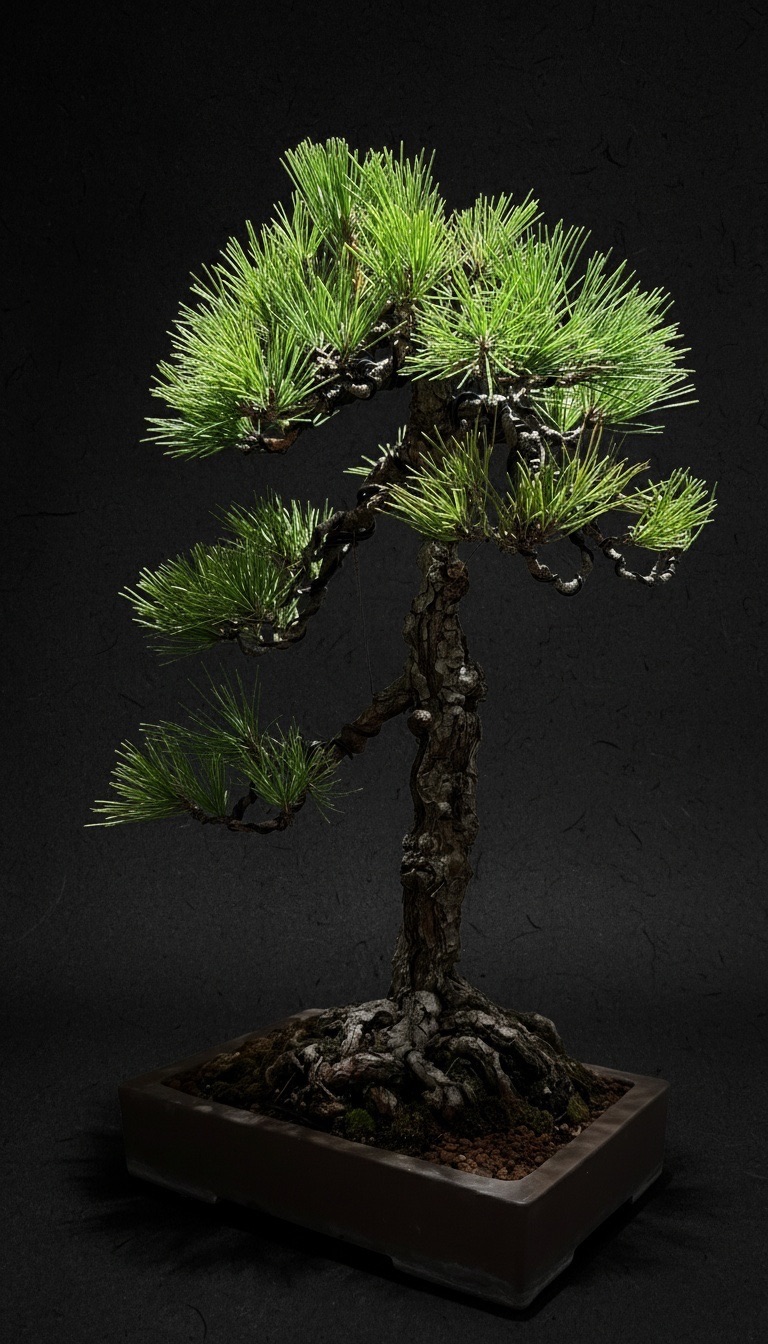
Japanese black pine, moyogi, informal upright / Photo: Azukari
Line up three bonsai of the same species and the difference that matters first is not in the foliage. It is in the trunk: one rising straight as a mast, one curving in a long S on its way up, one giving up the climb halfway and falling past the rim of its pot. A young tree does not choose one of these paths on its own. A grower chooses, early, in the tree's first years of training, and the tree follows that choice — visibly, structurally — for the rest of its cultivated life. Japanese bonsai practice named this choice centuries ago and narrowed the options down to a short, working list.
A bonsai's jukei (樹形, "tree form") is the trunk shape a tree is trained toward in its first years, drawn from a short vocabulary of named forms, and once set it holds for the rest of the tree's cultivated life.
The vocabulary is short because growers narrowed it on purpose
Jukei names the line a trunk and its branches make together — not the species, not the pot. Japanese growers could have left the possibilities open. They did not. Over centuries of practice they narrowed them down to a working vocabulary: a dozen or so named forms, each with its own logic for how the trunk should move and where the branches belong. Knowing this vocabulary is close to knowing the alphabet of the art. It does not tell you what a given tree will say, but it tells you the grammar it is written in.
Every form answers one question: what does the trunk do against straight up?
The fastest way to tell the forms apart is not to memorize a dictionary of names. It is to watch what each one does to the vertical line a trunk would take if nothing shaped it. Three forms sit at the poles of that question, and most of the rest of the vocabulary is a position somewhere between them.
Chokkan (直幹, "formal upright") answers "yes," without qualification: the trunk rises straight from the nebari (根張り, "surface roots"), thick at the base and tapering evenly as it climbs, with branches beginning roughly a quarter of the way up. Nothing about a chokkan trunk has anywhere to hide. That is exactly why it is the hardest of the three to grow well — a single flaw reads instantly against a straight line.
Moyogi (模様木, "informal upright") answers "mostly." The trunk moves in a gentle S-curve, each bend carrying a branch on its outer edge, yet the apex still settles directly above the point where the trunk meets the soil — so despite all that movement, the tree reads as balanced rather than wild. It is the form most people picture when they picture a bonsai at all, because it is the closest match to how an ordinary tree grows when nothing forces it straight.
Kengai (懸崖, "cascade") answers "no." The trunk climbs briefly, then gives up the vertical altogether, falling below the rim of the pot in a line modeled on trees that cling to a cliff face or hang out over a riverbank. A gentler relative, han-kengai (半懸崖, "semi-cascade"), lets the trunk fall only to the level of the pot's base rather than past it.
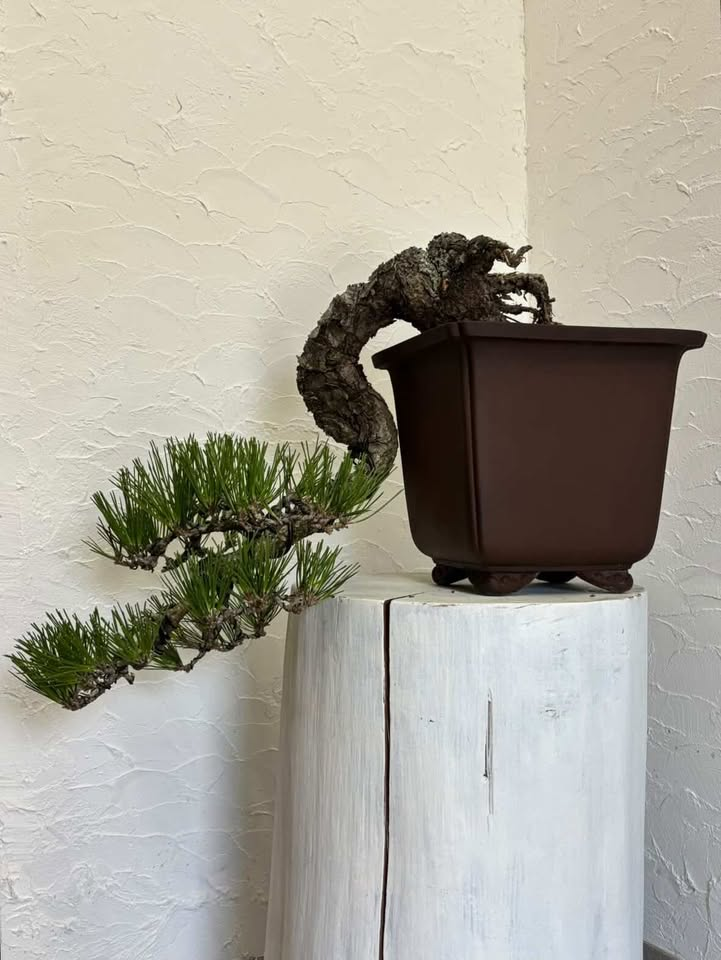
Japanese black pine, kengai, cascade / Photo: Azukari
Once that one question is the frame — straight, curved but balanced, or given up entirely — the rest of the vocabulary sorts itself around forms built from more than one trunk or tree: bunjingi (文人木, "literati style"), its bare, unhurried line borrowed from Chinese literati ink painting; kabudachi (株立ち, "clump style"), several trunks rising from one root mass like a stand of trees; and yose-ue (寄せ植え, "forest planting"), several separate trees composed together into the impression of a wood. Each has its own logic worth its own space, and this series looks at each in turn: chokkan, moyogi, kengai, bunjingi, kabudachi, and yose-ue.
The form is read off the tree, not chosen from a catalog
A grower does not open a book of shapes and pick a favorite. The material in front of them — a trunk collected from a mountainside, or grown for years in a nursery row — already leans, already tapers unevenly, already carries branches in some places and bare wood in others. The first work of styling is reading what that particular trunk is already arguing for: a lean toward kengai, a straightness worth keeping as chokkan, a natural give toward moyogi. As we've written about the idea of kata, a fixed form is not a cage imposed on raw material. It is the closest available match between a tree's actual character and a solution many generations of growers have already tested. Choosing a jukei is an act of listening before it is an act of shaping.
The trunk's line outlives the artist who set it
Once a form is chosen, it is set in place through wiring — copper or aluminum wire wrapped along a branch or trunk to hold it in a new position while the wood grows into that shape. Depending on the species and its growth speed, a branch typically needs somewhere from six months to a year or two under wire before the position holds on its own. That is the fast part. The slow part is the trunk line itself, which past a tree's early years of training is close to fixed: an established chokkan does not become a kengai, and a mature moyogi's curves are not redrawn from scratch. Choosing a jukei early commits the tree — and every artist who tends it after the one who made that first decision — to one visual logic for decades to come. A tree's line can be remade later through drastic restyling, but that is a rare, deliberate undertaking, not a routine adjustment.
Naming the form is where reading one begins
This is why the vocabulary matters to a viewer, not only to a grower. Once you can put a name to a trunk on sight, a tree stops being simply "a small pine" and becomes a specific moyogi, judged against every other moyogi you have stood in front of — this curve tighter, that branch more assured. Next time you are in front of a bonsai, the question worth asking is not the species. It is what the trunk is doing against straight up: climbing without a bend, curving but staying balanced, or giving up the vertical entirely. That is the same shift that learning to read a bonsai's front, roots, and deadwood makes — looking turns into reading. Form is where that reading starts.
A jukei is a decision the next owner inherits too
Every bonsai an artist takes on already carries a form, decided in most cases before its current owner ever saw the tree — sometimes before its current artist did either. A jukei is not a costume fitted to a tree for one season's photograph, but the sentence structure it will be read in for the rest of its life. Azukari keeps that structure in Japan, under artists who go on reading it after the decision was made, while an owner joins the record from wherever they live. Knowing the handful of forms a bonsai can take is the plainest way of knowing what is actually being handed over.
References
- Bonsai Empire — Bonsai Styles — overview of the named bonsai forms, including formal upright (chokkan), informal upright (moyogi), cascade (kengai), literati (bunjingi), multi-trunk (kabudachi), and forest (yose-ue).
- Wikipedia — Bonsai, "Bonsai styles" — general definitions of formal upright, informal upright, cascade, and forest/group planting as commonly recognized bonsai style categories.
- Bonsai Society of Greater Cincinnati — Informal Upright "moyogi" or "tachiki" — description of the moyogi style's S-curve trunk and outer-branch placement.
- Bonsai Empire — Wiring — explanation of wiring technique and typical timelines, roughly six months to a year or more, for a branch position to set.