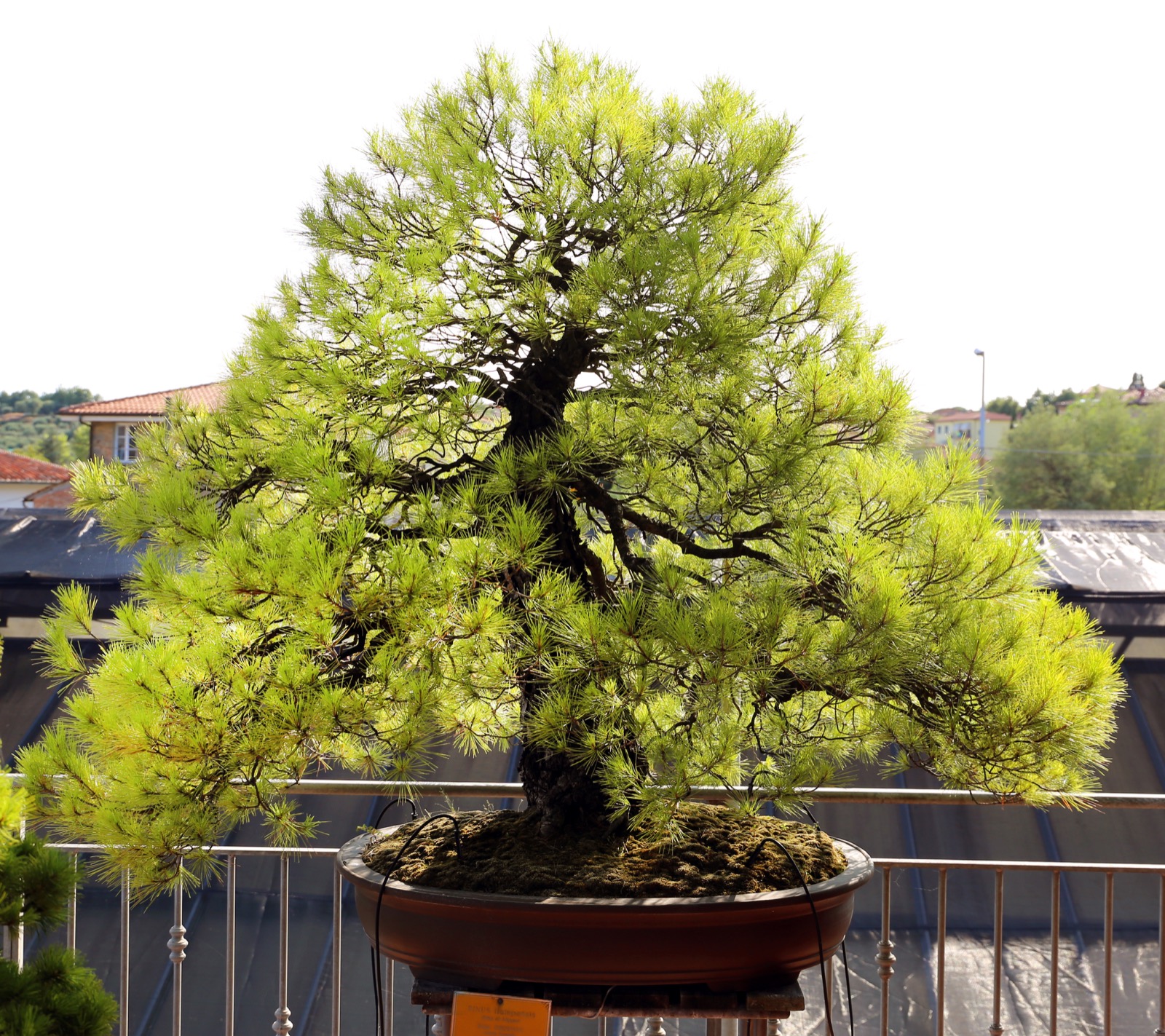
Aleppo pine (Pinus halepensis), chokkan, formal upright style, roughly 60 years old, Bonsai Museum, Pescia, Italy. / Photo by Sailko, CC BY-SA 4.0, via Wikimedia Commons — Source
,_da_italia,_circa_60_anni.jpg)
A trunk arrives at a bonsai workshop already carrying some history: a lean toward the light, a bend around a fallen neighbor, a kink from an old injury. Chokkan (直幹, "straight trunk") is reserved for the rare trunk that carries none of it — one that rises from its roots in a single unbroken line and holds that line all the way to its own tip. It is one of the oldest and least forgiving forms in the vocabulary of jukei (樹形, "tree form") introduced in our overview of bonsai's basic tree forms.
Chokkan is the style with no second chance: a trunk trained to rise dead straight, thick to thin, root to tip, in a form so plain that any flaw shows at once.
One unbroken axis has to run the whole tree
The rule sounds simple and is almost impossible to satisfy by accident. A single vertical axis runs from the center of the nebari (根張り, "surface roots") to the apex, and the trunk must taper along that axis without deviating from it even slightly — no lean absorbed by a curve, no jog left over from an old injury. Practice generally places the first branch somewhere around a quarter to a third of the way up the trunk, on one side; the second branch sits opposite it and a little higher; a third reaches toward the back for depth. Later branches keep alternating up the trunk, spaced a little closer together as the taper narrows, so the outline reads as a soft, continuous triangle rather than a pole with sticks attached. A single leading shoot, rather than the trunk line itself, is usually left to form the apex — the one place in the design the eye is allowed to soften.
A straight trunk reads as intent, not history
Because it admits no informality, a chokkan reads differently from a moyogi the moment it is seen. A curved trunk suggests a tree's own history — wind, a fallen neighbor, a slope it grew on. A straight one suggests intention: something planted, tended, and held to a single line on purpose. The same visual grammar shows up well outside bonsai, in the cedar-lined approaches to old Japanese shrines — the roughly four-hundred-year-old avenue of sugi (杉, "Japanese cedar") planted along the roads into Nikko, begun around 1625 under the daimyo Matsudaira Masatsuna and later listed by Guinness World Records as the longest tree-lined avenue in the world. No one claims the bonsai style descends directly from that avenue, but both share the same instinct: a trunk, or a row of them, held to one unbending line as a mark of formality and respect, set against the more conversational curve of a moyogi.
Mistakes have nowhere to hide in a chokkan
A curved trunk can absorb small compromises — an uneven taper here, an apex a little off-center there — because the eye is already following a bend and does not expect strict symmetry. A chokkan offers no such cover. Any kink, any thickening in the wrong place, any apex that drifts even slightly off the vertical line running up from the roots, reads instantly as a fault rather than as character. For that reason, most of the discipline in a chokkan sits in the choice of material rather than in correcting it afterward: a trunk with the right straightness and taper already present, grown for years in a nursery row or raised from seed toward this form specifically, rather than collected from the wild and coaxed into shape after the fact. Once the branches are set, the trunk itself rarely needs wiring at all — the honesty the form demands is mostly decided before training even begins. If you are ever judging a chokkan yourself, the material tells you more than the technique does: ask what it never needed corrected, rather than what the artist corrected in it.
Conifers arrive already halfway trained
Chokkan is traditionally built from conifers — pine, juniper, spruce, larch, sugi — more than from broadleaf trees, though a disciplined zelkova or elm can be trained this way too. Conifers tend to keep one dominant leading shoot as they grow, producing the kind of straight, evenly tapering trunk a chokkan needs with comparatively little correction; many broadleaf species branch and fork more freely by nature, and are more often guided toward the softer curves of a moyogi instead. Among pines specifically, goyomatsu (五葉松, "Japanese white pine") and kuromatsu (黒松, "Japanese black pine") are named again and again as classic choices, their bark and needle color suited to a form associated with the oldest, most formal end of the bonsai vocabulary — closer to a shrine's entrance than to a garden path.
The discipline is decided before the shaping starts
Chokkan is not the style most bonsai take on, and it is rarely the one a grower reaches for first. Like any kata, its discipline is fixed before the shaping even starts: material honest enough to bear the form, and an artist willing to give up the small corrections a curve would allow. What it returns is a trunk that shows its discipline at a glance — one line, held for decades, with nowhere to hide a shortcut. A chokkan already in training keeps that line whether or not anyone is watching it. Under Azukari, the season-by-season record an owner receives is not a report of what changed — it is confirmation that, once again, nothing needed to.
References
- Bonsai Society of Greater Cincinnati — Formal Upright "Chokkan" — trunk taper, first-branch placement around a quarter of the tree's height, and the triangular branch silhouette of the chokkan style.
- Virginia Bonsai Society — Formal Upright Style — branch placement rules, apex form, and species suited to formal upright, including pine, juniper, larch, spruce, and cryptomeria.
- Wikipedia — Cedar Avenue of Nikko — history of the cedar-lined approach to Nikko Toshogu, begun around 1625 by Matsudaira Masatsuna and later recognized by Guinness World Records as the longest tree-lined avenue in the world.
- Bonsaiable — Formal Upright Bonsai — species guidance noting the style's traditional association with conifers, with deciduous species such as zelkova used less commonly.