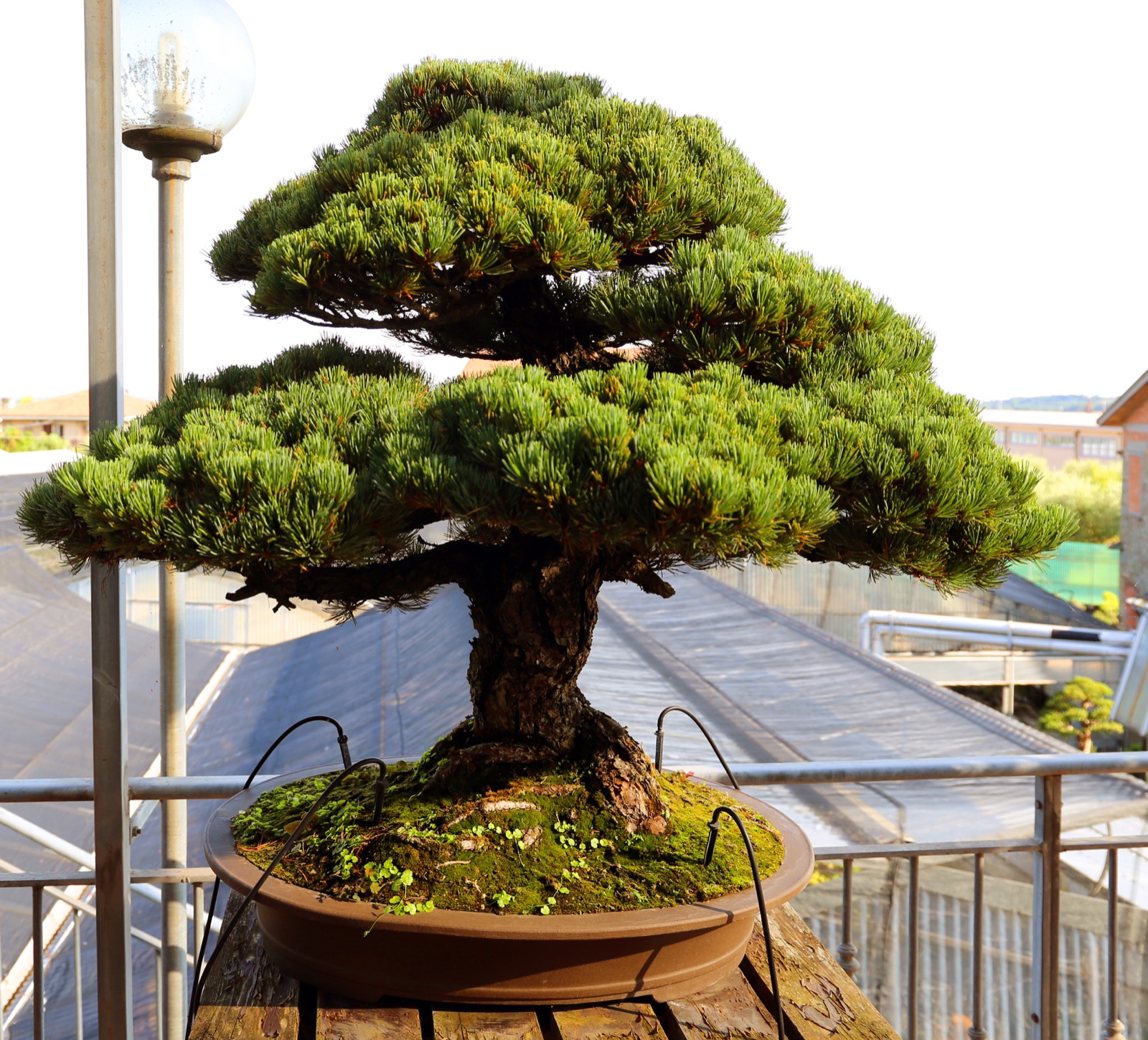
Japanese white pine (Pinus parviflora var. pentaphylla), moyogi, informal upright style, roughly 50 years old, Bonsai Museum, Pescia, Italy. / Photo by Sailko, CC BY-SA 4.0, via Wikimedia Commons — Source
,_dal_giappone,_circa_50_anni.jpg)
The white pine in the photograph above has been in training for roughly fifty years, and it does not live in Japan. It stands in a bonsai museum in Pescia, Italy, where the label reads moyogi rather than an Italian translation — a Japanese tree form absorbed so completely into the world's idea of "a bonsai" that a Tuscan collection keeps a half-century example under its original name. It is also the shape most people already carry in their heads the moment someone says the word bonsai: a trunk that leans, curves once or twice, and straightens again near the top. That shape is what our overview of bonsai's basic tree forms introduced as moyogi (模様木, "informal upright") — the form the world already means when it says bonsai.
Moyogi is the S-curved trunk most people already picture as "a bonsai": a form close enough to how an ordinary tree actually grows that keeping it from reading as either arbitrary or chaotic takes real discipline.
A trunk that never repeats a bend
The rule sounds almost too simple to be a rule at all: the trunk bends, then bends back, in a shallow curve that climbs from the nebari (根張り, "surface roots") to the apex without ever flattening into a straight run. Instruction on the style is often summarized as a single "gentle S-curve," though it is commonly elaborated into two or three distinct bends over the height of a tree — enough to read as movement, not so many that the eye loses the line. Each branch grows from the outside of its nearest bend rather than the inside, following the curve the way cloth follows a bent pole; a branch placed on the inside of a bend, crowding the space the curve opens on its outer edge, is one of the fastest ways to make a moyogi read as clumsy rather than alive. How those branches are ordered and spaced up the trunk is its own, more detailed subject — what matters here is only that they follow the curve rather than fight it.
As with any jukei (樹形, "tree form"), this line is set gradually, through wiring applied over successive seasons rather than bent into place in one sitting: one curve is set and allowed to hold before the next is introduced further up the trunk. A moyogi's shape is built the way a sentence is written — one clause making sense only in relation to the one before it.
The form closest to how a tree actually grows
Ask why moyogi is trained more often than any other single form, and bonsai instruction gives an answer rooted in observation rather than taste: it is close to how an ordinary tree growing in the open actually behaves. A seedling rarely rises perfectly straight. It leans toward light, is pushed by wind, is nudged by a neighboring branch, and straightens again as it clears the obstruction — a record of small corrections that, seen from a distance, reads as a gentle curve. Chokkan, the formal upright, asks for a trunk that shows almost none of this history. Moyogi is trained from material that already shows a little of it — ordinary nursery stock, a young pine, a collected trunk with no single dramatic sweep — which is a large part of why it, rather than the stricter chokkan, is the form most bonsai in cultivation are eventually worked toward.
Balance has to be earned inside every bend
What keeps a moyogi from simply looking like a bent stick is a rule that runs against its own curves: however many bends the trunk makes on its way up, the apex still has to land directly above the center of the nebari, so the tree reads as standing rather than falling. This balance is harder to hold than a straight trunk's. A chokkan's vertical line does that work automatically; a moyogi has to earn the same sense of stability while its trunk is actively leaving the vertical, again and again, on the way there. It is also a stricter rule than the forms on either side of it in the vocabulary. Kengai, the cascade style, abandons the requirement altogether and lets the trunk fall past the pot's rim; a windswept trunk pushes every branch toward one side and never returns to center. Moyogi keeps the requirement and works inside it — motion at every bend, resolved each time back into balance by the point the eye reaches the top.
Taught first, because it teaches all the others
Because moyogi trains material that already tends this way, and because judging its balance is a skill that carries directly into reading any other form, it is usually the first style a beginner is set to work. A student who can see whether an S-curve's apex sits correctly over its own roots has already learned most of what it takes to judge a chokkan's straightness or a kengai's fall; the reverse is less true. Execution is not what makes moyogi "the basic form." Moyogi is simply the form through which the underlying grammar of jukei — balance read against a moving line — is first taught and most often practiced. Species guidance follows the same logic: pines, junipers, maples, and elms are all commonly trained this way, less because the form suits any one of them specifically than because moyogi is the default a tree is worked toward whenever nothing about its trunk argues strongly for something stricter. As we've written about kata, moyogi's fixed structure is exactly what lets one grower's trunk read as different from the next — the same S-curve rule, followed by ten different trees, still leaves ten different trees.
This gives anyone standing in front of a moyogi — at an exhibition, in a nursery, in a listing photograph — one test worth running before any other. Do not count the bends; the count is the least important thing about them. Find the surface roots, find the apex, and ask whether the top has come home over the base. If it has, every curve between them will read as movement. If it has not, no amount of dramatic bending will keep the tree from reading as a fall that has not finished yet.
A balance being kept, not a shape being finished
A moyogi is never finished the way a single sentence is finished. Each season adds a little new growth at the tips of a line that already carries years of bends behind it, and every artist who takes over its training inherits the same task as the one before them: read where the existing curve is heading, and add the next stretch so the balance holds — the same continuity we've written about elsewhere applied to one particular line, curve by curve. This is also why the S-curve is, quietly, the best argument for how Azukari keeps trees: a line built clause by clause over decades is exactly the kind of work that should not change hands every time its owner does. The tree stays with an artist in Japan who can read where the sentence was heading; the owner, wherever they are, receives the record of each new clause as it is written. Fifty years from now, a trunk like the one in Pescia will still be answering a curve set this season — by whom is the only part that was ever optional.
References
- Bonsai Society of Greater Cincinnati — Informal Upright "moyogi" or "tachiki" — the moyogi trunk's gentle S-curve, outer-branch placement along each bend, and apex alignment above the base.
- Wikipedia — Bonsai styles — definition of the informal upright style's visible trunk curves with the apex fixed directly above the trunk's entry into the soil, and its contrast with the formal upright style.
- Bonsaiable — Informal Upright Bonsai Fundamentals — the style's resemblance to trees shaped by weather and wind in nature, and the range of conifer and deciduous species commonly trained this way.
- Bonsai Today — Moyogi (Informal Upright Style) — moyogi's standing as bonsai's most commonly trained style and its relation to natural, weather-shaped tree growth.
- Wikipedia — Pinus parviflora — the taxonomy of Japanese white pine, including var. pentaphylla as a northern-Japan variety historically described as a separate species by Heinrich Mayr.