
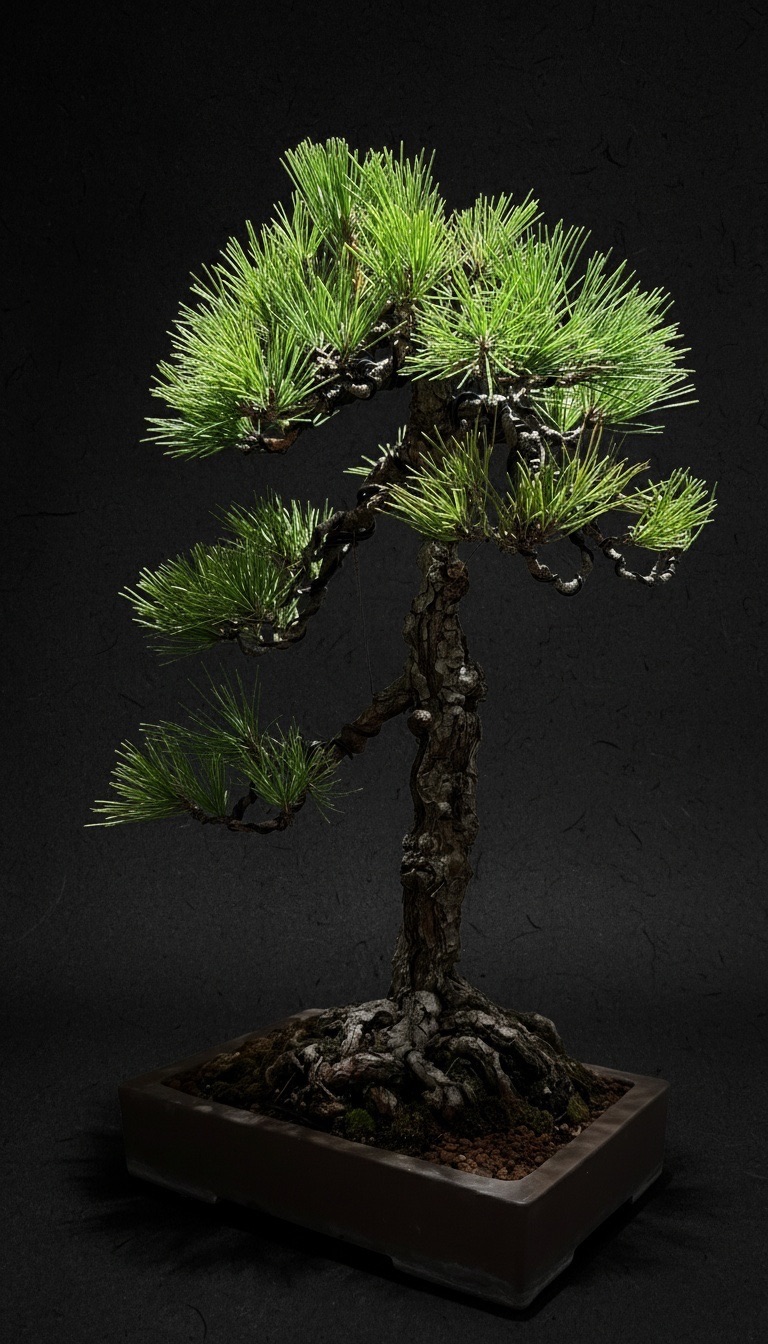
Japanese black pine, moyogi, informal upright / Photo: Azukari
Look at a well-trained bonsai long enough and the branches stop reading as a tangle of green. A first branch reaches out near the base, to one side. A second answers it, a little higher, on the other side. A third slips toward the back, low enough to be missed at a glance and essential once you notice it. None of this is improvised. The branches on a bonsai are the trunk's decisions made visible, and once you know what to look for, a crowded canopy resolves into a structure with a beginning, a middle, and a back.
A bonsai's branches follow a working order, and reading that order — where each one sits, how much air separates it from the next, and which shapes a trained eye removes on sight — is what turns a glance at a tree into an actual reading of it.
Branch order: a plan, not an accident
Japanese practice calls the sequence in which branches are trained edajun (枝順, "branch order"), and it starts low on the trunk and works upward on a rough script written in advance. The lowest branch — usually called simply the first branch — is generally set at around a third of the tree's total height in the informal-upright, moyogi style, or closer to a quarter of the height in the stricter, straight-trunked chokkan form. It is also, as a rule, the thickest and longest branch on the tree, because a bonsai's branches taper the way its trunk does, growing shorter and finer the higher they sit. A second branch answers the first from roughly the opposite side, a little further up the trunk. A third is set toward the back, angled outward enough that its foliage still shows from the front, so the silhouette reads with depth rather than as a flat cutout. Together the three sit at roughly even angles around the trunk, and every branch trained above them keeps alternating sides, moving closer together as it nears the apex — the same rhythm, compressed, that an actual tree shows as its crown thins toward the sky.
None of this is arbitrary. A branch set a hand's width too high, or placed directly opposite the one below it, unsettles the reading of the whole tree the way one word out of order unsettles a sentence. Once you know to look for the first branch, the second, and the one hiding at the back, you are no longer looking at foliage. You are looking at a plan.
Space is what separates a good branch structure from a crowded one
Position is only half of what a trained branch structure is doing. The other half is what has been deliberately left empty. Bonsai growers have a plain way of stating the standard: leave enough space between branches that a small bird could fly through the tree without touching a twig. It sounds whimsical, but the reasoning behind it is entirely practical. A branch pad that touches its neighbor blocks the light and air the layer beneath it needs, and it erases the very thing that lets a viewer's eye tell one branch from the next.
This is also where quality shows itself fastest. Crowd a tree's branches together and the trunk line all but disappears behind them; a well-regarded bonsai is, as often as not, simply one where every branch has been given the room to be read on its own. The negative space between one pad and the next is doing as much design work as the branches themselves — it is the silence between the words, and without it the sentence does not parse.
Imieda: the shapes a trained eye prunes away
Not every branch a tree produces earns a place in that order. Japanese practice groups the branch shapes that undercut a tree's form under a single term, imieda (忌み枝, "branches to avoid," literally "branches under a taboo"). These are not weak or diseased growth — the wood is often perfectly healthy. What disqualifies them is what they do to the read of the tree.
A kannuki-eda (閂枝, "bar branch") is one of the clearest examples: two branches growing from directly opposite sides of the trunk at the same height, like a bolt run straight through it. English-language bonsai instruction arrives at the same rule from the other direction, warning growers off "bar branches" and holding that only one branch should ever be kept at a given point on the trunk. A kuruma-eda (車枝, "wheel branch") is a related fault: several branches radiating from a single point on the trunk like the spokes of a wheel, which floods that one spot with sap, swells it out of proportion, and breaks the taper a trunk is meant to hold from base to apex. A crossing branch, one that reaches over the trunk or over another branch, causes a plainer problem: it breaks the outline a viewer's eye is trying to trace.
None of these shapes are unusual on an untrained tree — a young pine, or a piece of material freshly collected from the wild, tends to throw them constantly. The work of the artist is to see them for what they are early, before they thicken into permanent flaws, and to remove them while the wood is still small enough that the cut leaves no trace. A branch structure that looks effortless a decade on is, in practice, the record of years of that kind of quiet subtraction.
Reading branches deepens what you see
None of this changes what a bonsai is; it changes what you notice. Once edajun, negative space, and imieda are in your eye, a tree you might once have called simply "full" or "sparse" starts to show its actual structure — a first branch, a second, a back branch spreading depth behind them, and the deliberate silences an artist has kept open between each one. It is the same habit of close, patient looking that reading a bonsai's front and roots and reading its overall form both call for: seeing a tree is a skill built one part at a time, and the branches, once you can read them, are among its most legible parts.
It is also, quietly, a way of reading years of someone else's work. Every well-kept branch structure carries the decisions of whoever trained it — what was let grow, what was cut back, what was removed before it ever became a problem. At Azukari, that structure keeps developing in Japan under an artist's ongoing care, with a seasonal record kept as it changes, so that an owner elsewhere can follow, and eventually read, what years of that quiet work have produced.
References
- Evergreen Gardenworks — The Rules of Bonsai — branch placement at roughly one-third tree height, 120-degree spacing between the first three branches, the rule against bar and whorled branches, and the "let the birds fly through" spacing guideline.
- Bonsai Today — The Branches — the first, second, and back branch structure, height ratios for the moyogi and chokkan styles, and branch angle and taper.
- Bonsaiplace — Branch Selection 101 — bar branches and whorled branches, and how branches originating from a single point cause reverse taper.
- Wikipedia (Japanese) — Imieda — definition of imieda and the named categories of branch faults recognized in Japanese bonsai practice, including kuruma-eda (wheel branch), kannuki-eda (bar branch), and crossing branches.
- Kindai Shuppan — Bonsai Beginner's Course: Points of Branch Placement — height ratios for the first branch in the moyogi and chokkan styles, alternating branch order, and the use of front and back branches to express depth.