
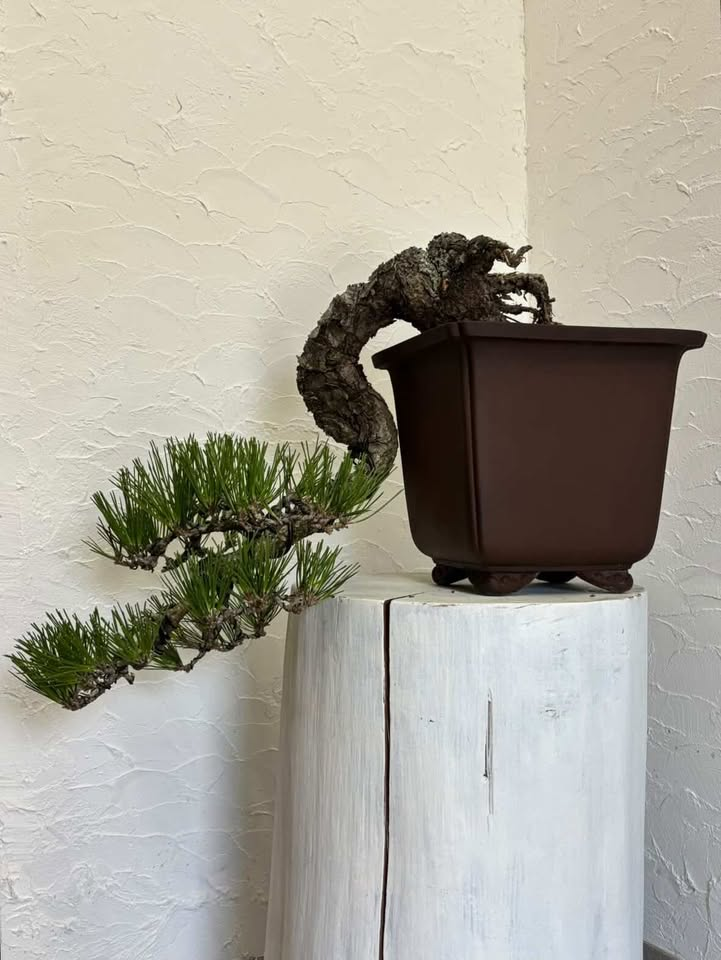
Japanese black pine, 45 years, cascade style / Photo: Azukari
The black pine in the photograph above is forty-five years old and grows downward, past the lip of its pot, in the style called cascade. Most people meeting a tree like it take in the silhouette all at once, decide whether they like it, and move on. A bonsai is not built to be read that way. It has a fixed order of reading, and the order begins before the tree itself — with the question of which side you are meant to be standing on.
A bonsai has a fixed way of being read — front, then roots, then trunk, then deadwood, then pot — and once you know the order, the minutes spent in front of a single pot change completely.
The order is fixed: front, roots, trunk, deadwood, pot
The small tree in the pot carries the shape of a large tree from a mountain or a forest, with decades folded into its trunk and branches. Reading it means moving through five things in sequence, always from the same direction. Skip the order and the tree still looks pleasant enough. Follow it, and the tree starts explaining itself. In Japan the training built around this kind of looking — the arranging and the viewing, rather than the growing — carries its own name, keido (景道, "the way of the view").
The front decides everything read after it
Every bonsai has a front — the single direction from which it looks most complete. An artist settles that direction by watching how the trunk flows, where the branches fall, and how the roots spread, the way a portrait painter settles on an angle of a face before touching the canvas. A tree on display is already turned to face the viewer, so the first task is smaller than it sounds: meet the tree at a height low enough to look slightly upward, and the trunk's reach and the whole tree's balance both come into focus at once.
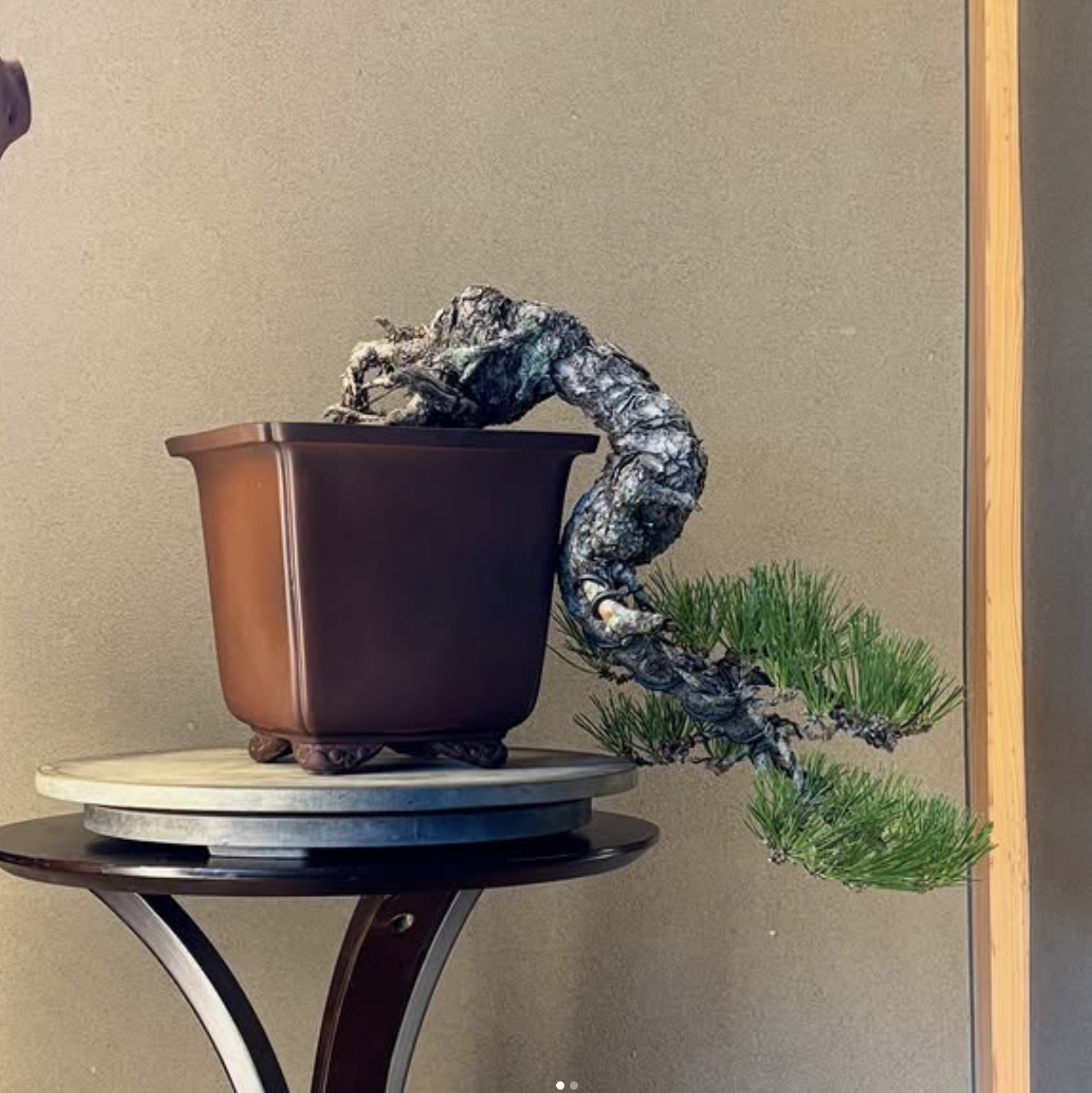
Japanese black pine, 45 years, cascade, grown in Kagawa / Photo: Azukari
Nebari counts years no other part of the tree admits to
Once the front is fixed, the eye drops to the feet of the tree. Nebari (根張り, "the surface roots radiating outward from the trunk's base") is the tree's grip on the ground, and it cannot be manufactured in a season. Roots spreading evenly in every direction say the tree has stood, undisturbed, in real soil for real years; a nebari that is thin on one side or missing on another says something about that history too. Most attention goes to the branches and foliage above, and the base gets skipped entirely. It shouldn't — the base is where a tree's age is hardest to fake and easiest to verify.
The trunk's bends are a record of weather
From the base, the eye climbs. The point where the trunk leaves the soil is its base; the way it thins steadily on the way up is its taper, and a trunk that stays honest to that taper — thick low, narrowing toward the apex — is following the same physics as a tree that grew that way on an actual mountain. The curves along the way are not decoration. A trunk that rises, settles, and rises again in gentle stages is holding the memory of wind and snow it leaned into for years before anyone trained it. Traced from bottom to top, the trunk is the closest thing a bonsai has to a written record.
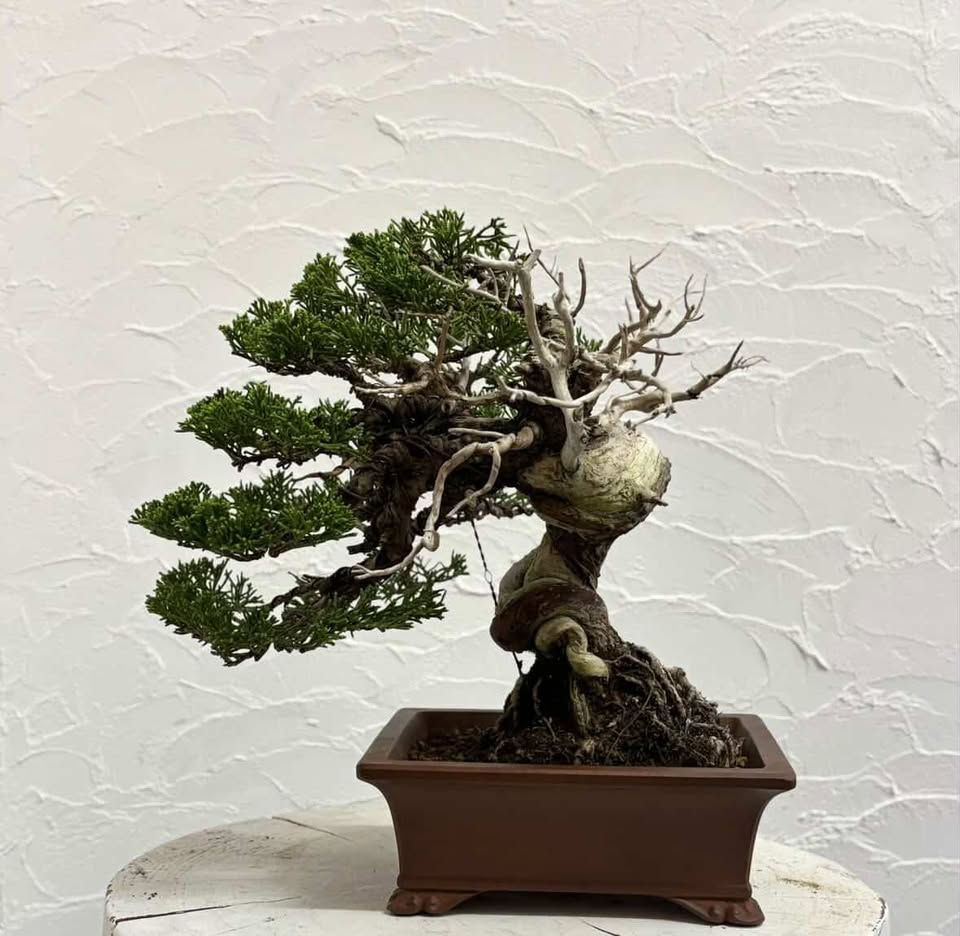
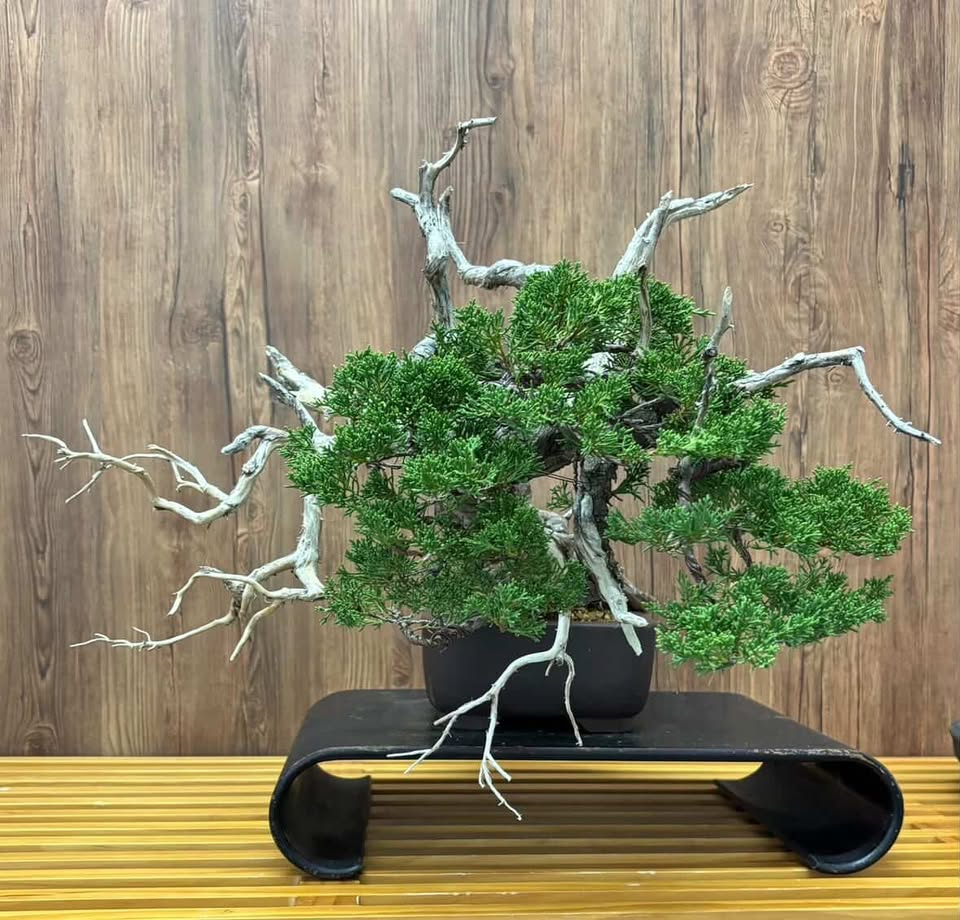
Shimpaku juniper, 30 years, informal upright, grown in Saitama / Photo: Azukari
The dead wood carries as much argument as the living green
On a conifer, and on a shimpaku juniper above all, two more terms matter. Jin (神, "a dead branch tip bleached to bone-white") is what remains once a branch has died and weathered pale; shari (舎利, "bark stripped back to bare wood," a word borrowed from the Buddhist term for relics) is a stretch of dead trunk exposed the same way. In nature, lightning, cold wind, and enough years kill part of a tree and leave that bleached shape behind; bonsai preserves the same evidence on purpose, setting the dead white wood directly beside the living green. That contrast, more than the foliage alone, is why a juniper like this is worth standing in front of. Follow where the white lines run along the trunk and where they meet the living branches, and the tree shows its hardest years and its healthiest ones in the same glance.
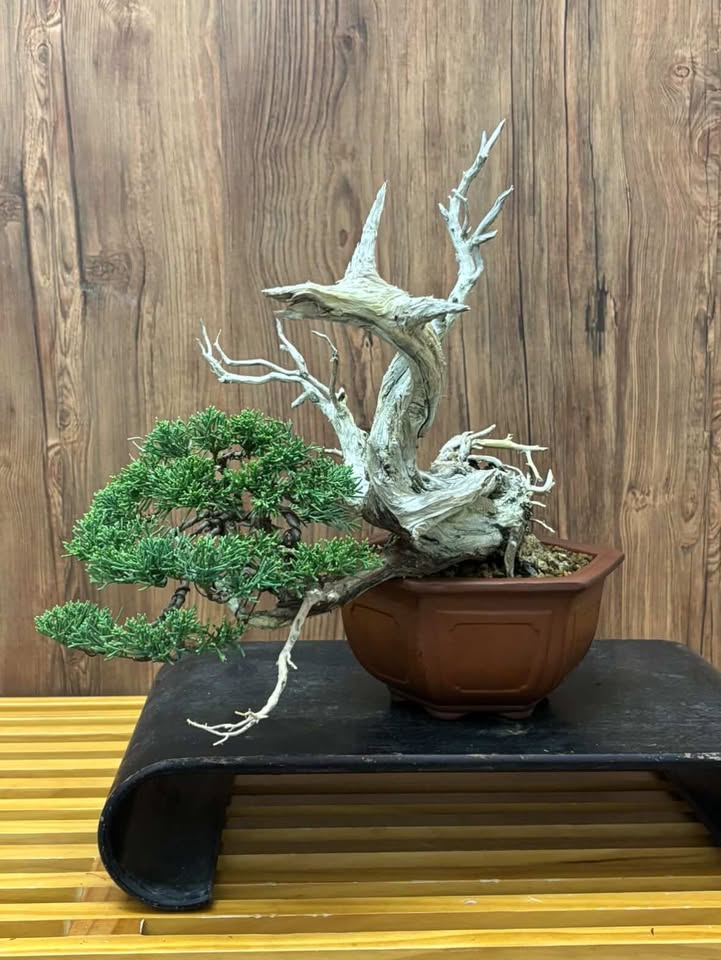
Shimpaku juniper, 40 years, semi-cascade, grown in Tochigi. White shari against living foliage. / Photo: Azukari
The pot finishes a sentence the tree started
Last comes the pot, which is less a container than the other half of a conversation. A powerful conifer wants a deep, heavy pot beneath it; a delicate, refined tree wants something shallow and light. When a pot's color and shape answer the tree's mood instead of merely holding it, the two stop being separate objects and become one landscape. Reading that pairing is also reading how the artist who chose it sees the tree — which is why the way of looking at a bonsai isn't finished until the vessel is included.
Shimpaku juniper, 50 years, semi-cascade, grown in Tochigi. The quiet balance of tree and pot. / Photo: Azukari
Test it yourself the way I was first taught to: find what looks like the front, meet the tree at a height slightly below its own, and check whether the roots, the trunk's rise, and the pot resolve into a single line. If they don't, move around the pot until they do.
In my case, this reading practice isn't something I arrived at alone. It's what I keep going back to a garden in Tokyo to learn, standing in front of trees that aren't mine, taught by artists who have been reading fronts for decades longer than I have.
None of that requires owning a place to put a tree. Under Azukari, a tree stays in Japan under an artist's daily hand, and what an owner receives each season is the record of exactly this reading — front, roots, trunk, deadwood, pot — carried on by someone who has done it for years. See individual trees by species on the Azukari marketplace. A bonsai does not ask to be admired. It asks to be read.
Frequently asked questions
How do you find the front of a bonsai? Look for the direction where the trunk's flow looks most complete, the roots spread evenly to both sides, and the branches are arranged toward the viewer — in a display, the tree is already set with its face turned outward. Where do jin and shari appear? Almost always on conifers whose deadwood resists rot, the shimpaku juniper above all, where bleached trunk or branches sit directly against living foliage. Why does nebari matter so much? Roots spreading evenly in every direction give a tree stability and the bearing of real years, and how they spread tells a trained eye both the tree's quality and its age.
References
- Bonsai aesthetics — Wikipedia — overview of a bonsai's designed "front," the nebari root spread, and jin/shari deadwood as core viewing conventions.
- The visible or surface roots of Bonsai (Nebari) — Bonsai Empire — on nebari as the visible root spread that reads as stability and age.
- Deadwood on Bonsai (Jin, Shari and Uro) — Bonsai Empire — definitions of jin and shari as the two classic deadwood techniques, modeled on natural weather damage.
- Deadwood bonsai techniques — Wikipedia — on jin (神) and the related sharimiki (舎利幹) trunk style.
- Shunkaen Bonsai Museum — Kunio Kobayashi — the garden in Edogawa, Tokyo, where the author studies.