A painting stops when the artist sets down the brush.
A sculpture stops when the chisel is put away. The moment the work is signed, it ceases to move. After that, it simply exists, the same tomorrow as it was today, and the day it was completed becomes the day by which it is always known.
Bonsai has no such day.
It is alive, and a living thing has no final draft.
A bonsai is never finished. What exists is only the tree as it stands today.
This is not a sentimental way of speaking about trees. It is a fact about how bonsai is practised, collected, and handed on, and it is worth taking seriously, because it changes what it means to own one.
The tree changes every year
A bonsai changes its appearance with each turn of the seasons.
Buds break in spring. Foliage fills out and darkens through summer. Depending on the species, colour shifts in autumn. In winter, deciduous trees stand bare and even the evergreens slow to a rest.
This movement happens within a single year, and it keeps happening across years. Set yesterday beside today and the difference is almost nothing — a shoot a little longer, one more leaf unfurled. That is close to the whole of it, day to day.
But small differences accumulate, season after season, decade after decade. Part of what shapes that accumulation is deliberate: in early to midsummer, an artist tending a pine may perform mekiri (芽切り, literally "bud-cutting," known in English as decandling) — removing that year's new shoots, or "candles," so the tree pushes a second, finer flush of growth and, over years, denser branching and shorter needles. It is one of many small acts of teire (手入れ, the ongoing care and maintenance a tree requires) repeated so often that no single instance seems to matter. Yet give it ten years and the thickness of the trunk, the arrangement of the branches, the character of the bark will all have become something else entirely.
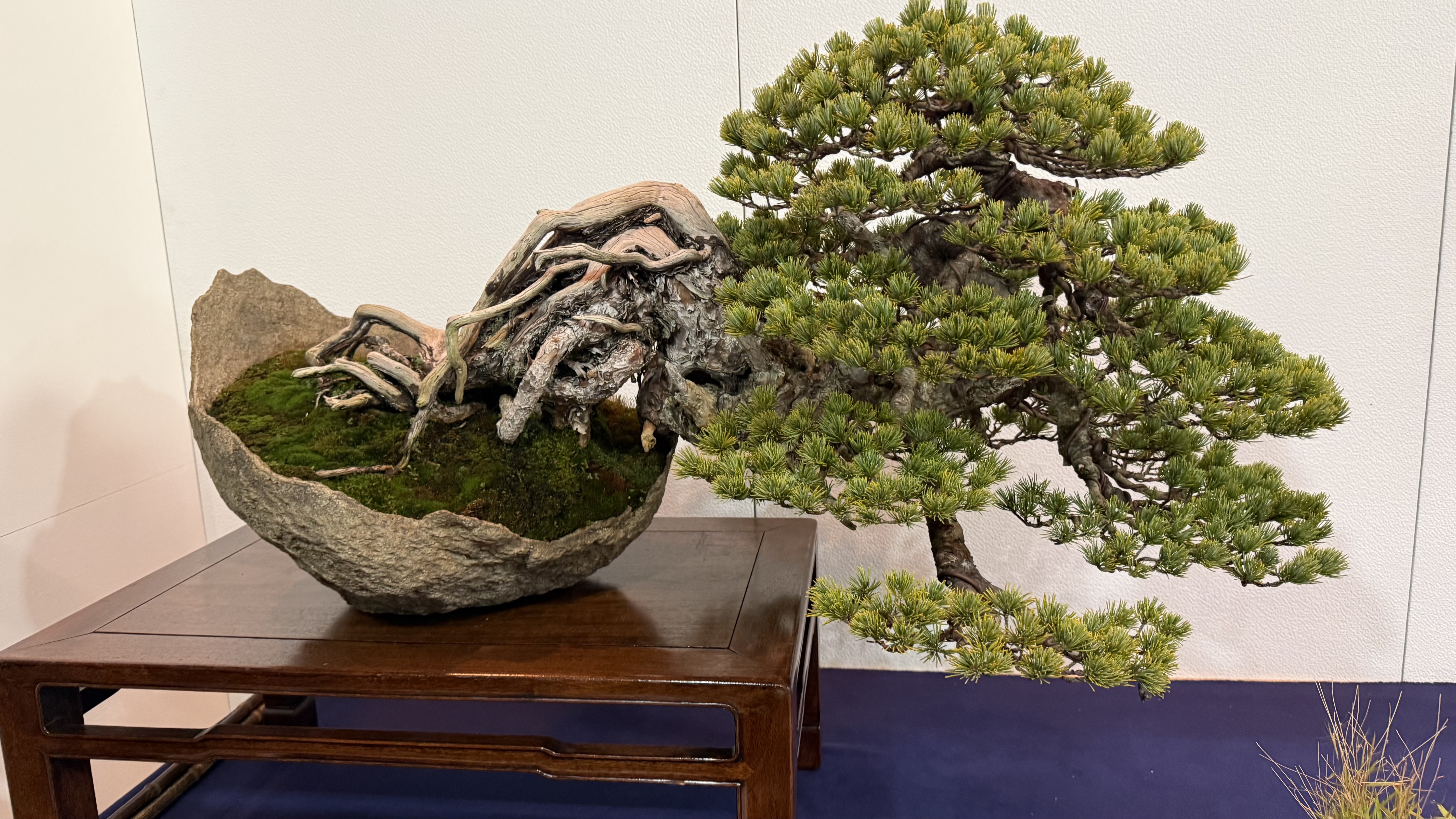
When you look at a bonsai, you are looking at a single moment. But that moment is only a waypoint. It is not a finished, final form — it is one cross-section of a tree that is still, right now, alive, and will look different the next time you see it.
Knowing how to read the front of a tree, its nebari, and its jin and shari helps you see more in that one cross-section — and reminds you that even the reading is provisional, since the tree you learn to see today is not quite the tree you will see next year.
People keep watching, too
If the tree keeps changing, the work of the person watching it never ends either.
Branches are cut back. The silhouette is adjusted. Someone checks whether the tree is weakening before it shows in the foliage. Someone plans the following season's work while this season's is still underway.
A bonsai is not something an artist makes and then stops attending to. It is something kept in growth, kept under watch, and it is a relationship between the tree and the artist that continues rather than concludes. There is no equivalent of a gallery opening — no evening on which the work is declared done and the artist moves on to the next piece.
Behind any one bonsai is not a task completed in a given year, but decades of ongoing observation and judgment: whether to water more or hold back, whether to apply wire this month or wait, whether to let a branch run for another season before deciding its fate. Even choosing to do nothing this year is itself a judgment, arrived at only by watching closely enough to know that restraint is what the tree needs.
A tree being given a name — a mei (銘, a name bestowed on a tree in recognition of its story) — happens inside this ongoing relationship, too. A name does not mark a completion, the way a title marks a finished canvas. It is a signpost planted along a story that keeps being told, updated in practice as the tree itself continues to change.
Passed down across generations
At Japan's oldest bonsai nurseries, it is not unusual to find trees that have been carried across three, four, or more generations of a single family or lineage of artists.
Often the lifespan of one tree outlasts the lifespan of the person who shaped it. The Yamaki Pine, now held at the U.S. National Arboretum's National Bonsai & Penjing Museum, is a well-documented case: trained since 1625 by five generations of the Yamaki family in Hiroshima, it survived the 1945 bombing of the city before being given to the American people in 1976. At Mansei-en, one of the historic gardens of Omiya Bonsai Village just north of Tokyo, the Kato family has kept the nursery since the nineteenth century. These are not curiosities; they are close to the ordinary shape of how a serious bonsai's history unfolds.
That duration is exactly why an artist grows, shapes, and eventually leaves a tree for the generation that follows. The work is not aimed at finishing the tree while it is in one's own hands. It is aimed at keeping the tree in a state from which the next steward can keep tending it. Letting go, when the time comes, is not a closing point — it means leaving the tree in a form the next person can still carry forward, still read, still shape.
Many of the masterpiece bonsai still in Japan have reached the present exactly this way. A single artist's name may be attached to a tree — sometimes recorded formally, as bodies such as the Nippon Bonsai Association do for trees recognised as of outstanding merit — but in practice a tree of real age has been raised by generations of hands. No one person finished it. What you see today is the shape left by an unbroken chain of care, each steward working within limits set by the ones before and leaving room for the ones after.
Because it is never finished, there is time
Never being finished is not a flaw.
Family, work, the body, the mind — none of these are things that finish and stop. They continue. They change. They require tending, more or less indefinitely. Bonsai is the same, and this is not a strained analogy so much as the same fact appearing in a different register.
If a bonsai were something that finished on a given day and stopped there, all that would remain afterward is possession — an object, held. Nothing more would pass between the person and the tree.
But because bonsai never stops, time opens up inside it. Because time opens up, a relationship forms between the person and the tree: how to tend it today, how to shape it next year, what scene it might hold in ten. It is precisely because a bonsai is unfinished that there is still room to stay involved with it. Being unfinished is not a shortcoming. It is the open space in which time, and a relationship, are able to form at all.
Closing
A bonsai is never finished. The artist knows this and keeps watching the tree anyway, every day. Today's watering, today's observation, today's small decision all carry forward into what the tree will look like ten years from now.
Azukari is a way of receiving that ongoing time, in the form of a record. The tree keeps growing in the care of an artist, and its owner receives, season by season, the record of a tree that never stops changing.
Watching a tree that never stops, without asking it to stop, is what it means to live alongside bonsai.
References
- National Bonsai Foundation, "Yamaki Pine": https://www.bonsai-nbf.org/yamaki-pine
- Bonsai Empire, "Omiya Bonsai Village": https://www.bonsaiempire.com/inspiration/bonsai-japan/omiya
- The Omiya Bonsai Art Museum, Saitama (English): https://www.bonsai-art-museum.jp/en/
- Bonsai Empire, "Pruning Bonsai, Cutting Branches to Shape the Tree" (on maintenance vs. structural pruning, and decandling): https://www.bonsaiempire.com/basics/styling/pruning
- Nippon Bonsai Association (日本盆栽協会), organisational overview: https://bonsai-kyokai.or.jp/company.html