In a chado (茶道, "the way of tea") lesson, a beginner does not touch the tea for weeks. First comes learning to slide open a door. Then how to cross the tatami without a misstep. Then the bow, correct in depth and timing, exactly as taught. Only once all of that has settled into the body does an instructor set out a bowl and let a student near the tea itself. None of it is invented by the student on the spot. It is inherited whole, down to the wrist angle for scooping powdered tea, from generations of people who had already worked out what to do with a kettle and a cloth.
A kata (型, "a fixed form") is not a constraint imposed on a beginner. It is a solution, refined by generations before them, handed over so they do not have to solve the same problem from zero.
A form is a gift, not a cage
A kata looks, from outside, like a rule limiting what a student may do. It is closer to the opposite: the compressed result of a great many people, over a great many years, discovering what actually works — and failing to find anything better. In kendo and aikido, a kata is a fixed sequence of movements: how the feet step, how the hip turns, how the blade or the arm travels through a strike. A student receives this sequence already tested against centuries of bodies moving under real pressure; they do not invent it. In Noh theater, a performer trains from early childhood inside a repertoire of standardized stance and gesture, reproduced with such fidelity across generations that a movement made on stage today can still be traced to one set centuries ago.
Someone already spent a working life finding the most efficient way to hold a sword, pour water, or cross a stage. The form carries that discovery forward, so a new student does not have to spend years rediscovering it alone. Learning the kata starts a student from the far end of someone else's already-finished search.
The form is fixed; the person inside it is not
Give the same kata to ten different students, and ten different people become visible. The steps of a kendo kata do not change from one practitioner to the next, yet anyone who has watched enough of them can tell one performer from another. The fixed sequence exposes differences in timing, weight, breath, and intention that would otherwise stay hidden. A rule with no shape gives individuality nowhere to register. A precise, shared form gives it a stage: because everyone is measured against the identical structure, the smallest true variation — a fraction of a second's hesitation, a slightly different distribution of weight — becomes visible as exactly what it is, this person and no other, inside this form.
Constraint, here, is what makes personal expression legible at all.
Katayaburi is not the same as katanashi
A kata can be departed from, which makes it tempting to think that leaving it behind — bending the rule, improvising past the form — is simply the next stage after learning it. Japanese has two different words for this, and the distinction between them is exact.
Katayaburi (型破り, literally "form-breaking") describes someone who has fully absorbed a kata and then, from inside that mastery, breaks from it deliberately. Katanashi (形無し, "without form") describes someone who never learned the form in the first place and is simply doing whatever they like. Both depart from the expected pattern, but one departure is built on years of discipline and the other on nothing at all.
The distinction is closely associated with the kabuki actor Nakamura Kanzaburo XVIII, known for productions that stretched far outside kabuki convention. Told that his style was katayaburi, he is remembered for answering, in effect, that you can only call it katayaburi if there is a kata to break — without the form behind it, what looks like innovation is just katanashi, shapelessness with nothing to depart from. The line is often traced back further, to a Buddhist teacher whose words Kanzaburo had heard and made his own. Breaking a form convincingly requires having first held it completely.
A trunk line is a kata too
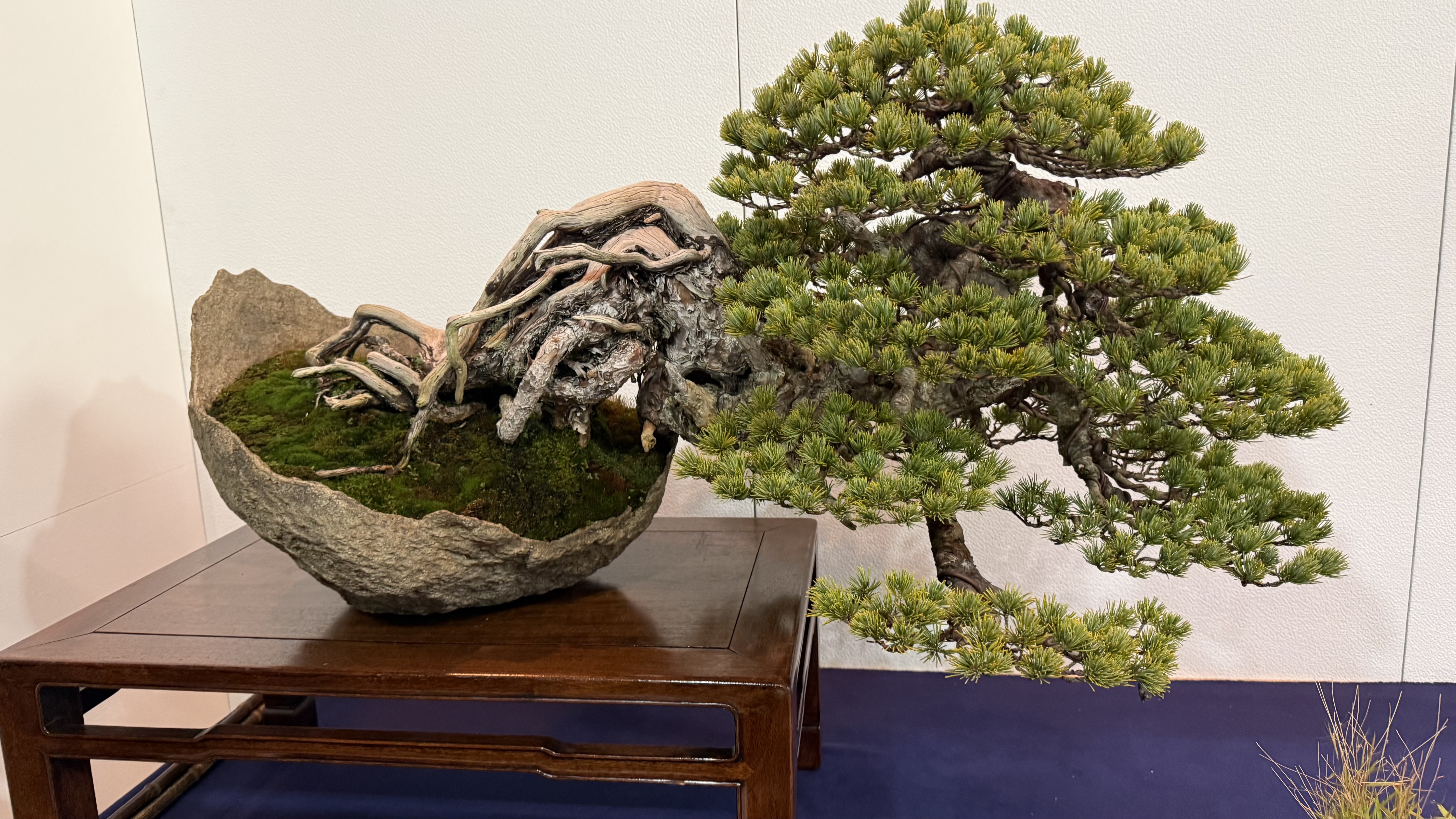
A bonsai's trunk line follows the same logic. The moyogi (模様木, "informal upright") style is not a free-form shape a grower invents from nothing — it is a fixed structure: an S-curve trunk that never reverses direction twice the same way, branches growing from the outside of each bend rather than the inside, the apex settling directly above the point where the trunk meets the soil. The kengai (懸崖, "cascade") style is equally fixed in its own logic, the trunk committed entirely below the rim of the pot. These are forms in the same sense a kendo kata is a form: inherited, precise, and not invented anew by each artist who works within them.
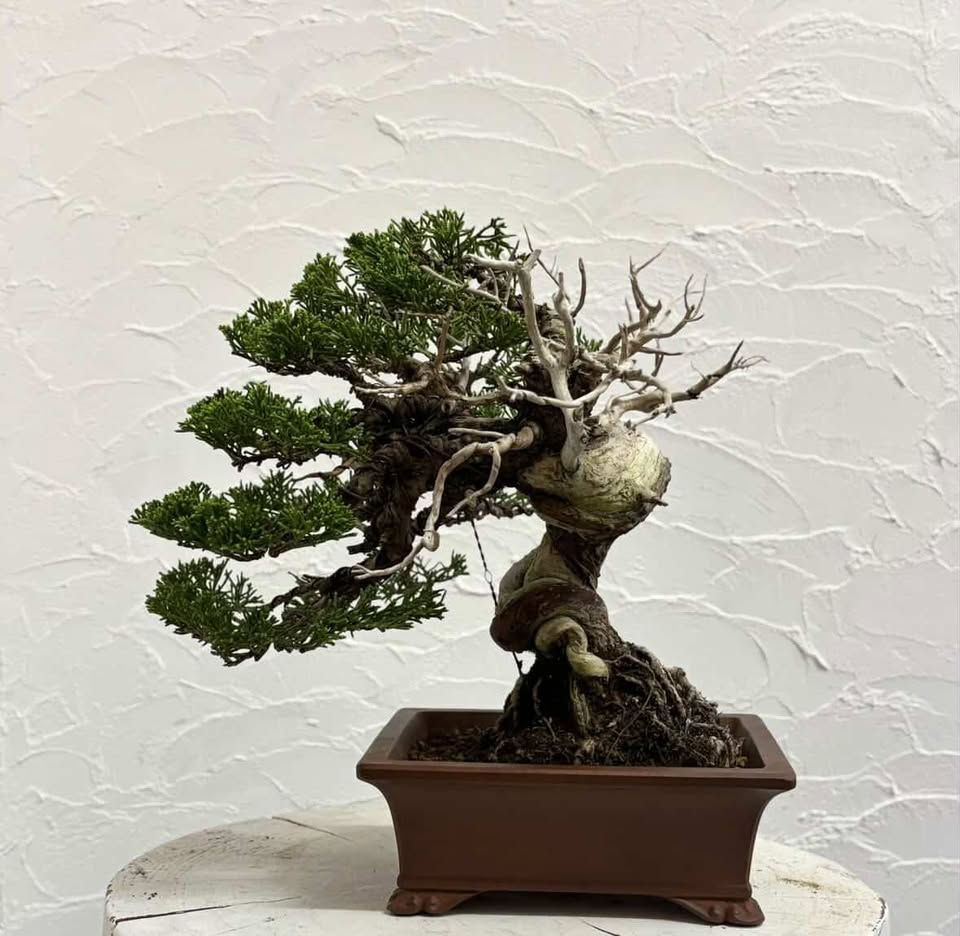
A shimpaku juniper trained in moyogi, its trunk following the style's inherited S-curve.
Because the form is fixed, the individuality of a given tree becomes visible rather than hidden. Two moyogi pines can follow the identical structural rule and still be unmistakably different trees — one curve tighter, one bend more sudden, one silhouette more austere — because the shared form is what lets a trained eye see where this particular trunk, and no other, diverges from the last one it stood beside. Next time you look at a moyogi tree, do not just check the shape against the rule. Look for the exact point where it breaks from every other tree that shares the same rule — that divergence is where the artist's hand is.
For more on how a tree's form is read, see "Shuhari: The Three Stages of Mastery," "How to Look at a Bonsai," and "Why Japan Avoids Symmetry."
A kata is never really about the trunk, the sword, or the bowl. It is a cage that turns out, once you are inside it, to be the fastest way out.
References
- Wikipedia — Kata — overview of kata as fixed, transmitted forms in Japanese martial arts and traditional arts including kabuki and tea ceremony.
- Wikipedia — Japanese tea ceremony — description of temae as precisely prescribed procedure, and the sequence in which students learn fixed forms before handling tea itself.
- Aishinkan Kyoto — "型があるから型破り、型が無ければ形無し" — account of Nakamura Kanzaburo XVIII's distinction between katayaburi (form-breaking) and katanashi (formlessness).
- Bonsai Society of Greater Cincinnati — Informal Upright "moyogi" or "tachiki" — definition of the moyogi style's S-curve trunk and outward branch placement.