Stand at the center of the gardens at Versailles and the logic of the place declares itself immediately: two axes, north-south and east-west, a Grande Perspective run through the estate "like a geometrical line," parterres mirrored left and right, allées converging on points the eye can measure from a single spot. Walk the grounds of Katsura Imperial Villa in Kyoto and no such spot exists.
A symmetrical form is a form that has stopped changing — and Japanese design has long preferred forms that have not.
Versailles closes the question; Katsura keeps it open
André Le Nôtre built the Versailles gardens to be read from that one vantage: an argument, laid out in clipped hedges and raked gravel, that human reason could impose order on nature and hold it there. Everything about the design supports the claim. The axes are fixed, the parterres answer each other, and the eye, once it has taken the measure of one half, already knows the other.
Katsura offers no such argument. The garden is a kaiyu-shiki (回遊式, "stroll-style") design, built around a pond whose shoreline was shaped to be uneven, winding into small inlets and false distances. Teahouses are placed so that one is not visible from another; the path bends deliberately so that each new view arrives as a small discovery rather than an extension of the last. The garden was made to be experienced in sequence, on foot, over time — never grasped all at once from a fixed position.
Versailles asks how order can be made visible. Katsura asks how a place can keep offering something new to someone who already knows it.
The finished form is the stopped form
A symmetrical composition announces its own completion. Once the axis is fixed and both sides answer each other, the eye checks the balance, confirms it, and moves on — which is exactly what symmetry is built to do. It is the visual language of a monument, a treaty, a state room: something meant to stand fixed, correct, and unchanging.
Japanese aesthetics has a name for the opposite quality: fukinsei (不均整, "asymmetry" or "irregularity"), counted among the seven principles that the scholar Shin'ichi Hisamatsu identified as underlying Zen-influenced art, alongside kanso (簡素, simplicity) and shizen (自然, naturalness). Symmetry closes a form; fukinsei leaves it open. An off-center composition has not yet resolved, and that lack of resolution is what keeps the eye engaged — there is still a relationship to work out, still tension to follow. A tree that leans, a bowl that is not quite round, a garden path that curves out of sight: each suggests that what looks incomplete by the measure of the drafting compass may in fact be more alive for it. What the compass calls unfinished, the eye keeps returning to.
A broken line still answers to the shape it left behind
This preference for imbalance is a different, more demanding kind of order — one still governed by proportion, only refusing the shortcut of mirrored form. The term kuzushi (崩し, "a deliberate breaking of form") names the method directly: to kuzusu a shape is to knock it slightly off its expected symmetry, on purpose, in a way that still holds together. A calligrapher writing in a freer, more cursive style is performing kuzushi on the character's formal structure. What gives the result its tension is that the viewer can still sense the regular form being departed from — imbalance only reads as alive when an implied balance still presses against it from somewhere just out of frame.
Ikebana (生け花, the art of flower arrangement) formalizes the same instinct through its classical structure of ten-chi-jin (天地人, "heaven, earth, man"). In the traditional Shoka style, three stems are cut to three different lengths — Heaven the longest, Man roughly half its length, Earth shorter still — and set at different angles so that no two branches point the same direction or reach the same height. Even numbers are avoided outright. The arrangement is built, stem by stem, to resist symmetry, and the resulting composition holds a visible tension between its three unequal parts, each pulling the eye differently, none of them settling the others into stillness.
A front tells you where to stand, not how it will balance
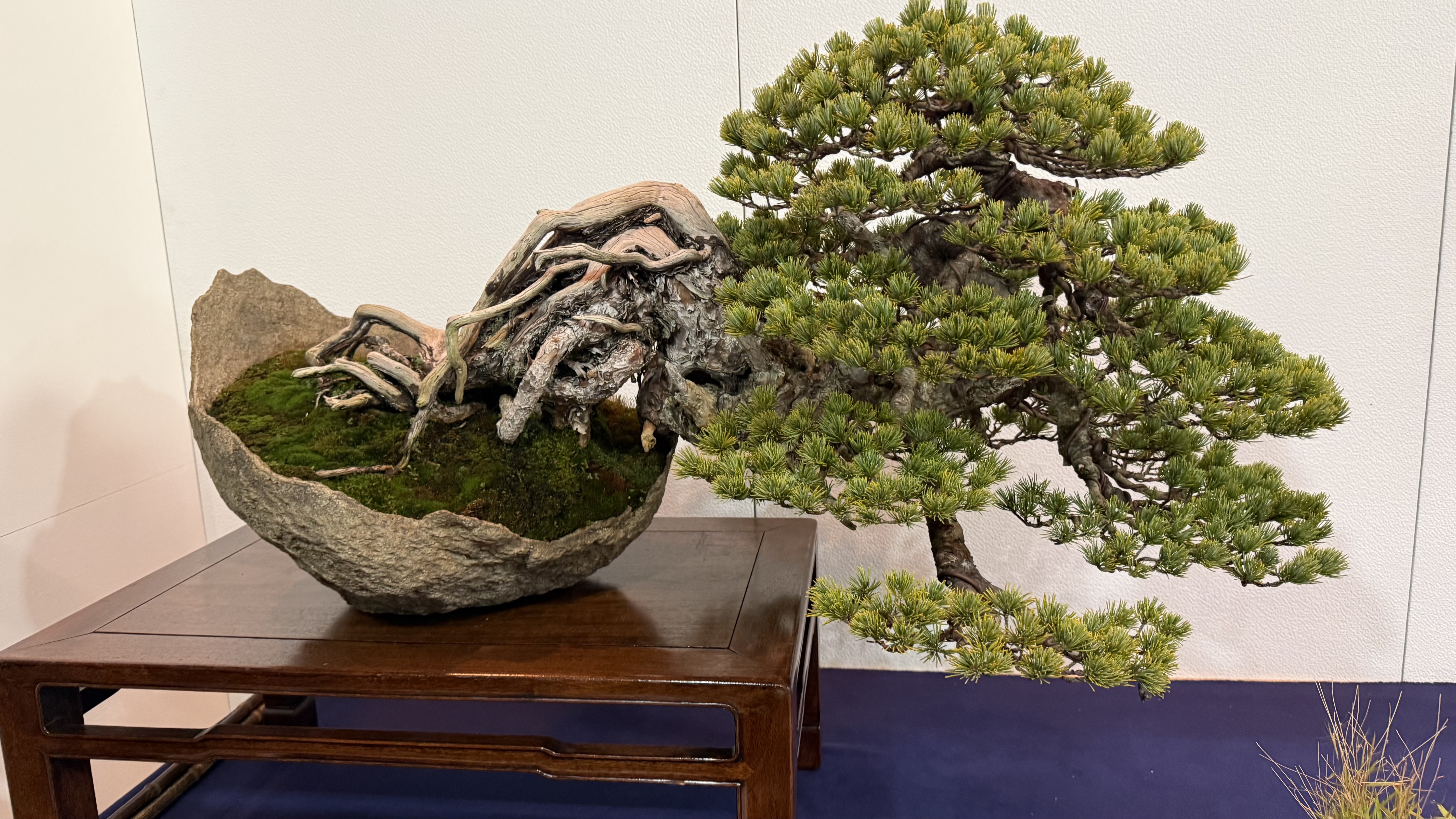
A bonsai carries this same logic in its trunk. Nearly every classical style gives the tree a clearly defined shomen (正面, "front") — the one angle from which it is meant to be viewed, chosen by the artist to show the trunk's best line and the roots' best spread. That front is simply the answer to where a viewer should stand; it makes no claim that both halves of the view will match.
In the moyogi (模様木, "informal upright") style, the most common form in bonsai, the trunk climbs in a series of alternating curves, never straight, never mirrored — each bend answering the one below it without repeating it, the way a sentence with real rhythm never falls into a metronome's beat. In kengai (懸崖, "cascade") style, the trunk abandons the vertical altogether and falls below the rim of the pot, pulled toward the ground as if by the memory of a cliffside gale, all of the tree's weight and motion committed to one side. Neither style offers a mirror — each gives the eye a line to follow, one curve implying the next, the whole form still visibly in motion even though the tree itself may be a century old.
The test, in a garden or a pot, is never whether the two halves match. It is whether an implied balance still presses against the imbalance from somewhere just out of frame — that pressure is what separates a form still arriving from one that has simply come apart. Katsura's shoreline, a length of cut chrysanthemum stem, the curve of a pine trunk: a tree, unlike a monument, is not something that is ever finished being alive.
For more on how a bonsai's form is read, see "How to Look at a Bonsai," "Bonsai Is Not a Small Tree," and "Bonsai Is Never Finished."
References
- Château de Versailles — Gardens and Groves — official description of André Le Nôtre's axial, geometrically symmetrical design of the Versailles gardens.
- Japan Travel (Japan National Tourism Organization) — Katsura Imperial Villa — official tourism board page describing Katsura's pond-centered stroll garden and its sequence of changing views.
- Presentation Zen — "7 Japanese Aesthetic Principles to Change Your Thinking" — overview of the seven Zen aesthetic principles identified by Shin'ichi Hisamatsu, including fukinsei (asymmetry).
- Wikisource — "Japanese Flower Arrangement," Chapter 4 — classical instructions for the ten-chi-jin (heaven-earth-man) structure in ikebana, specifying unequal stem lengths and asymmetrical placement.