— a landscape in a pot
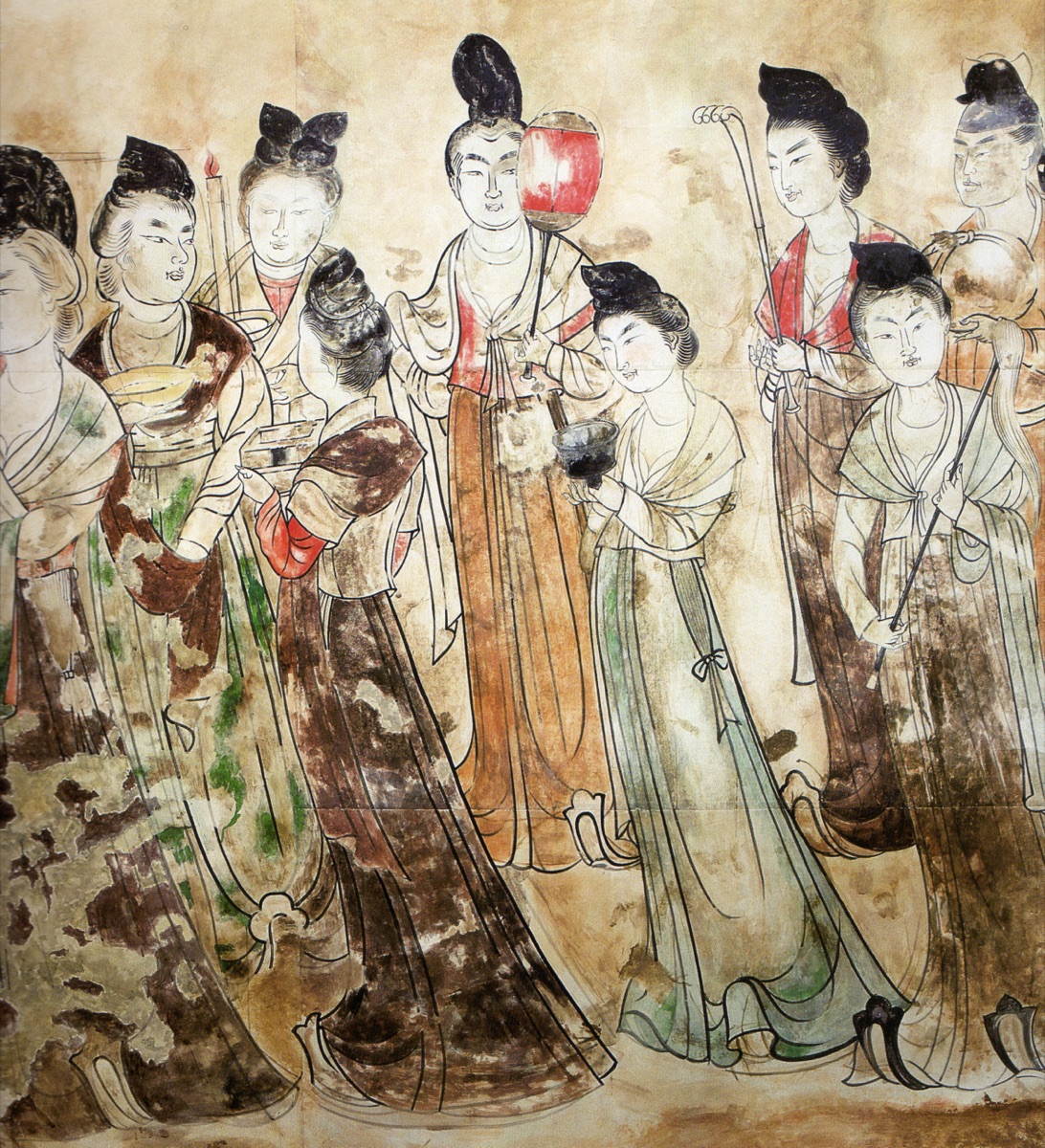
In 706 AD, inside a Tang-dynasty tomb near the Qianling Mausoleum in what is now Shaanxi, someone painted two court attendants carrying a potted plant across a wall meant to stay sealed for good. Whoever painted it could not have known it would end up cited, thirteen centuries later, as one of the earliest surviving images of potted-tree culture anywhere in the world. But the scene already gets one thing right that a lot of people still miss: the plant is not decoration in the background. It is being carried like it matters.
In our last letter we talked about jukei — the inherited vocabulary of bonsai shapes. This letter is about what those shapes are actually depicting, and what happens across a year and a day to keep them that way.
Most people's first read of a bonsai is a small tree. That's not wrong. It doesn't reach the center.
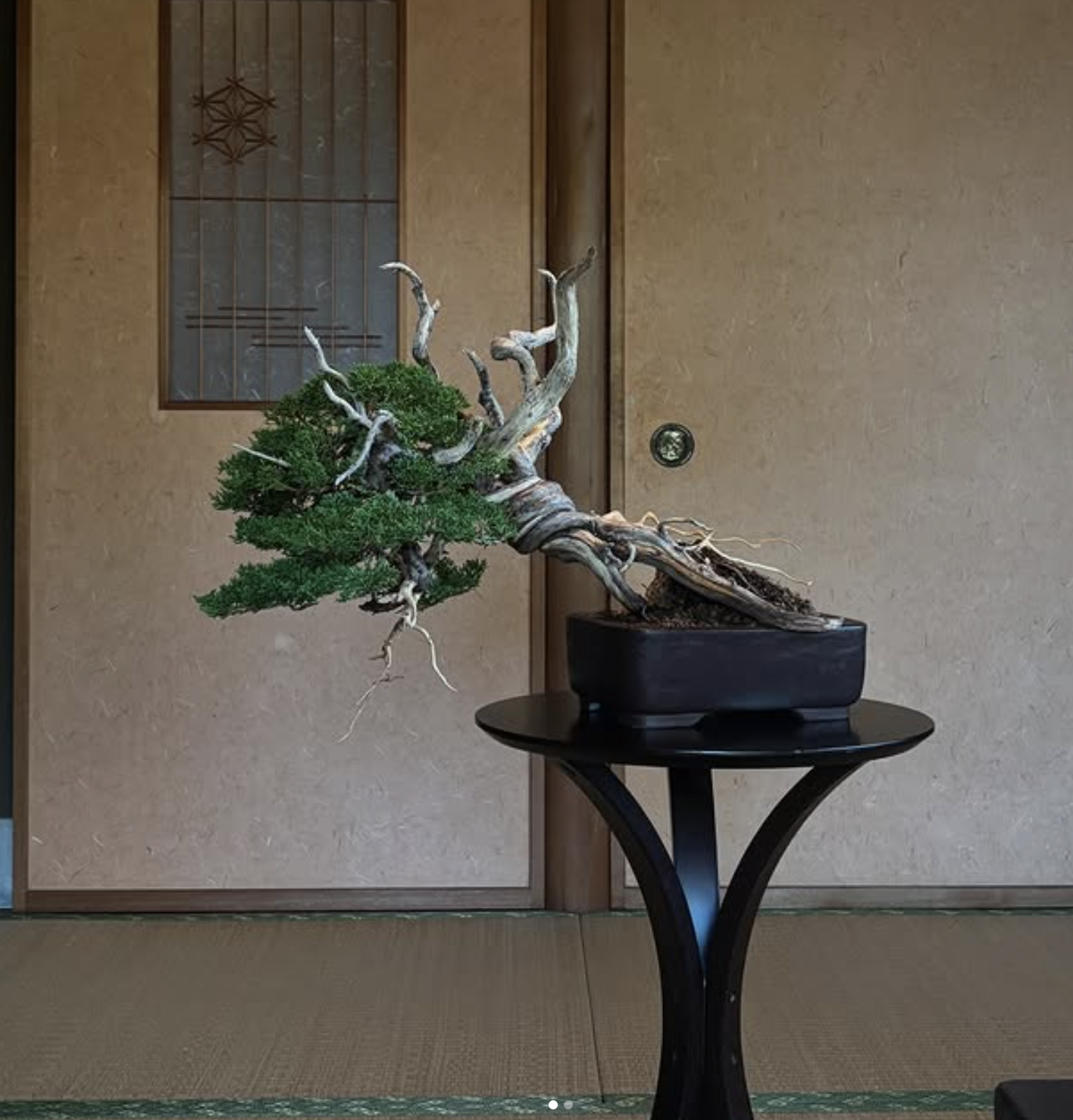
Bonsai paints a landscape inside a pot — using a single living tree as the whole canvas.
A tray held a landscape before it held a single tree
Bonsai begins in China, as penjing — the older art of arranging miniature landscapes on a tray. The Tang-dynasty mural above dates to that same world, within the dynasty's 618–907 reign, when a potted plant was already something formal enough to put on a tomb wall.
Penjing was never about a tree alone. The tray held tree, stone, moss, and sand together, compressing an entire landscape — the same impulse you find in Chinese landscape painting (shan shui).
This culture crossed into Japan roughly 800–1,200 years ago, between the Heian and Kamakura periods.
Japan kept carving away. The stones, the moss, the sand — gone. What remained was a single tree in a pot, and within its trunk and branches, the whole landscape was meant to be summoned.
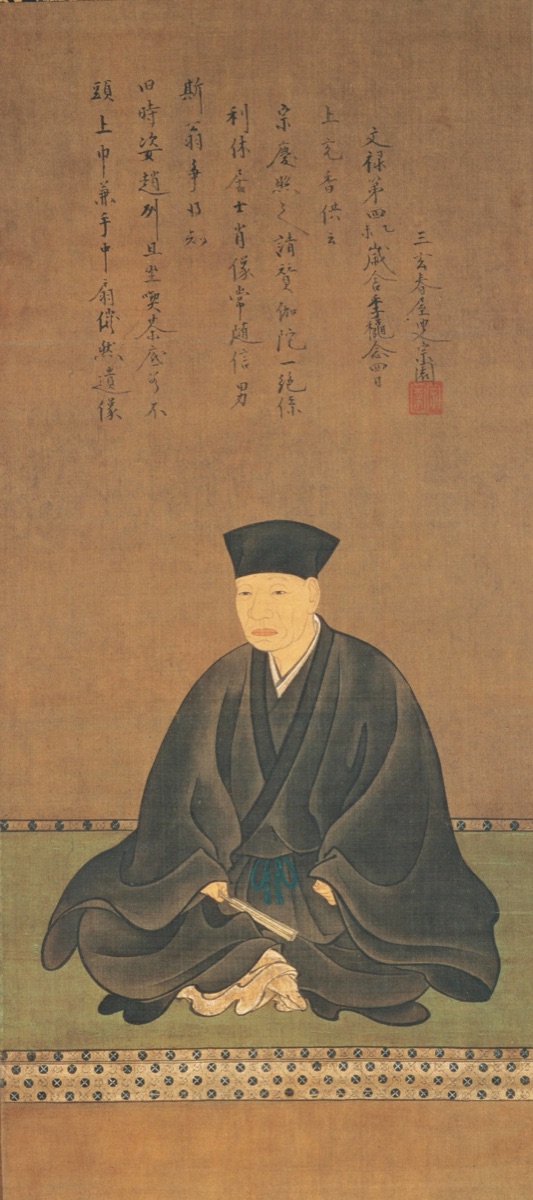
That carving-away is wabi-sabi at its root — the Japanese aesthetic built on subtraction, not addition: removing and removing until what remains can hold an entire world. About 450 years ago, the tea master Sen no Rikyu (1522–1591) shaped this same philosophy into the tea ceremony, where a single flower can suggest more than a hundred.
Japanese gardens have a technique called shakkei, or "borrowed scenery" — drawing a distant mountain or forest into the garden as part of its composition. Bonsai runs that technique backward. The mountain and the forest get pulled inward, into the pot in front of you, and rendered in a single tree.
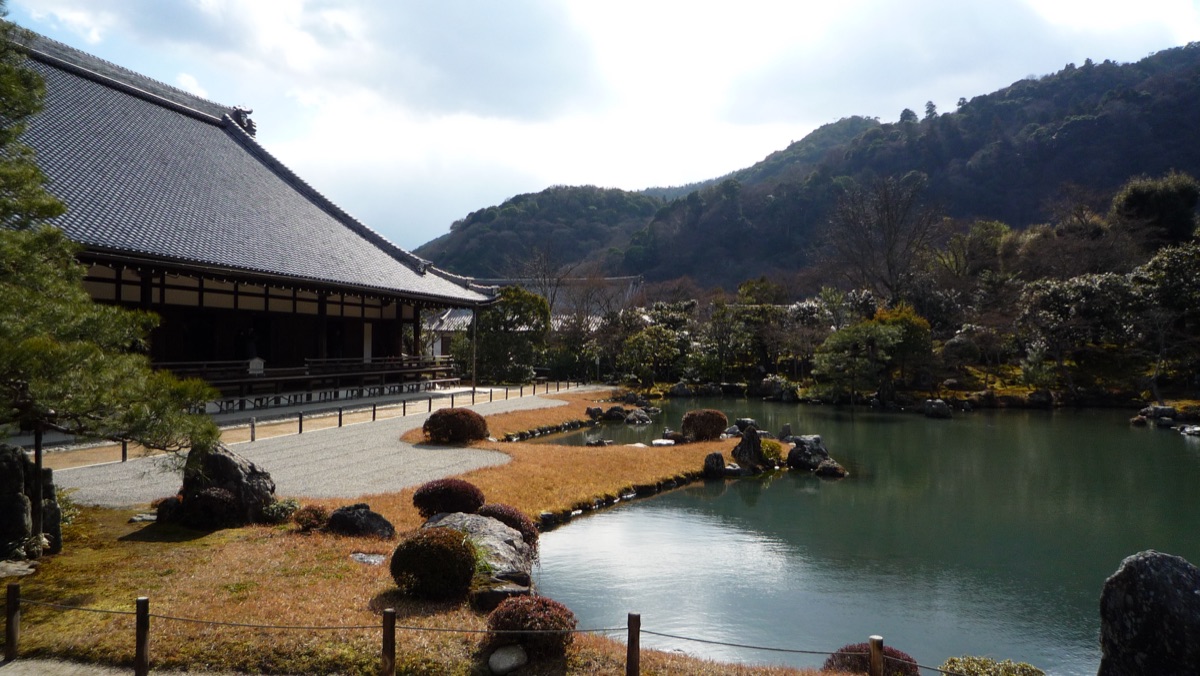
Bonsai is that inward pull, taken as far as it goes.
Yasunari Kawabata put this most precisely, on the largest stage available to him. He was the first Japanese writer to win the Nobel Prize in Literature, and on 12 December 1968, in his Nobel lecture "Japan, the Beautiful, and Myself" at the Swedish Academy in Stockholm, after describing the dry stone gardens of Japan, he continued:
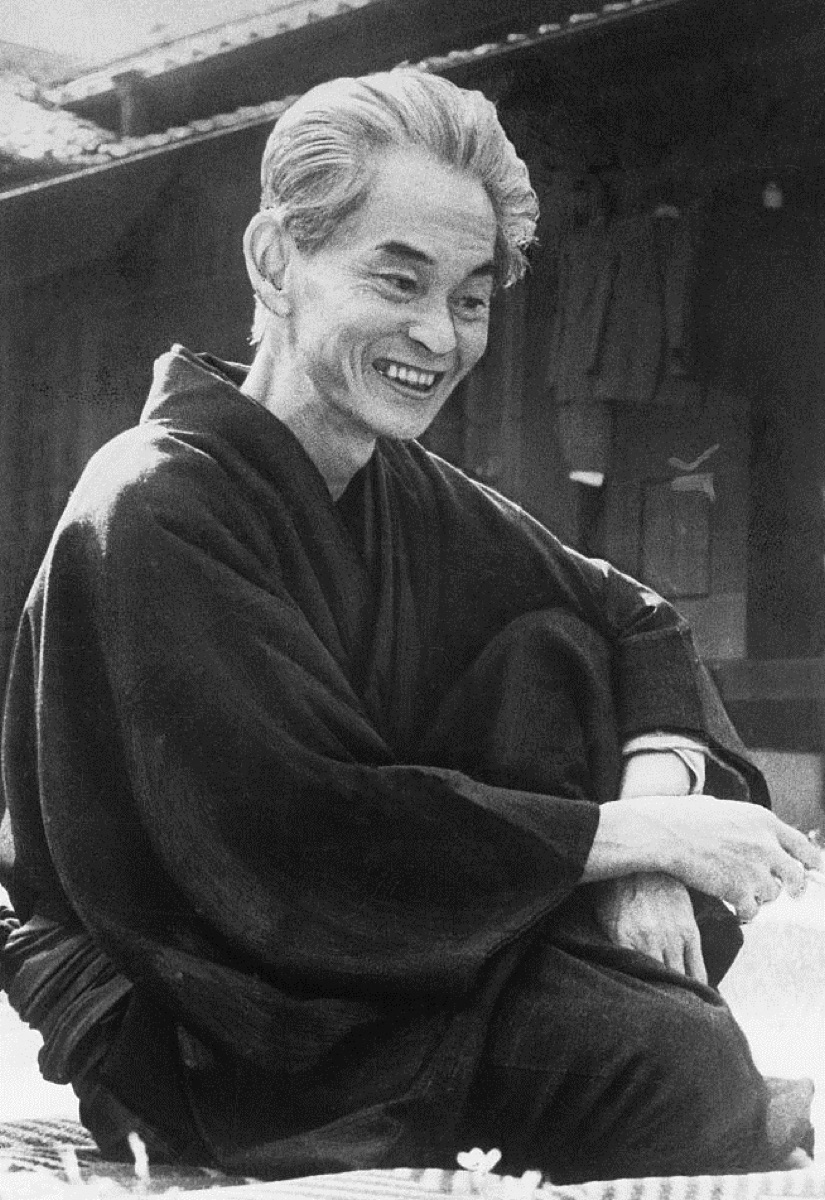
"The contraction, carried further, produces the bonsai dwarf garden and the bonseki miniature landscape on a tray."
— Yasunari Kawabata, Nobel Lecture, 1968 (trans. Edward G. Seidensticker)
The garden, compressed past its limit, becomes bonsai. Kawabata said its name out loud, to the world.
The artist paints a landscape you have to find
The artist always works on a tree in a pot while holding, in mind, a larger tree out in nature.
- A giant alone in a forest.
- A trunk leaned by coastal wind.
- A calm old tree beside a village.
- A trunk clinging to a cliff.
- A tree still standing under the weight of snow.
Reading the nature of the tree in front of them, the artist raises one of those landscapes inside the pot. That is the work.
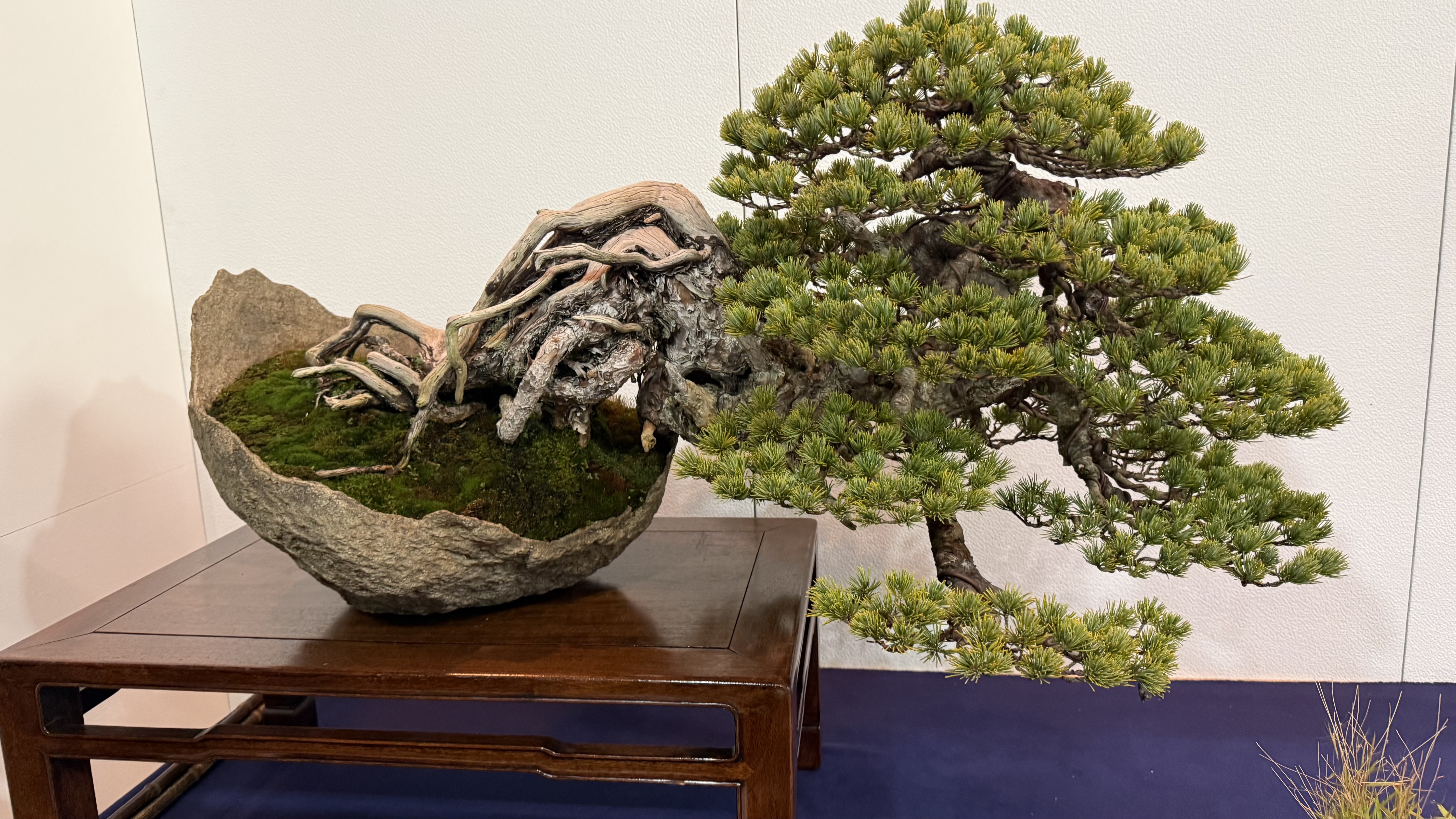
So a question is handed to whoever stands in front of the bonsai.
What landscape do you see in this single pot? Does your imagination reach the scene the artist meant to draw?
Three axes help you answer it.
Age. Has time entered the bark? Japanese black pine (Pinus thunbergii) and red pine (Pinus densiflora) build up plated layers; Japanese white pine, when grown long in a pot, develops a fine, scale-like skin. This is not a technique — only time can produce it.
Scale. Inside a tree only 30 cm tall, how many meters of tree can you see? Needle length, branch thickness, the taper of the trunk — every detail builds the illusion of a "great tree." This is also why black pine needles are kept under 2 cm through a summer technique called mekiri (decandling: cutting back the first flush of spring shoots so a finer second flush takes their place).
Landscape. Does the scene the artist held in mind reach the viewer? The direction of wind, the angle of a trunk clinging to rock, the posture of a tree looking down a valley. When the intended landscape and the viewer's imagination meet, the bonsai becomes itself.
At the very top of the art, bonsai carry a mei — a given name. Yoroi-kake no Matsu ("Armor-Hanging Pine"), Shikishima ("Isles of Japan"), Higurashi ("All Day Long"), Musashi-ga-Oka ("Musashi Hill"), and a 3,000-year-old shimpaku juniper called Hokusai — named for the ukiyo-e master Katsushika Hokusai. Some live in the Imperial Household Collection. These are to bonsai what the Mona Lisa is to painting: named, attributed, watched over across centuries. We'll write about mei in another letter.
The pot never grows; the judgment calls never stop
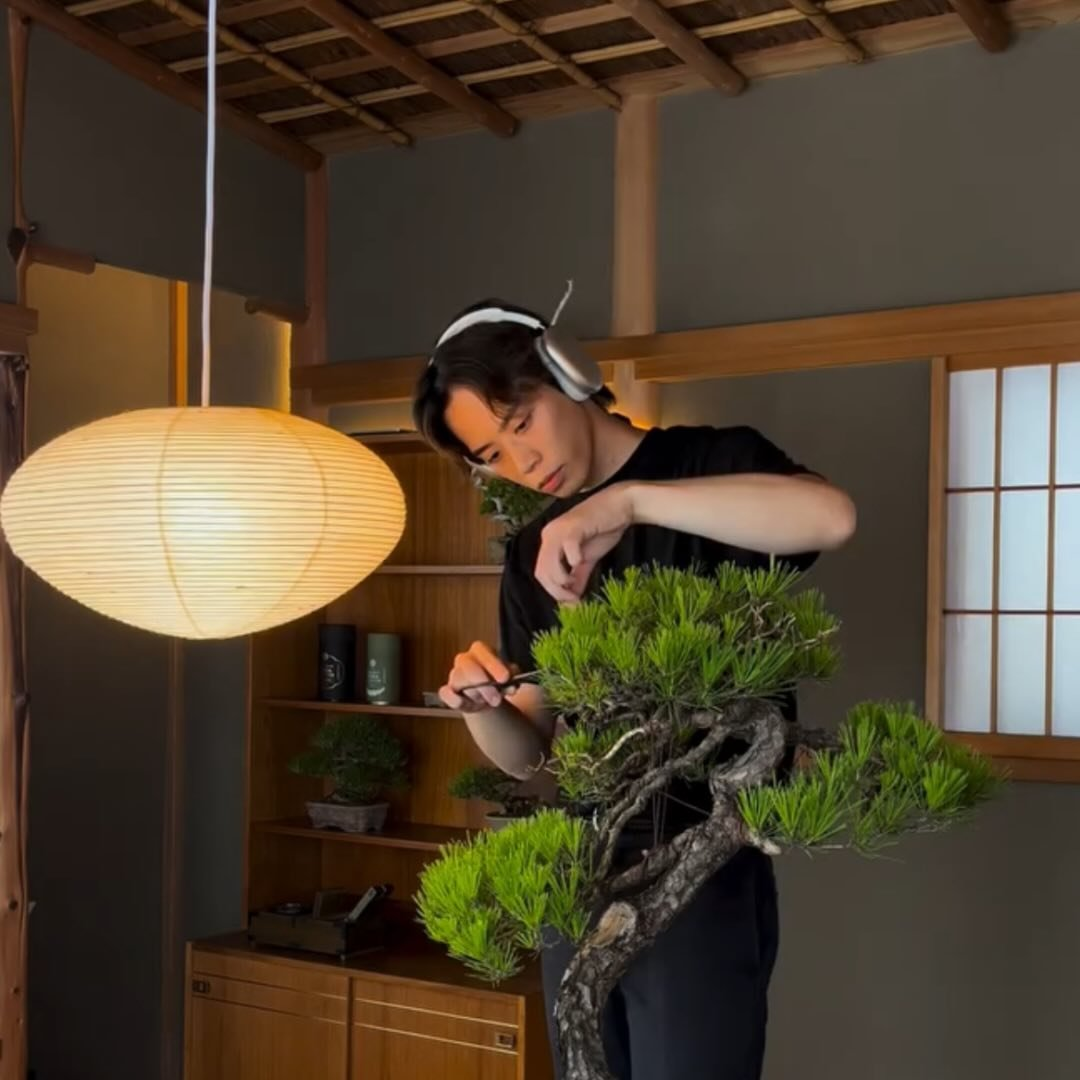
This is the part about daily work.
A tree wants to grow. Planted in the ground, it will reach several meters. Bonsai holds it at the pot's size — for decades, sometimes centuries. Keeping that size steady is the discipline: a great tree's landscape, held at the pot's scale, for as long as the tree lives. That is bonsai's structure.
To hold it there, the tree receives a human hand every day, and every year.
Water it. Cut a branch. Wire a curve. Reset the roots. Change the pot. And, sometimes, do nothing at all.
Each of these is a judgment about what the tree is doing. Get it wrong, and decades of landscape can collapse.
The next year's landscape gets decided months in advance
Azukari's current lineup centers on Japanese black pine (kuromatsu) and shimpaku juniper (Juniperus chinensis var. sargentii). Their year moves roughly like this.
- Spring (Mar–May) — Repotting, begin feeding. New shoots stir. Black pines get fresh soil and trimmed roots every 2–3 years, around April–May.
- Summer (Jun–Aug) — Mekiri (decandling), water 2–3× daily. In late June–July, the first shoots are cut so a finer second flush takes their place. Scale is decided here.
- Autumn (Sep–Nov) — Pruning & wiring, resume feeding. Drop the leggy, crossing, and surplus branches; set the angles. Build the tree's reserves before winter.
- Winter (Dec–Feb) — Observation, light watering. Once every two or three days, just enough to dampen the topsoil. The quietest season — where next year's landscape is decided.
Different species, different calendars. Shimpaku junipers keep extending shoots into autumn, so they need more frequent pinching. Maples and fruit-bearing species need their own care.
Every morning, the one making these judgments is Saeki.
Behind the single landscape you see in one glance: every day's watering, every season's judgment, and centuries layered behind both.
Bonsai is not a small tree.
It is the work of painting a large landscape inside a pot, and keeping that landscape alive across long time.