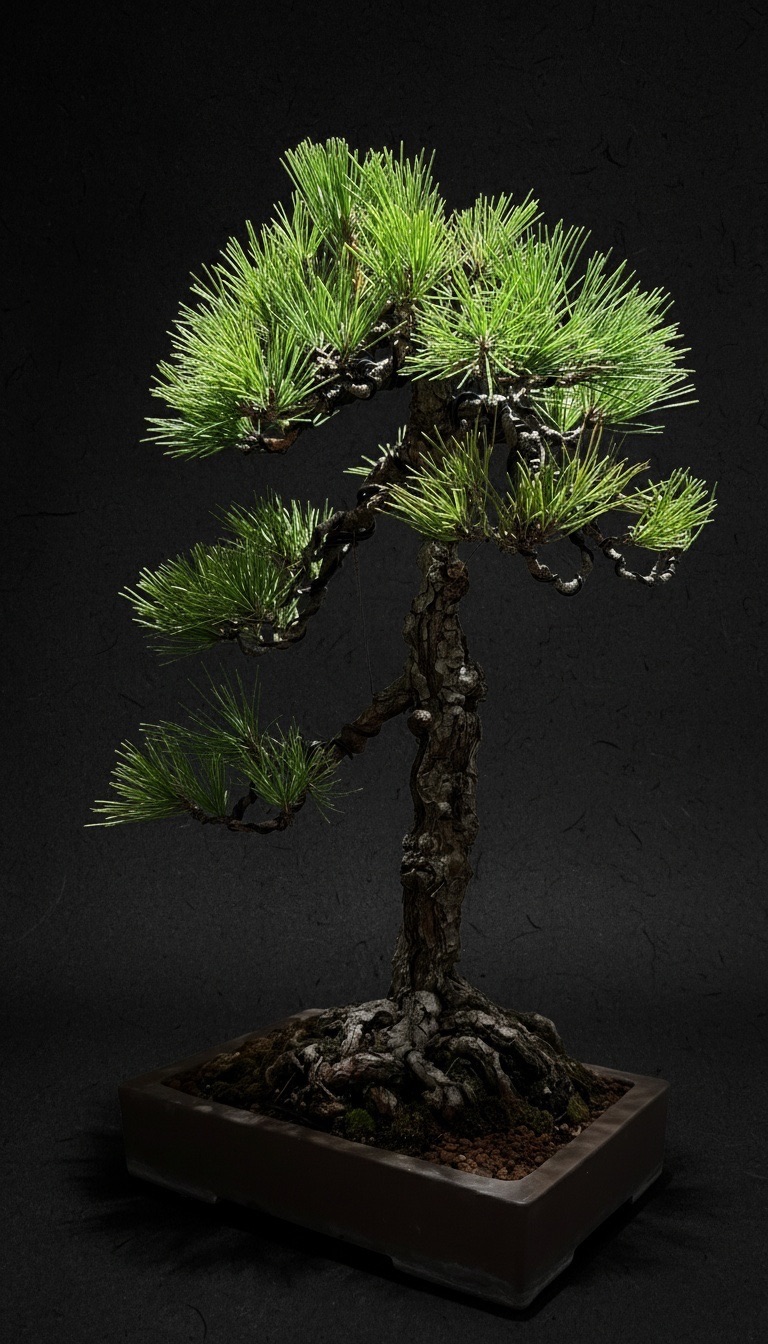
One December, reading Kunio Kobayashi's book Bonsai mo Hito mo Kareru Kara Omoshiroi (盆栽も人も枯れるから面白い, "bonsai and people are both more interesting for withering"), I ran across a term I had never needed before: keido (景道, "the way of display") — the discipline of the scroll, the stand, the companion planting, the empty space left around a tree. I called Shunkaen, the Tokyo garden where Kobayashi teaches it, the next day. I have gone as an enrolled student since the New Year that followed, into a garden holding more than a thousand trees.
First you obey the form completely. Only then can you break it. Only then can you leave it — and even then, you are asked never to forget where it came from.
That is shu-ha-ri (守破離), and Shunkaen runs on it as plainly as any dojo, even if the students rarely say the word out loud. The phrase is usually traced to a poem attributed to Sen no Rikyu, the sixteenth-century tea master, collected among the verses known as the Rikyu Doka (利休道歌, "Rikyu's teaching poems"): kiku saho, mamori tsukushite yaburu tomo, hanaruru totemo moto o wasuru na — "rules and forms: obey them completely, and even if you break them, even if you leave them, never forget where they came from." The idea did not stay inside the tea room. It moved into martial arts, into Noh theatre, into calligraphy, and into workshops like the one I am learning in now, because it describes something true about learning in general, not just about any one discipline.
Shu is obedience you are not yet allowed to question
Shu (守, "protect" or "obey") is the opening stage, and what it demands is severe: complete obedience to one form, under one teacher, with no editing allowed.
Nobody in shu yet knows which part of the form is essential and which is simply how this particular teacher happens to do it. That is the whole point of the stage. The form gets followed in full, odd corners included, because the student is not yet positioned to tell the difference. Only repetition — the same motion, performed enough times that the hands stop needing instruction — eventually reveals why the form is built the way it is: why this hand turns here and not there, why one step has to precede another. A beginner who starts editing the form early is not saving time — they are guaranteeing that they will never find out what the form was for.
Ha only opens once shu is finished, not beside it
Ha (破, "break") does not run alongside shu. It starts only once shu is done. Having taken in one form completely, a practitioner can finally set it against others — a different teacher's line, a rival school's habits — and begin testing where their own version might improve. This is where real variation enters the picture. But it is only open to someone whose form is already solid enough to tell an improvement from a mere difference.
This is the point most first-time readers of shu-ha-ri get backwards: they treat "follow the rules" and "break the rules" as two options to weigh against each other, when the two are stages in one sequence, and ha stays closed to anyone who has not been through shu. Breaking a form you never fully held does not count as invention — it only shows the form was never learned. Only mamori tsukushite, obeying a form completely, buys the standing to break it. That is also a working test for anyone claiming to be an innovator, in bonsai or elsewhere: did they finish out an apprenticeship under one teacher before they started to vary it, or did they jump to their own version the moment someone else's rules started to chafe?
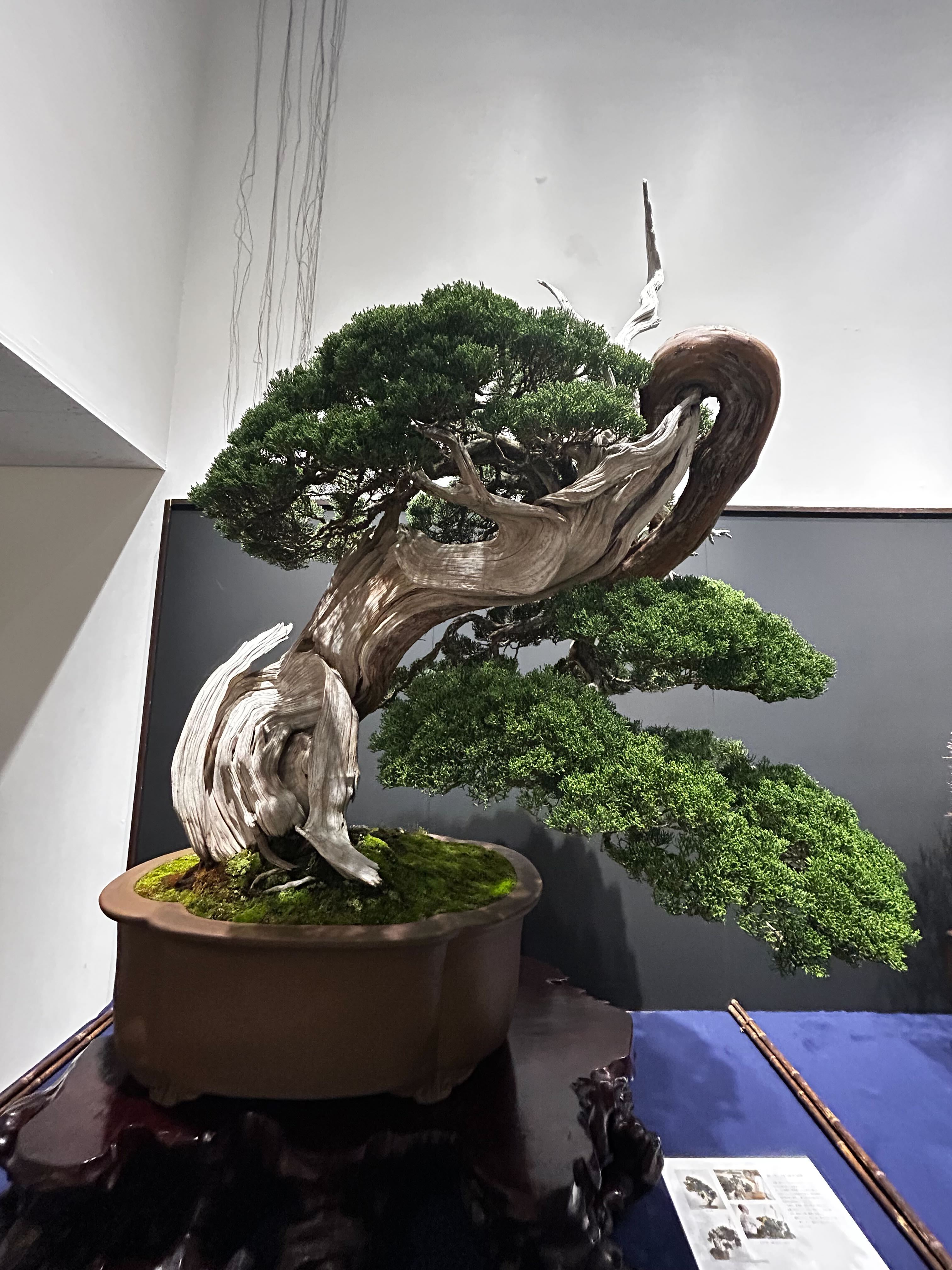
A shimpaku juniper shaped over decades. Its jin and shari — the weathered deadwood running through the living trunk — could not have been reached by skipping the discipline of a simpler, more formal shape first.
Ri looks like freedom but is built entirely from the form
Ri (離, "leave" or "separate") is the last stage, and the one most often misread as "now anything goes."
The poem does not say that. It says hanaruru totemo, moto o wasuru na — even in leaving, do not forget the root. Ri is not a license to drop the form. It is what happens once the form has been absorbed so deeply it no longer needs consulting — it simply moves, in the hand or the brush or the branch, without being thought through. Someone in ri can look like they are improvising freely, and in a narrow sense they are. But that freedom is made entirely of the form they spent years obeying and then testing. Strip out shu and ha, and ri has nothing left to stand on — only a performance of freedom, missing the structure that made the real thing worth watching.
Which is why the poem's closing line carries the whole teaching, not just a footnote to it: a foundation learned so thoroughly that a practitioner can move past its letter and never once lose its spirit.
The same order runs through every apprenticeship
Careers in Japanese craft are still built around this same three-stage path, and its clearest living form is deshi-iri (弟子入り, literally "entering as a disciple" — the traditional apprenticeship system found in crafts, cooking, and the arts).
A deshi moves into a master's workshop, sometimes into the household itself, and starts on the plainest work there is: sweeping, cleaning tools, watching. Instruction stays sparse for years, on purpose — the apprentice is expected to pick the craft up through proximity and repetition, not explanation. That is shu at its most unadorned: total submission to one master's way, for long enough that the apprentice stops asking why.
A bonsai apprentice trains the same way. Years go by under one teacher's eye, learning to read a trunk, wire a branch, judge how much water a tree needs, exactly the way that teacher does it — with no room yet to disagree. Only later, often after formal independence, does a bonsai artist start visiting other gardens, studying other stylists' work, testing variations against a discipline already carried in the hands. That testing is ha. And only the artists whose feel for a tree's line has gone from rule-following to instinctive — who have reached ri — go on to shape trees that get called distinctive, individual, their own. Ask even one of them where the eye came from, and the answer runs back decades, to a teacher's workshop where they were not yet allowed an opinion.
Shu-ha-ri names a discipline's internal shape — how a form gets built to be learnable in the first place, and why it is worth obeying before it is worth questioning. For the form itself, see our companion piece on kata, the trained shape a practitioner obeys through shu and still carries at ri.
Naming your own stage is harder than learning the three
My own position in this is easy to state: in keido, at Shunkaen, I am still inside shu, an enrolled student of a form I am in no position yet to argue with. Staying there is how ha and ri eventually become possible for me — not instead of shu, but only after it.
Azukari runs on the same order, on the artist's side. The trees under an artist's care are shaped by people who have walked considerably further down this path than I have: years of shu under a teacher, seasons of ha testing what they learned, and, for some, a hand that has reached ri. A tree's record reflects that path as much as it reflects the tree. For a closer look at what that trained hand is shaping toward, see our piece on the artist's craft, and on why that shaping never really ends.
References
- Shuhari — Wikipedia (English) — overview of the concept's attribution to Sen no Rikyu's Rikyu Doka, its later spread into martial arts including Aikido, and the three-stage structure.
- 守破離 — Wikipedia (Japanese) — cites the original poem "規矩作法 守り尽くして破るとも離るるとても本を忘るな" and explains each of the three stages in detail.
- JAPAN HOUSE Los Angeles — "Deshi and the Art of Apprenticeship" — on the traditional deshi apprenticeship system in Japanese crafts, its stages, and the path to independence, discussed with bamboo artist Tanabe Chikuunsai IV.