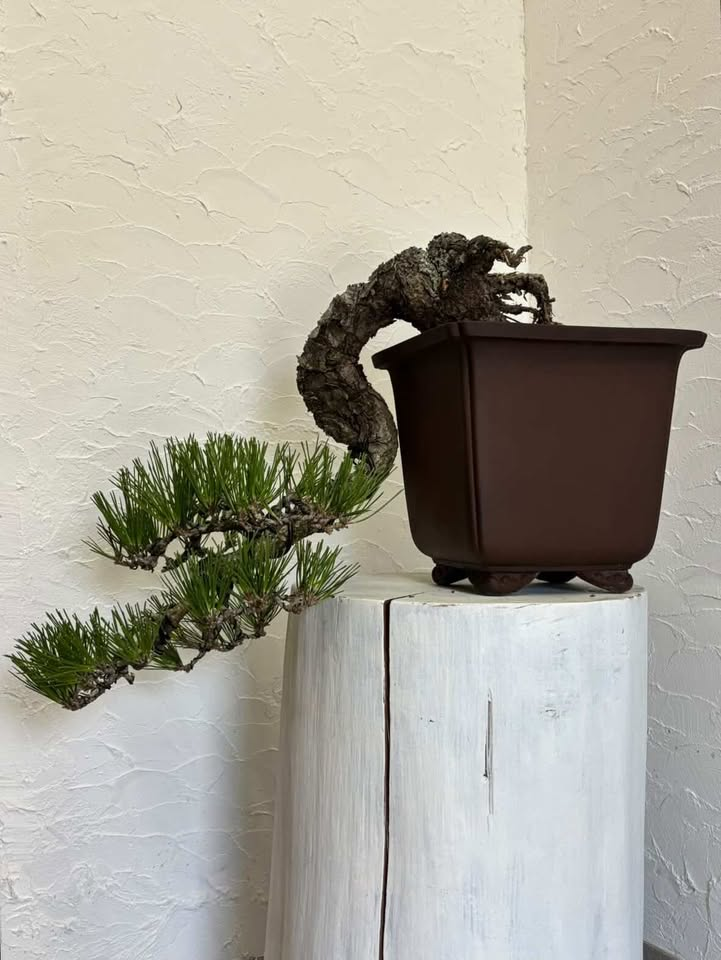
Japanese black pine, kengai, cascade / Photo: Azukari
Every bonsai trunk answers the same quiet question — which way is up — and nearly every named form in the vocabulary covered in our overview of bonsai's basic tree forms answers it the ordinary way, whatever curve or lean it takes along the way. Kengai (懸崖, "cascade") answers it differently. The trunk rises for a short stretch, reverses, and spends the rest of its cultivated life growing down and out — past the rim of its pot, and often past the table or stand it sits on.
Kengai trains a trunk to fall rather than rise, recreating the shape of a tree that lost its footing on a cliff and kept growing anyway — and the resulting imbalance is deliberately difficult to hold, in the pot and in the eye.
A trunk built to fall
The style splits into two degrees. In a full kengai, the trunk's lowest point, and often its apex, drops below the base of the pot, so the tree reads as a single downward gesture when seen from the side. In the gentler han-kengai (半懸崖, "semi-cascade"), the trunk bends down to roughly the level of the pot's rim or base but no further — dramatic, but still contained within the silhouette of the container. Both share the same grammar: the trunk climbs briefly from the nebari (根張り, "surface roots"), then commits downward, with side branches left to reach horizontally or slightly upward along the fall so the line does not read as a single collapsed stroke.
Copied from a cliff, not invented at a bench
The form is not a stylistic invention so much as a transcription. Growers describe kengai as modeled on trees that cling to a rock face or hang out over a riverbank — trunks pushed downward early in life by snow load, a falling neighbor, or an eroding foothold, then turning back toward the light once the worst of the pressure has passed. That two-part motion, forced down and then recovering, is what a kengai bonsai is built to preserve in miniature: not simply a tree hanging over an edge, but a tree that was made to hang over an edge by something larger than itself and adapted to keep growing regardless.
The weight problem
A kengai is harder to keep upright — literally — than its calmer relatives. The trunk's own habit is to grow toward light, which in a cascade means growing back up and out of the shape the artist is training it toward; holding the downward bend generally asks for a heavier gauge of wire and more frequent checking than a moyogi or a chokkan of the same size. The container has to cooperate too: growers generally reject the shallow, wide pots suited to upright styles in favor of tall, deep containers — drum pots, cylinders, tall hexagonal forms — that can visually anchor a trunk falling away from them, and the whole planting is usually raised on a stand or set at a table's edge so the cascade has room to fall and can actually be seen rather than disappearing against the floor. Left alone, a trunk trained entirely downward reads as lifeless; part of the discipline is leaving enough upward-reaching branches along the fall to keep the eye moving both ways at once.
Species that take the bend
Junipers are named again and again as suited to the style, prized for wood pliant enough to hold a tight downward curve without splitting, alongside wisteria, weeping cultivars of Japanese maple, cotoneaster, and flowering cherry — species already inclined, in the wild, toward a hanging or trailing habit. Fuji (藤, "wisteria") trained in cascade carries the form a step further, since its own cascading flower clusters echo the line of the trunk beneath them, a pairing we look at in our piece on wisteria in cascade. Pines, including the kuromatsu (黒松, "Japanese black pine") shown above, are also trained into kengai, though the bend runs against a stiffer, more upright habit than a juniper's, and generally takes longer to set.
A style built to surprise
Where a chokkan's discipline reads as calm and a moyogi's curve reads as natural ease, a kengai is built to unsettle, just slightly, the moment it is seen — a trunk that appears to be falling out of its own container. That is part of why the style is shown raised, on a stand tall enough to let the lowest branch clear the tabletop with room to spare: the drama depends on the viewer being able to see the full drop, cliff-face and all, rather than a trunk simply resting on a shelf.
Closing
A kengai never fully resolves into a finished, settled shape the way a chokkan eventually can. Its whole form is an ongoing argument with the direction the tree would rather grow, and that argument does not end when the wire comes off — a season of unchecked growth is usually enough to let the trunk begin drifting back upward. Keeping a cascade in its trained shape asks for the same seasonal attention, year after year, that keeps any bonsai alive, only with less room for a missed season to go unnoticed. Azukari keeps that attention in the hands of an artist in Japan through exactly this kind of tree, with the owner's record joining the same seasons the trunk is still, quietly, being held against its own instinct to climb back up.
References
- Bonsai Society of Greater Cincinnati — Cascade "Kengai" — the cascade style's inspiration in cliff- and mountainside-growing trees, the trunk bending below the level of the pot, and the wiring, pruning, and potting needed to keep the form balanced.
- Bonsai Today — Kengai, Cascade Style — the style's roots in trees on a rock face pushed downward by snow and wind before turning back upward, and the core rule that foliage grows below the level of the pot.
- Root & Bonsai — Cascade Style Guide — pot depth and stand-height requirements for displaying a cascade, species suited to the style including junipers, wisteria, and weeping maple, and the need for upward-reaching branches to avoid a lifeless silhouette.
- Bonsai Empire — Bonsai Styles — the distinction between full cascade (kengai) and semi-cascade (han-kengai), including the rule that a semi-cascade trunk never grows below the base of the pot.