
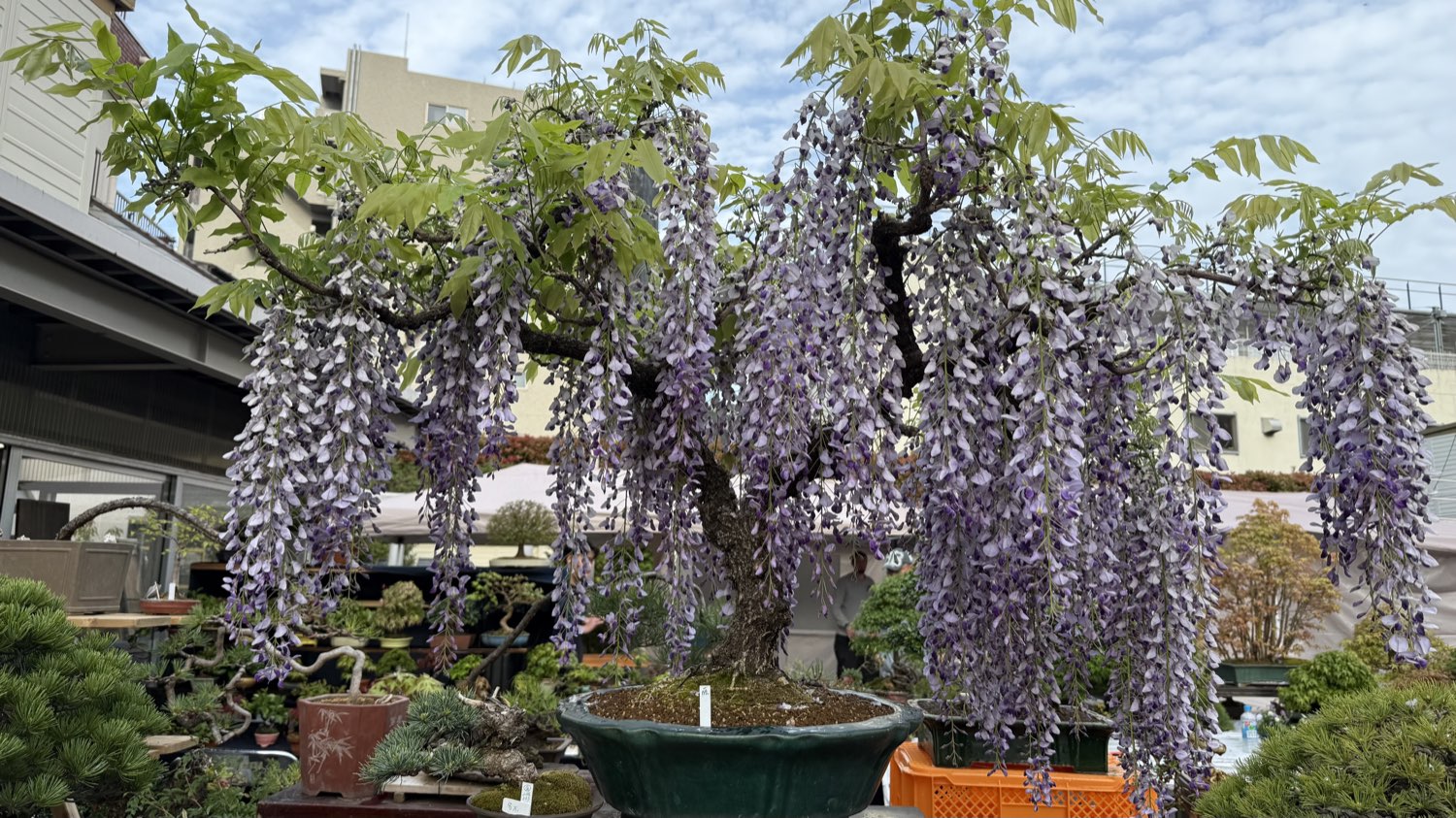
A wisteria bonsai spends most of the year as an unremarkable tangle of vine and leaf, and then, for a few weeks in spring, lets down flower clusters that hang like water — which is exactly the gesture the cascade style exists to hold.
Fuji (藤, "wisteria") is a climbing, twining vine before it is anything else. Left alone it will run up and over whatever it can reach, thickening year by year into the kind of woody, muscular growth more often associated with an old tree than a garden climber. Trained as bonsai, that vigor has to be argued with constantly — wired, cut back, restrained — so that what a viewer eventually sees is not the plant's own preference for climbing, but a chosen shape: usually a downward one.
Flower clusters that fall like water
The wisteria raceme, the pendant cluster of pea-family flowers, is the reason the species is grown at all. In Wisteria floribunda, the Japanese wisteria most commonly trained as bonsai in Japan, a raceme opens from its base downward over roughly one to two weeks rather than all at once, so a single cluster is still lengthening into full bloom even as its top flowers have already faded — a slow, cascading unfurl rather than a single event. Selected long-raceme cultivars have been reported at extraordinary lengths in the open garden, with one cultivar known as Kyushaku Fuji (九尺藤, "nine-shaku wisteria," referring to a traditional unit of roughly thirty centimeters) recorded at close to two meters. A bonsai's clusters will never approach that scale, but the same downward, lengthening habit is what a grower is working to display in miniature: not a flower held up for inspection, but one still visibly falling.
Why the cascade style suits it
Most bonsai styles ask a species to do something a little unnatural — a maple pruned into the discipline of a formal upright, a pine calmed into stillness. Wisteria trained in kengai, the cascade style, is closer to an agreement than a correction. The vine already wants to hang; the style's whole grammar — a trunk that climbs briefly before committing downward, past the rim of the pot and often past the stand beneath it — was shaped for growth habits like this one. What a kengai wisteria adds is a second cascade layered over the first: the trunk falls, and from the trunk the flower clusters fall again, so the two motions read together as a single downward gesture rather than a plant hung with ornaments. Growers generally still favor a tall, deep pot to anchor the visual weight of the fall, and the trunk itself needs a heavier gauge of wire and steadier attention than the flowers alone might suggest, since a vine this vigorous will happily climb back out of its trained shape within a season if left unchecked.
The discipline behind the display
A wisteria bonsai flowers only when it is persuaded to, and persuasion here runs against the plant's own chemistry. Wisteria fixes nitrogen from the air through bacteria living in its roots, so even a grower who withholds nitrogen-rich fertilizer entirely is still, in effect, feeding the vine's appetite for leaf and stem over flower. Growers manage this by favoring low-nitrogen, phosphorus-leaning feed, by keeping the plant somewhat pot-bound rather than repotting it into generous new soil, and by cutting new shoots back hard after flowering — typically to two or three leaves — so the plant's energy is redirected into next year's flower buds rather than this year's climbing growth. None of this happens quickly. A wisteria trained from a young cutting is commonly said to need something like five to ten years of this restraint before it blooms with any reliability, which means the tree a grower is shaping in a given spring is, more often than not, being shaped for a bloom several years still to come.
A tree kept mostly out of sight
For the other eleven months of the year, a flowering wisteria bonsai is, frankly, plain — a woody, twining shape with unremarkable pinnate leaves, worth a grower's daily attention but not a display shelf. It earns its place there for a matter of weeks each spring, when the racemes open, and the practice among growers has long been to bring a flowering tree forward only for that window and return it afterward to the working rows where the rest of the collection is grown on. That restraint is itself part of what makes the display work: a bonsai kept in bloom-ready condition all year would defeat the point, since the brevity of the display is what gives the moment its weight. It is a smaller version of a pattern found across Japanese gardens at large — the wisteria trellises at shrines and parks that draw crowds for a single month and then simply become green shade for the rest of the year — compressed here into a single pot, watched over by one grower rather than a public.
Closing
A wisteria bonsai asks a grower to spend most of a year in preparation for something that will not last long once it arrives, and to do that preparation again the following year regardless. Azukari exists for trees kept on exactly that kind of unhurried schedule — cared for through the quiet months by an artist in Japan, with an owner's record joining a timeline built, deliberately, around a bloom that was never meant to stay.
For more on the style built to carry a wisteria's cascading habit, see "Kengai: The Cascade," and for wisteria's place among Japan's other flowering species, see "What Is Flower Bonsai?" On the seasonal attention flowering bonsai demand more broadly, see our piece on watering.
References
- Wisteria floribunda — Wikipedia — Japanese wisteria's native range in Japan, its clockwise-twining climbing habit, raceme lengths reaching up to 2 m (7 ft) in select cultivars, and its early- to mid-spring flowering season.
- Bonsai Empire — Wisteria Bonsai Care Guide — pruning timing (hard pruning in early spring or after flowering, cutting new shoots back to two or three leaves), the risk of excess nitrogen suppressing bloom because wisteria fixes its own nitrogen, and the note that wisteria bonsai flower better when kept somewhat root-bound.
- Bonsai Mirai — Wisteria Bonsai — flowering promotion through phosphorus-leaning fertilization and reduced nitrogen, repotting every two to three years before bud swell, and the observation that mature trees around seven to ten years old bloom more consistently.
- Ashikaga Flower Park — The Great Wisteria Festival — the seasonal, weeks-long nature of wisteria's peak bloom at one of Japan's best-known wisteria gardens.
- Root & Bonsai — Cascade Style Guide — wisteria's suitability for cascade-style training and the pot depth and stand-height conventions used to display cascade bonsai.