
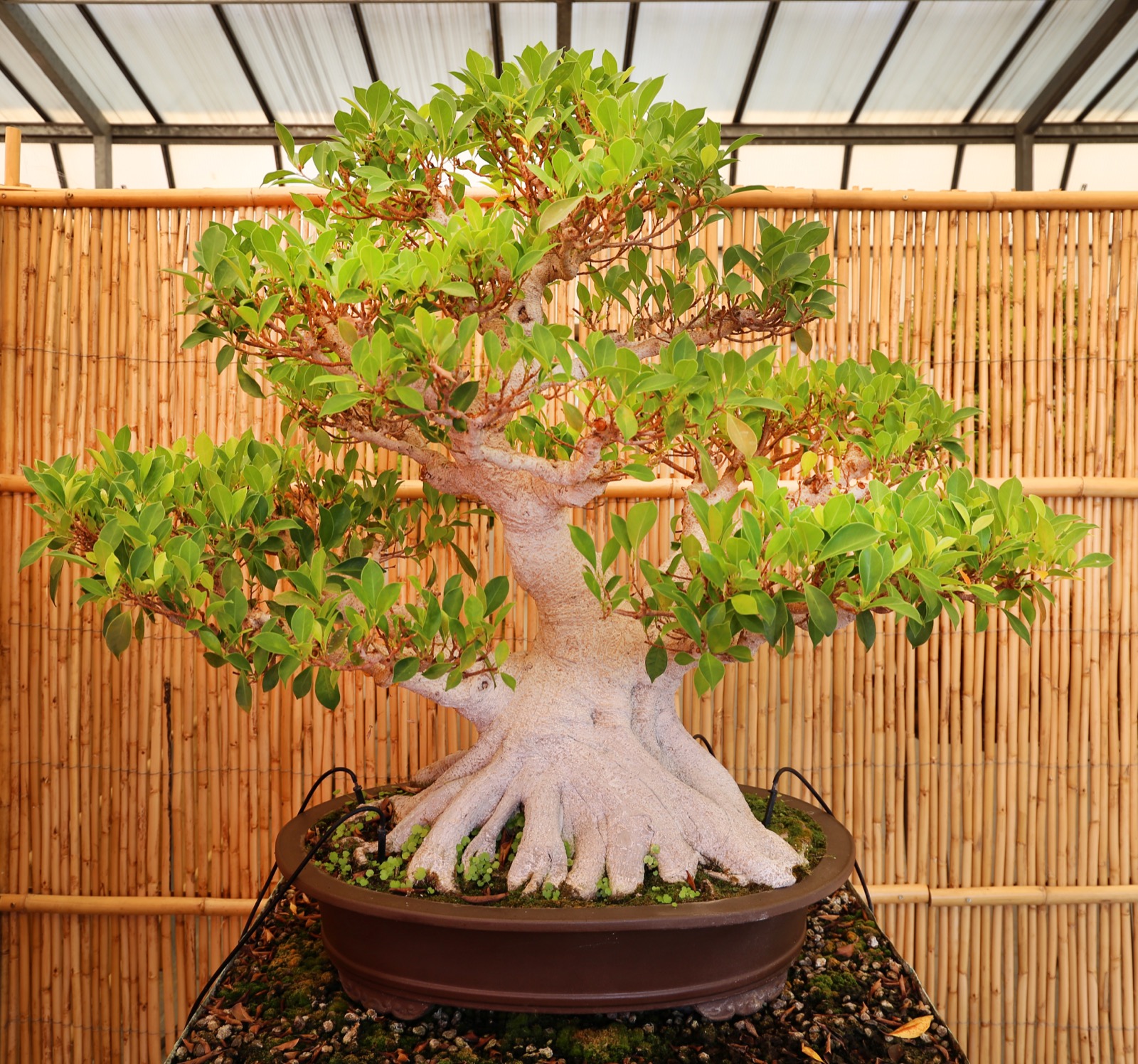
Ficus retusa, informal upright, roughly 50 years old, Bonsai Museum, Pescia, Italy. Its roots radiate from the trunk in nearly every direction. / Photo by Sailko, CC BY-SA 4.0, via Wikimedia Commons — Source

The ficus above is about fifty years old, and most of what a viewer needs to know about that age is sitting in plain sight at its base. The trunk leans in a gentle, informal-upright curve — pleasant enough, but not unusual for the style. What is unusual is the base: roots radiate outward from the trunk in nearly every direction, gripping the rim of the pot the way the buttress roots of a full-sized tree spread across open ground. That spread has a name — nebari (根張り, "root spread") — and it is one of the few places in a bonsai's design where years cannot be shortcut.
A bonsai's roots are the one part of its age that can be read without cutting anything open.
Nebari Fights a Seedling's Instinct to Root Straight Down
A young nursery tree usually sends one or two thick roots straight down, the way most seedlings do, with only thin lateral roots hidden beneath the soil surface. Nebari is what a grower spends years building against that habit — persuading the tree to push its roots sideways instead of down, until they rise, thicken, and finally sit visible on top of the soil. Growers speak of an ideal called happo-nebari (八方根張り, "eight-direction root spread"): a base ringed evenly by roots on every side, so the trunk appears to stand in the pot rather than merely rest in it.
Building Nebari Takes Five to Ten Years of Repeated Repotting
Nebari has to be built. It does not appear just by letting a tree grow on its own. At each repotting, the grower cuts back the thick roots reaching straight down and leaves the shallow, sideways-growing roots in place; given nowhere to go but out, those lateral roots thicken a little more each time. Some growers train young material over a flat tile or in a shallow tray for the same reason — with no room to travel downward, the roots have only one direction left. Others use a tourniquet: a wire wound tightly around the base of the trunk in early spring, which partly blocks the flow of nutrients and forces the tree to push new roots out just above the wire, closer to the surface. Where a trunk lacks a root on one side entirely, a specialist can approach-graft a young seedling's own stem into the gap; over a year or two the graft fuses, and what began as a separate young tree finishes its working life as one more root of the older one, with any of the scion's own shoots pruned away as it settles in. None of this moves quickly. Growers commonly describe a presentable nebari as needing something like five to ten years of repeated repotting to form, and considerably longer for the widest, most dramatic spreads.
A Wide Nebari Does Real Structural Work, Not Just Decoration
A wide, even nebari earns its place on the tree physically, not only visually: it is what keeps a heavy, wind-caught trunk from rocking loose in a shallow pot the way a single taproot never could. In the kengai (懸崖, "cascade") style, where the trunk falls below the rim of the pot, the roots on the side opposite the fall matter especially, holding the whole composition level against a shape that would otherwise look ready to topple. A nebari that grips unevenly — thick on one side, thin on the other — unsettles the eye before a viewer even works out why. Seen this way, nebari works as evidence at the base of the tree: visible proof that the trunk's lean, its taper, its whole posture, is earned rather than staged.
The Base Is the One Place a Tree's Age Can't Be Faked
A tree's growth rings are normally the hidden part of its age — sealed inside the trunk, unreadable without cutting the wood open. Nebari is the opposite: it is the one place where years of cultivation sit in plain view, for anyone to read. That is why a grower or a buyer who wants to judge a tree's standing looks here first, before the branches or the foliage: bark can be aged with technique and foliage can be groomed within a season, but a wide, thick, evenly spread nebari cannot be shortcut past a certain point — someone had to sit through the repottings. We wrote elsewhere about the other places age shows in a bonsai — the trunk line, the bark, the deadwood on a juniper. Nebari belongs at the front of that list, not the back.
The Slowest Proof in the Garden
None of the work described above happens in a single afternoon, and almost none of it is visible while it is happening. A root pruned this spring will not show at the surface for another year or two; a graft will not read as a root for longer than that. This is the part of bonsai practice that asks the most patience and offers the least immediate reward — care given toward a shape the grower may not see finished for a decade.
Azukari sits inside that same stretch of time. An artist in Japan continues this kind of unglamorous, years-long root work on a tree its owner may never see mid-repotting, and records what was done, season by season, regardless. We wrote more about why a bonsai's care never really stops. A tree's nebari is simply the one place where that ongoing care becomes, for once, something you can actually see.
References
- Bonsai Empire — The Visible or Surface Roots of Bonsai (Nebari) — definition of nebari, why it matters to a tree's design, and the root-pruning technique used to develop it.
- Bonsai Empire Japan — 根張りについて — Japanese-language explainer on root pruning at repotting and the wire tourniquet method for developing nebari.
- Bonsai4me — Approach Grafting Roots for Better Bonsai Nebari — technique and timeline for grafting a seedling's stem into a nebari gap.
- 盆栽.com — 根と樹の部位関連の盆栽用語の意味一覧 — glossary entry for nebari and the term happo-nebari, via root grafting.
- Wikimedia Commons — File: Pescia, museo del bonsai, ficus retusa... — source and license (CC BY-SA 4.0, photo by Sailko) for the header image.