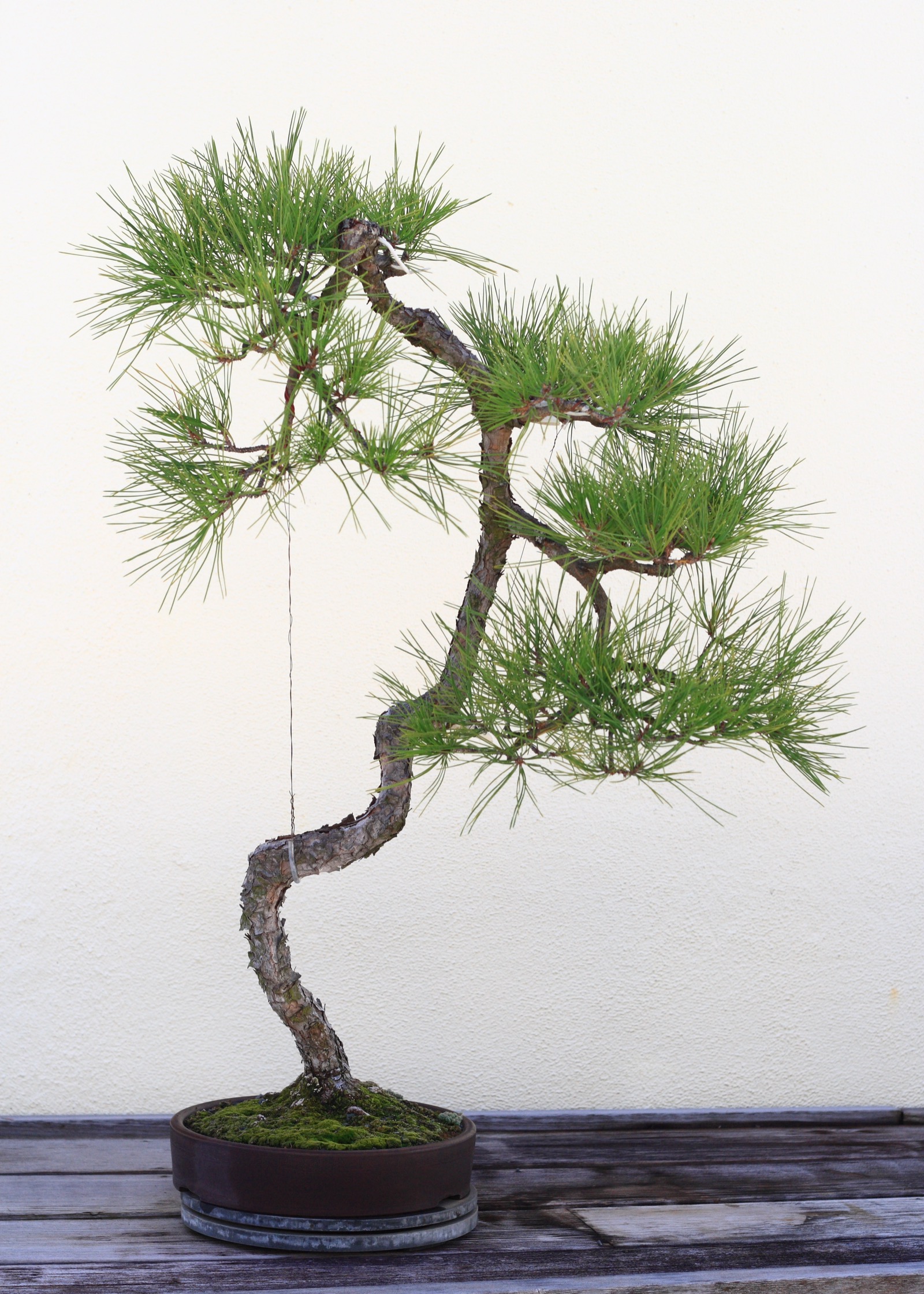
Japanese black pine (Pinus thunbergii), bunjin (literati) style, Chinese Collection, National Bonsai & Penjing Museum, U.S. National Arboretum. / Photo by Sage Ross, CC BY-SA 3.0, via Wikimedia Commons — Source

Most bonsai styles ask a tree to fill its space fully — a dense pad of foliage here, a balanced branch there, the eye given plenty to rest on. Bunjingi (文人木, "literati style"), one of the forms introduced in our overview of bonsai's basic tree forms, does the opposite. It asks how little a tree can carry and still read as a tree at all.
Bunjingi is the bonsai style that keeps almost nothing: a slender, unhurried trunk carrying only a few branches, drawn directly from the ink paintings of Chinese and Japanese literati painters.
A trunk with almost nothing left on it
A bunjingi trunk is long relative to the tree's overall size, thin, and often moves in loose, unpredictable curves rather than the steady taper a chokkan or moyogi is expected to show. Most of its length is left bare. What foliage remains is pushed high, gathered into a small number of pads near the apex rather than spread evenly along the trunk, so that a long stretch of trunk line sits in open air before the eye reaches any branch at all. Lower branches are often removed entirely, or reduced to a stub of deadwood that records where a branch used to be. Where a chokkan's discipline lies in perfect straightness, a bunjingi's lies in the opposite direction: an interesting, idiosyncratic line that would look wrong on any more conventional tree, held with just enough restraint that it never tips into chaos.
Painted first, potted later
The style did not begin in a nursery. It began on paper. During Japan's Edo period, a circle of bunjin (文人, "literati" — scholars practicing painting, poetry, and calligraphy as a mark of cultivated life) took up nanga (南画, "Southern painting," also called bunjinga), a school of ink painting modeled on Chinese wenrenhua — literati painting from the Song dynasty onward, prized for suggestion over technical realism. These paintings favored a particular kind of tree: elongated, contorted, sparsely foliaged, growing out of harsh or empty ground. Japanese growers of the same period, working from Chinese painting manuals such as the Jieziyuan Huazhuan (芥子園画伝, "Manual of the Mustard Seed Garden") that circulated among them, began training living trees to resemble those painted ones, and gave the resulting form the same name as the painters who had inspired it. A bunjingi is, in a real sense, a two-dimensional idea carried into three dimensions and kept alive.
The furthest reach of subtraction
Every bonsai style involves the discipline of taking branches away rather than adding them, but bunjingi pushes that discipline further than any other named form. The usual rules — steady taper from base to apex, branches distributed at intervals up the trunk, a silhouette that reads as a soft triangle — are set aside almost entirely. What remains has to earn its place with unusual force, because there is so little of it left to look at. A single branch placed slightly wrong, a foliage pad slightly too heavy, is far more visible on a bunjingi than the same flaw would be on a fuller tree, where neighboring branches would absorb the eye's attention. Growers who take up the style often describe it as harder than it looks precisely for this reason: there is nowhere left to hide an uncertain decision once nearly everything else has already been removed.
Where wabi settles most plainly
Among the named forms, bunjingi is the one most often spoken of alongside wabi (侘び, a fullness found within scarcity rather than abundance). A bunjingi offers no display of thick trunk, no dense green mass, no obvious show of strength or age. What it offers instead is a single considered line, and the empty space around that line, which the viewer is left to complete. That is close to the same discipline Sen no Rikyu practiced when he cut down an entire garden of flowers to leave one blossom in an alcove: not more to look at, but less, so that what remains is looked at completely. A bunjingi asks the same patience of its viewer that a bare tea room asks of a guest.
Closing
A bunjingi looks, at a glance, like the least worked bonsai in the vocabulary — a bare stick with a little green at the top. It is closer to the opposite: a form that holds its restraint for decades, since a single wrong cut cannot be hidden behind neighboring branches the way it could on almost any other tree. Azukari entrusts trees like this to artists in Japan for the same reason it entrusts any tree: the discipline a bunjingi demands does not pause when its owner is elsewhere, and each season's record simply confirms that the line the artist chose years ago is still the line being kept.
References
- Wikipedia — Nanga (Japanese painting) — on nanga's roots in Chinese literati painting (wenrenhua) and its direct connection to the bunjin (literati) bonsai style, described as trees "elegantly elongated and with few branches" made to resemble trees painted in nanga works.
- Wikipedia — Bonsai styles, "Literati style" — description of the literati (bunjin-gi) style's bare trunk line, minimal branching concentrated near the apex, and its origin in Chinese literati painting manuals such as The Mustard Seed Garden Manual of Painting.
- Wikipedia — Bonsai, "History" — on the Jieziyuan Huazhuan (Manual of the Mustard Seed Garden)'s influence on Edo-period bonsai terminology and style among literati circles.
- Bonsai Today — "Bunjin-gi (Literati Style)" — on the style's thin, character-filled trunk, often-barren lower branches, and its association with a wabi-sabi mood.
- Bonsai Society of Greater Cincinnati — "Literati or Bunjin 'Bunjingi'" — on the style's long, slender, often twisted trunk, high asymmetrical branch placement, and roots in the "artistic spirit" of Chinese literati scholars.