The city of Sakai still tells the story on its own website: word reached the warlord Toyotomi Hideyoshi that a fine stand of morning glories (asagao, 朝顔) was blooming in the garden of his tea master, Sen no Rikyu (1522–1591), and he asked to see it. When Hideyoshi arrived, every flower in the garden had already been cut down. Only once he stepped into the tea room did he find what Rikyu had spared: a single flower, the finest one, set alone in the alcove.
A garden stripped bare so a single flower could be seen completely is an extreme case of a habit that runs through Japanese aesthetics and through bonsai pruning alike: meaning tends to grow as material is removed.
Addition and Subtraction Read as Two Different Theories of Value
Walk through a European palace and the logic on display is additive. Gilded stucco fills the ceiling, brocade covers the wall, and a Baroque altarpiece gathers cherubs, columns, and scrollwork until almost no surface is left bare. That approach has its own coherent standard of value, in which richness is demonstrated by accumulation — more carving, more gold leaf, more for the eye to travel across.
Japanese design, at its most distinctive, runs the opposite direction. A tokonoma (床の間, an alcove built to hold a single hanging scroll or flower arrangement) holds one object rather than a display of many. A Zen temple's rock garden presents raked gravel and a handful of stones, with the empty gravel doing as much work as the stones. The tea room strips away color, ornament, and much of the light, until whatever remains in it is the only thing left to look at.
The two traditions locate meaning in different places: in the sum of what is present, or in the discipline of what has been withheld.
Removing the Inessential Is What Makes the Essential Visible
The case for subtraction is not that less looks prettier than more. It is that removing the inessential is what lets the essential become visible at all.
An object surrounded by ornament tends to be read as a whole impression — pleasant, rich, impressive, and diffuse. An object presented alone tends to be read closely: its grain, its asymmetry, the particular way light happens to sit on one surface. Nothing competes with it for attention, so the eye has nowhere else to go. Japanese aesthetic tradition treats that undivided attention as the actual goal and treats every added element as a small tax on it — each ornament may be beautiful on its own, and each one still draws away a fraction of the attention that would otherwise belong to the single thing that matters most.
Subtraction is also harder to practice than addition. Adding is a series of reversible choices, each one deferring a final judgment about what belongs. Subtraction forces the opposite: the decision about what is essential has to be made first, because everything else is about to be discarded. The tea masters, garden designers, and artists who practiced this discipline were not being modest. They were making a harder aesthetic judgment than the one required to fill a room with treasures.
A Single Flower Outweighed an Entire Garden
The morning-glory story comes from chanoyu (茶の湯, the Japanese tea ceremony) and its most influential figure. Rikyu served as tea master to Hideyoshi, the ruler under whom Japan was unified in the late sixteenth century. Sakai, Rikyu's home city, still presents the anecdote today, and it should be read as exactly what it is: a story passed down through generations of tea practice to teach an aesthetic point, not an eyewitness record.
Its details still matter, because they line up with a discipline tea masters are documented to have practiced in earnest well beyond this one story: rooms built at the smallest possible scale, walls left bare, utensils chosen for quiet imperfection over costly display. Whether or not the exact scene in the garden happened as told, the practice it illustrates is real. Rikyu did not merely decline to add anything to impress his guest — the story has him remove an entire garden of flowers so that a single one could be seen completely.
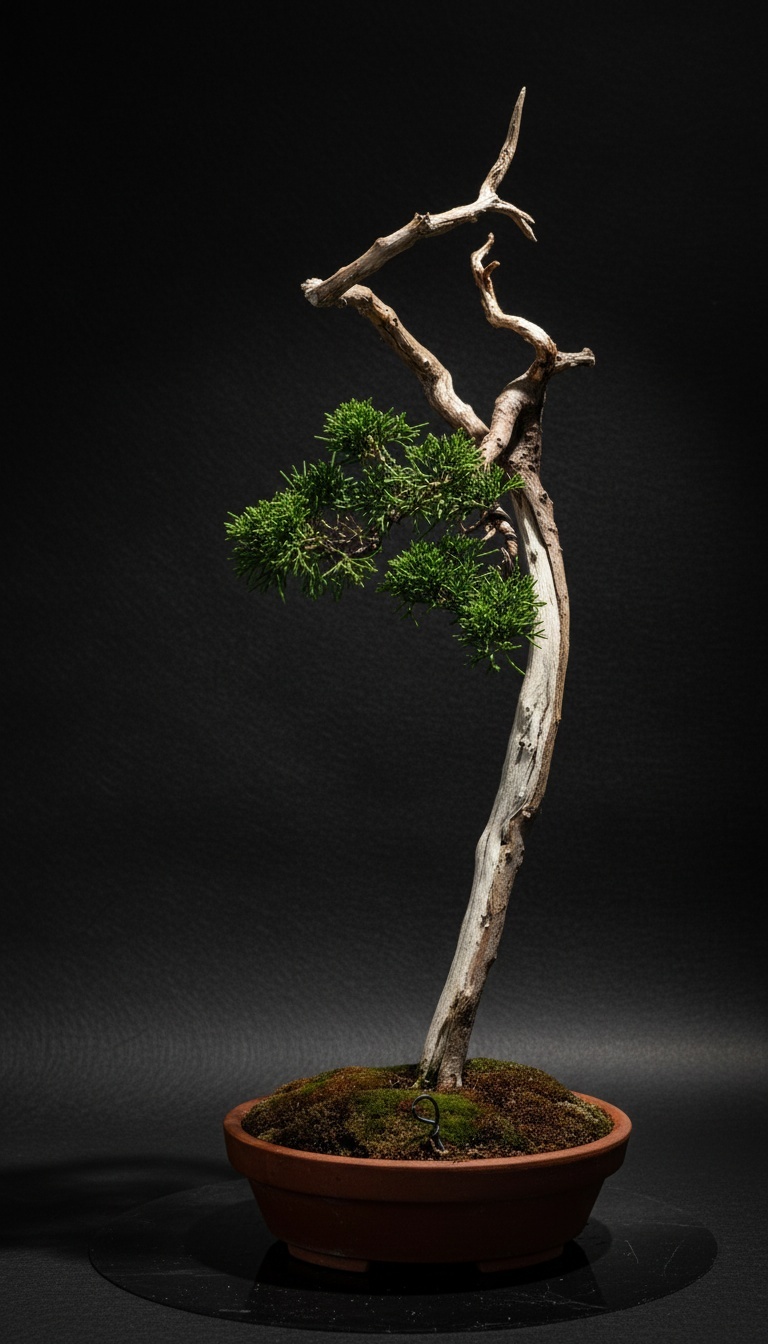
A shimpaku juniper, its present shape the record of decades of removal.
Pruning Turns the Same Discipline into a Year-Round Practice
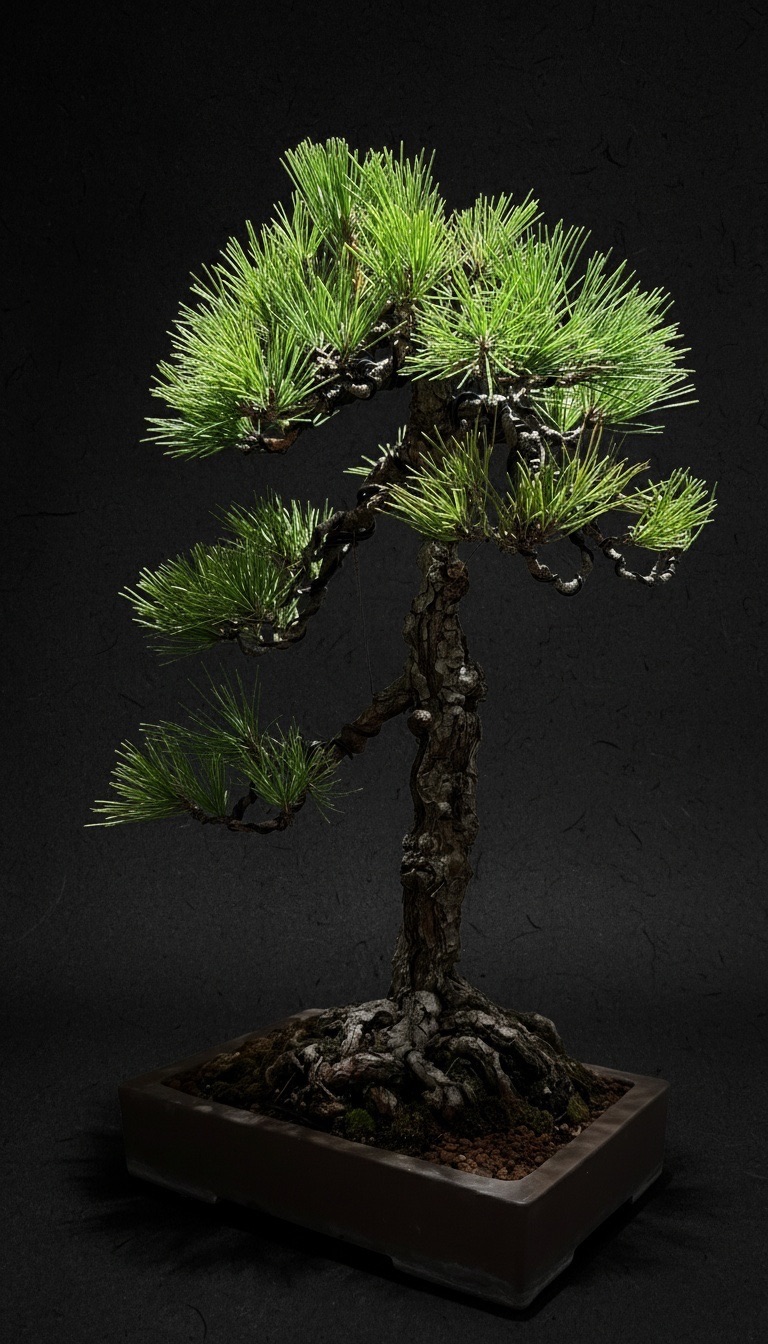
Nowhere is this discipline more literal than in bonsai. A tree left alone grows by addition: new shoots, more branches, more foliage, reaching in every direction at once. Left to its own habit, it accumulates rather than composes. Sentei (剪定, pruning) reverses that tendency — an artist studies the tree, decides which branches serve its form, and removes the rest. Nothing is glued on, painted in, or built up.
A well-kept bonsai rewards close, sustained looking in a way an untended tree rarely does. A neglected tree is a mass of competing branches, each one dividing the eye's attention. A pruned tree offers a line the eye can follow from root to apex without interruption, because everything that once obscured that line has been cut away. Each growing season adds new shoots; each pruning season removes most of them again, keeping only what belongs to the tree's evolving form. A bonsai artist spends a career learning what to take away.
The test travels well beyond tea rooms and gardens. When judging anything composed — a photograph, a room, a bonsai — the harder and more revealing question is what could still be removed from it.
What a mature bonsai shows — a wind-bent pine, a cascade of foliage falling past the rim of its pot — is not what an artist added to it this year, but what years of artists have refused to leave in.
For more on how that removal is meant to be read, see "How to Look at a Bonsai," and for what the finished-looking tree is really doing, see "Bonsai Is Not a Small Tree" and "Bonsai Is Never Finished."
References
- City of Sakai — Historic Figures: Sen no Rikyu — official city page recounting the morning glory anecdote and Rikyu's wabi aesthetic of simplicity.
- Stanford Encyclopedia of Philosophy — Japanese Aesthetics — scholarly overview of wabi, emptiness, and the aesthetics of omission in Japanese thought.
- Nippon.com — Japan Topics entry on Sen no Rikyu — profile of Rikyu's minimalist tea rooms and the development of wabi-cha.
- Urasenke Konnichian — An Introduction to Chado — official tea school history of the wabi aesthetic from Shuko through Rikyu.