To enter the tea room Sen no Rikyu (1522–1591) built in sixteenth-century Kyoto, a guest had to bend at the waist and duck through a doorway built barely tall enough to pass. Inside waited one hanging scroll, one flower, and a single bowl — sometimes a bowl with a visible crack, or a glaze pooled unevenly on one side. Nothing in the room argued for its own importance. The bareness itself was the room's whole argument.
Wabi and sabi began as two separate words, and together they built a standard for judging objects that runs opposite to most of the world's: wear can raise an object's value instead of lowering it, provided someone kept tending the object while the wear accumulated.
Wabi and sabi started as separate words
For most of their history, wabi (侘, "the fullness found within scarcity") and sabi (寂, "the trace time leaves on a surface") were unrelated words, and the compound most people now use together is a comparatively recent habit.
Wabi comes from the verb wabu, which originally meant to feel discouraged — the loneliness of a life lived apart from society. In poetry written more than a thousand years ago, the word carried no aesthetic charge at all; it simply named the ache of wanting something one did not have. Centuries later, largely through the tea ceremony, that meaning turned inside out. Wabi came to describe a fullness found precisely inside that scarcity. A small hut, a single flower, a plain bowl were understood as complete on their own terms.
Sabi took a different path. It is related to sabu, a word for desolation, and to sabi (錆, "rust"), a different character pronounced the same way. Where wabi names a state of mind, sabi names a quality visible on an object: the texture time leaves on a surface, the quiet that settles over something as it ages. A weathered stone, a bronze gone green, wood silvered by decades of sun — this is sabi, the record of time on a surface.
The two words converged mainly through the tea ceremony, in the century of tea masters Murata Juko and Rikyu, when a taste for plain, irregular, Japanese-made utensils displaced an earlier taste for lacquered, symmetrical, imported ones. By the twentieth century, common usage had folded the pair into the single compound now familiar outside Japan.
Wabi treats bareness as complete in itself
At the center of wabi is an attitude rather than a style: the decision to treat an absence — of ornament, of symmetry, of newness — as something other than a deficiency.
Rikyu's tea room, described above, makes the attitude easiest to see. A tea bowl formed by hand, slightly irregular in a way no wheel-thrown vessel from a palace workshop would be, read as more honest about what it was: something made by a person, marked by the moment of its making, unrepeatable.
Rikyu is remembered for the remark that a single flower suggests more than a hundred flowers arranged together. Cutting ornament, tolerating an irregular edge, leaving a room nearly empty — that kind of reduction brought a viewer closer to the thing in front of them, because there was less competing for their attention.
Wear only counts as sabi if someone kept tending it
Once that attitude is in place, it reorders how objects get judged. In most commerce, an object's value falls as it ages: new is the baseline, and wear counts against it. Under wabi-sabi, the direction can run the other way — with one condition attached.
A tea bowl mended with a visible seam of lacquer and gold, the technique now known outside Japan as kintsugi (金継ぎ, "golden joinery"), was not hidden once broken. The repair stayed visible, sometimes emphasized, because the break and its mending had become part of the bowl's record. A post silvered by weather was preferred to one freshly cut. A stone path settled unevenly into moss outranked a walkway laid uniform in a single week. What unites these examples is sabi in the strict sense: a trace of time read as evidence of a real, particular history rather than as damage to correct.
The condition is that this is not the same as neglect. An object left alone simply falls apart; abandonment does not produce sabi on its own. What wabi-sabi rewards is continued attention paid to something as it ages — a bowl still used, a garden still tended even as its stones settle. That is the test worth carrying past this page: in front of an old or worn object, ask whether it was cared for through its wear, or just left to sit through it.
An old bonsai carries decades no technique can fake
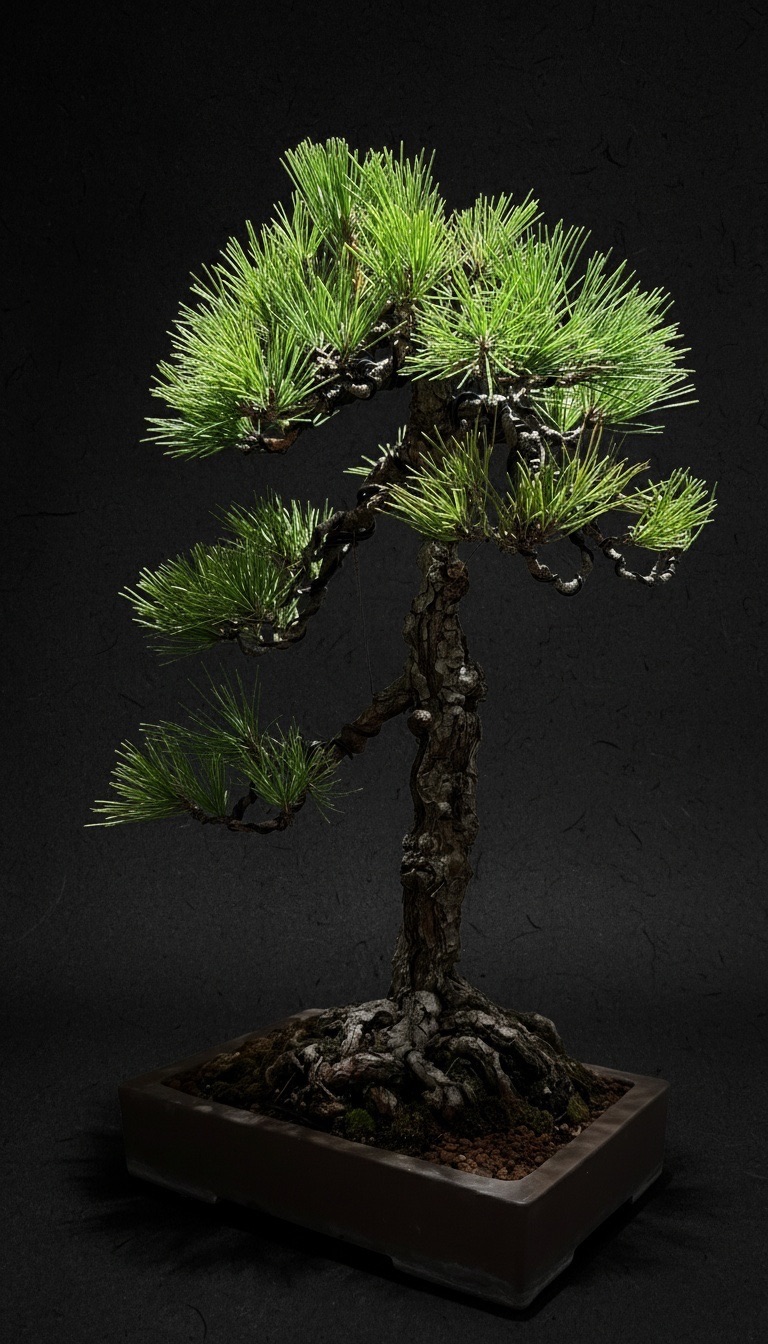
Bonsai make this logic unusually easy to see, because a tree's age is written directly into its form: bark thickened and cracked over decades, a trunk widened at the base the way trunks widen in a forest rather than a nursery, a branch line that records being shaped, allowed to grow, and shaped again across a span no single season could produce. None of it can be manufactured quickly. It can only be reached by keeping a tree alive, under attention, for a long time.
Two young pines can be trained into an identical outline within a few years. Only one of them, decades later and kept the way wabi-sabi asks, will carry the bark, the taper, and the sense of endurance that reads as an aged tree at a glance rather than a young one grown fast. Age in bonsai, seen this way, is sabi made visible in a living thing: proof that a tree was kept, shaped, and handed onward for years long enough to show it.
Azukari sits inside the same logic. A tree under an artist's care in Japan does not stop aging on the day it finds an owner; it keeps growing, keeps being shaped, keeps gathering the kind of history wabi-sabi asks a viewer to notice rather than correct. It has not been made to look old. It has been allowed to become old, under care — and that permission, more than the years themselves, is what shows. To read more on how that time gets recorded in a single tree, see "Bonsai Is Not a Small Tree," "What Is Keido? The Aesthetics of Bonsai and Suiseki," and "Meiboku: Japan's Historic Bonsai."
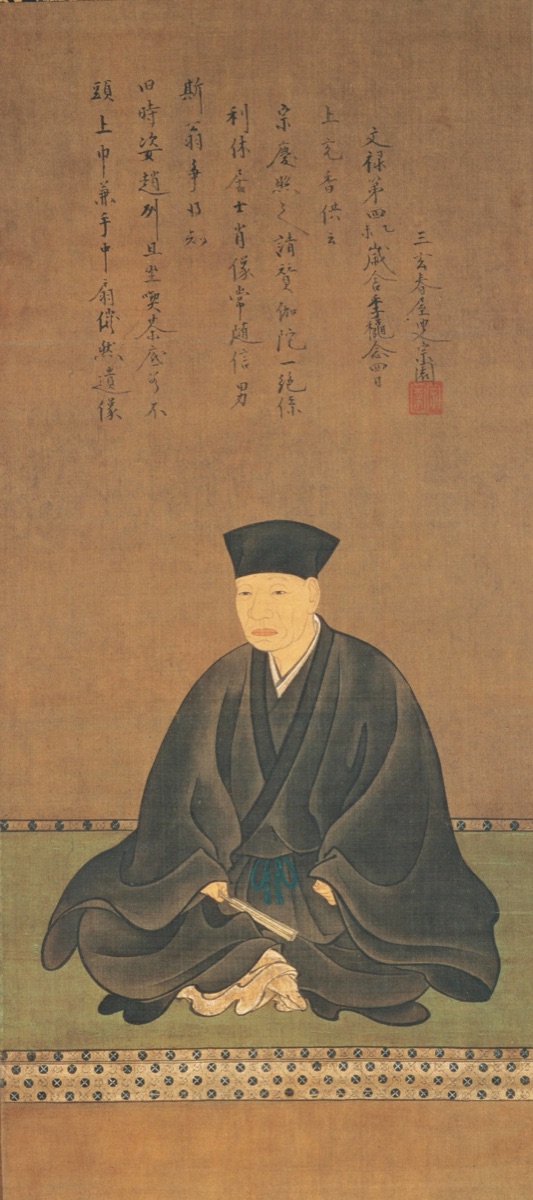
Sen no Rikyu (1522–1591), the tea master who carried the attitude of wabi into the tea ceremony and, through it, into the wider aesthetic life of Japan.
References
- Stanford Encyclopedia of Philosophy — "Japanese Aesthetics" — scholarly overview treating wabi and sabi as distinct concepts, including their separate etymologies and roles in Japanese aesthetics.
- Nippon.com — "'Wabi,' 'Sabi,' 'Yugen': The Surprising Changes in 'Traditional' Japanese Aesthetics" — on the separate historical origins of wabi and sabi and how they came to be paired.
- Portland Japanese Garden — "Tranquil Simplicity: Exploring the Meaning of Wabi Sabi" — definitions of wabi and sabi, including curator Diane Durston's account of imperfection and the patina of age.
- Portland Japanese Garden — "Wabi Sabi and Tea" — on Murata Juko, Takeno Joo, and Sen no Rikyu's role in shaping wabi through the tea ceremony.