One December, I read a line in Kunio Kobayashi's book Bonsai mo Hito mo Kareru kara Omoshiroi (盆栽も人も枯れるから面白い) and stopped on a word I'd never seen: keido (景道, "the way of the view"). Kobayashi runs Shunkaen, a garden on Tokyo's eastern edge holding more than a thousand trees inside one set of walls — reputedly the country's finest bonsai garden, and one I'd filed under someday, once I was ready. I called the next day instead. Since just after New Year last year I've gone as an enrolled student, and a member of Keido no Kai (景道の会), the group inside the garden that studies this one discipline: not trees, but how a tree is shown.
Keido is not the study of a tree. It is the study of everything arranged around it, and of what that arrangement does to the person standing in front of it.
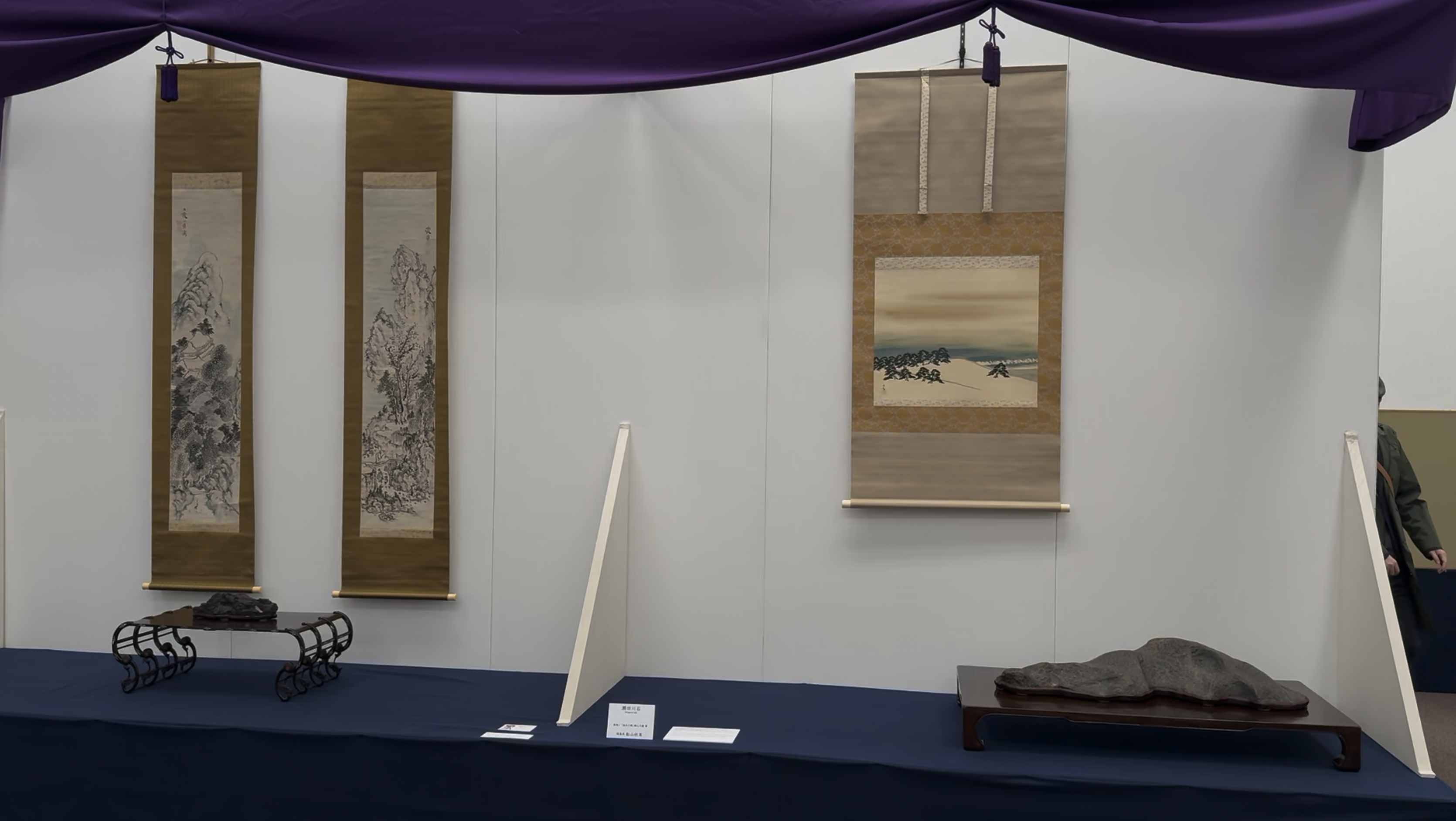
A display arranged in the alcove manner: a scroll behind, a stone on its stand, and the bare space between them left to do its work.
That arrangement's vocabulary — pot, stand, scroll, companion piece — has its own article and its own grammar here. Keido sits one layer above: arranging a display, then training your own reading of it, is a discipline worked at for years, not picked up in an afternoon.
Display work turns looking into training
Most writing on Japanese aesthetics treats the tree or stone as the subject and the presentation as an afterthought. Keido reverses the order: the tree is one part of a composition that also includes what stands beside it, what hangs behind it, and the space left bare on purpose. Every choice has to earn its place, the way a sentence has no room for an idle word. Doing this, again and again, on real objects, is what turns kanshou (鑑賞, "attentive viewing") into shugyo (修行, "sustained training") rather than a one-time judgment. What's trained is not the arrangement. It's the eye that arranges it.
Bonsai and suiseki compress a landscape two different ways
Bonsai is the half most people already know: a tree and its container built as one composition, small enough for a room, carrying a full landscape and years of weather. Yasunari Kawabata named this compression in his 1968 Nobel lecture, "Japan, the Beautiful, and Myself": "Compressed to the ultimate, the Japanese garden becomes the bonsai dwarf garden, or the bonseki, its dry version." Bonseki (盆石, "a tray landscape of loose sand and stone") is a close cousin of suiseki (水石, "an unaltered stone read as a landscape") but not the same — bonseki arranges materials into a scene; suiseki finds one already finished in a single stone, a way of seeing Japan calls mitate (見立て, "seeing one thing as another"), treated in full here. Kawabata is describing density in both cases, not size. A companion piece looks at how an unaltered stone gets read as landscape.
The bare space is doing as much work as the tree
The test I've been taught for reading any keido display: look at what was left out before you look at what was put in. A well-arranged display should feel like nothing could be added without crowding it, and nothing removed without leaving a gap that changes its meaning. Most displays fail this by having too much in them, not too little — a second scroll, an ornament repeating what the tree already says. The discipline is closer to editing than decorating.
What a year of this has changed
I'm still an early student — the people I train under have spent decades doing what I've done in one year. But I no longer walk past a tokonoma without checking what was chosen to sit beside the tree, and what was chosen to stay empty. A year in, that's the whole practice, worn to a single habit: not looking at the tree faster, but noticing everything around it more slowly.
Become a Bonsai Owner → Register Your Email
Read next: The Last Generation of Japanese Masterpiece Bonsai
References
- Shunkaen BONSAI Museum — Kunio Kobayashi — the garden in Edogawa, Tokyo, where the author trains in Keido no Kai.
- Yasunari Kawabata, "Japan, the Beautiful, and Myself" — 1968 Nobel Lecture, full English text — source of the quotation on bonsai and bonseki.
- Japan Suiseki Association — What Is Suiseki