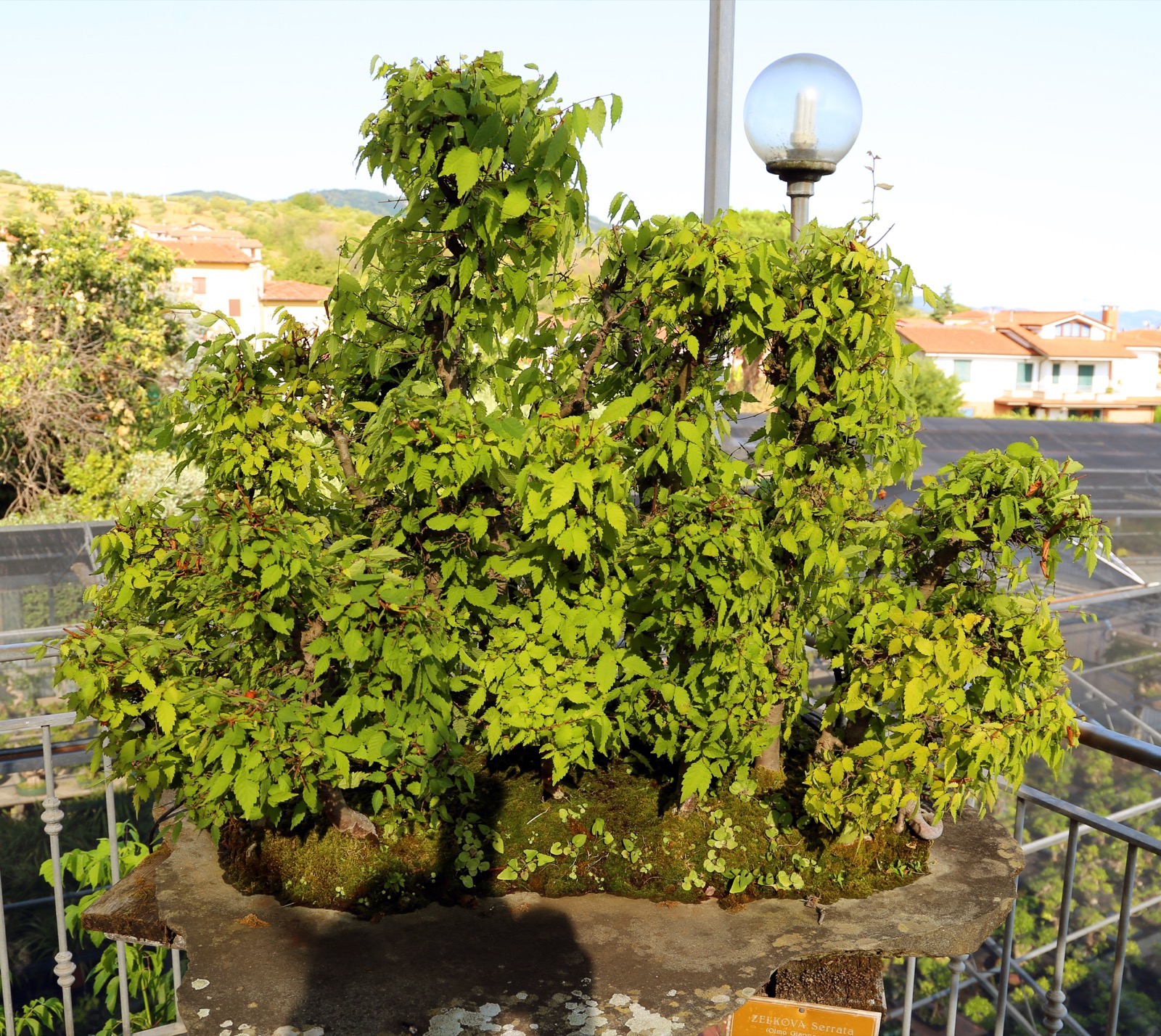
Japanese zelkova (Zelkova serrata), yose-ue, forest style, roughly 40 years old, Bonsai Museum, Pescia, Italy. / Photo by Sailko, CC BY-SA 4.0, via Wikimedia Commons — Source
,_dal_giappone,_circa_40_anni.jpg)
A single bonsai, however old, is still one tree standing in one pot. Yose-ue (寄せ植え, "gathered planting"), the forest or group style introduced in our overview of bonsai's basic tree forms, asks a different question: what if the pot held not a tree, but a wood?
Yose-ue gathers several separate trees — usually one species, almost always an odd number — into a single shallow container, composed so a viewer reads not five or seven individual trunks but one continuous stretch of forest.
Many trees, read as one
A yose-ue planting is not a random cluster of whatever trees happen to be at hand. Growers generally work in odd numbers — five trees, seven, sometimes considerably more in a large composition — because an even count tends to split the eye into pairs, while an odd one settles into a single, asymmetric mass. Most compositions keep to one species throughout: the same bark texture and the same leaf size and color repeated across every trunk, so the eye reads the whole planting as one habitat rather than a row of unrelated specimens. Trident maple, needle juniper, black pine, and zelkova — the species shown above — are common choices, in part because young, relatively thin nursery stock of these trees is easy to source in quantity and trains quickly into the fine, twiggy silhouette a forest calls for.
The tree that leads, and the trees that follow
Every yose-ue is organized around a shuboku (主木, "the leading tree"), a bonsai term for the tree given the most prominent standing in a composition — the same principle that governs which tree sits at the center of a formal display. In a forest planting this is usually the tallest and thickest trunk, and it is set not in the center of the pot but off to one side, roughly a third of the way in from an edge. The remaining trees step down in height and girth around it, arranged in a loose, uneven cluster rather than a straight line or a grid: a forest planted in rows collapses the illusion instantly, since real woods do not grow in ranks. Growers also check the trunks from the front as they place them, keeping each one clear of the ones behind it, so no two overlap into a single confused line when the piece is viewed head-on.
Perspective folded into a few centimeters of soil
The hardest problem a yose-ue solves is depth in a container barely deep enough to hold water. Distance is built the way a painter builds it: the tallest, thickest trunks are set toward the front, and progressively smaller, thinner ones recede toward the back and sides, so scale itself stands in for perspective. The front of the pot is usually left more open than the back — a clearing rather than a wall of trunks — which gives the eye a way into the planting and reinforces the sense that the ground continues past what is actually visible. The soil surface is rarely left flat; a slight rise here, a shallow dip there, suggests the uneven floor of a real forest. Branches are trained outward, away from the interior of the group, so that looking into the planting from any angle still finds open sightlines between trunks rather than a tangle. None of this changes the pot's actual dimensions. It changes what the eye is willing to believe about them.
A view no single tree can hold
A single bonsai, no matter how old or how carefully trained, shows the history of one trunk. A yose-ue shows something a lone tree cannot: the space between trunks, the way light and implied wind seem to move through a stand of them, the sense of a place rather than a specimen. It reads less like a portrait than a landscape — closer, in spirit, to the middle distance a traveler notices glancing sideways from a road than to the close study a single, carefully turned trunk invites. That shift, from a tree to a scene, is the reason the style exists at all.
Not the same as a many-trunked tree
Yose-ue is easy to confuse with kabudachi, the clump style, since both present several trunks rising from one pot. The difference sits below the soil. In a kabudachi, or in the related sokan (双幹, "twin trunk") and sankan (三幹, "triple trunk") forms, every trunk grows from a single root system — it is, biologically, one tree that happens to branch below ground rather than above it. A yose-ue is the opposite: each trunk is a separate tree with its own roots, planted close enough together that the pot reads as one mass. A clump is one organism remembering how to branch. A forest is many organisms agreeing, for the length of a viewing, to be read as one.
Closing
Composing a yose-ue asks a grower to think less about a single trunk's character and more about a group's proportions — how one tree's height sets the scale for six others, how the gap between two trunks becomes as important as either trunk itself. It is, in that sense, closer to arranging a room than shaping a single object. Azukari tends most of its trees as individual specimens, but the same discipline sits behind a yose-ue as behind any other jukei: a form decided early, held for years, tended by an artist whose work only reads correctly once every tree in the pot is considered together. Understanding how a forest is built in miniature is, in the end, another way of understanding what kata asks of a grower — a fixed structure that discipline, not decoration, fills in.
References
- Bonsai Empire — How to create a Bonsai forest / group planting — the odd-number rule for tree count, placing the largest tree slightly off-center, and avoiding rows when arranging the remaining trees.
- Bonsai Society of Greater Cincinnati — Forest Group Plantings "Yose-ue" — the odd-number convention, species uniformity, and varying trunk heights and thicknesses used to build the illusion of distance.
- Bonsai Learning Center — Forest Bonsai (Yose-ue): Designing a Living Woodland — the front-to-back size hierarchy, open foreground, soil-level variation, and outward branch orientation used to build depth.
- Wikipedia — Bonsai, "Styles" — definitions distinguishing multi-trunk styles, in which all trunks share one root system, from forest/group plantings, which combine multiple individually rooted trees.
- Kotobank — 主木 (shuboku) — dictionary definition of shuboku as the bonsai term for the leading tree in a composition or formal display.