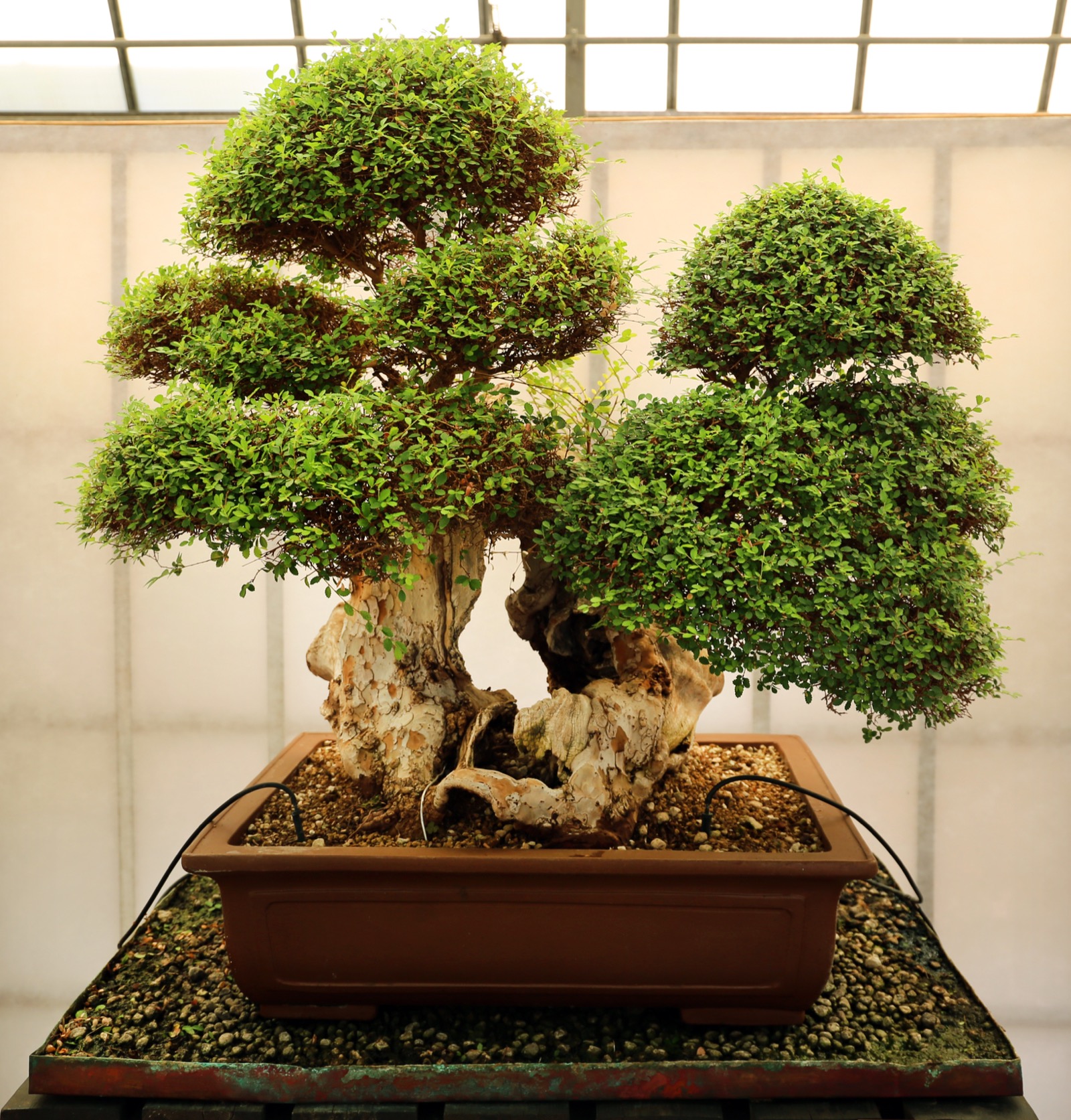
Chinese elm (Ulmus parvifolia), kabudachi, clump style, roughly 100 years old, from China, Bonsai Museum, Pescia, Italy. / Photo by Sailko, CC BY-SA 4.0, via Wikimedia Commons — Source
,_dalla_cina,_circa_100_anni.jpg)
Most bonsai trunks answer to a single line: one base, one stem, one apex. A tree trained toward kabudachi (株立ち, "clump," or more literally "stock, standing") breaks that rule from the ground up. Three trunks, five, sometimes more, rise together out of what looks, and structurally is, a single root mass — one plant reading, at a glance, like several. It belongs to the family of multi-trunk and multi-tree forms introduced in our overview of bonsai's basic tree forms, and it is worth its own look.
Kabudachi trains several trunks from a single root stock into one tree that reads, at a glance, like a small stand of trees.
One Root, Many Trunks
The defining rule of kabudachi is structural before it is visual: every trunk shares the same base and the same root system. Lift the tree from its pot and there is one root mass, not several. That single fact separates it from its closest relatives. Sokan (双幹, "twin trunk") is the same idea reduced to two trunks, one taller and dominant, one shorter and subordinate. Yose-ue (寄せ植え, "forest planting"), by contrast, achieves a similar crowd of trunks by an entirely different route — several individually rooted trees, each with its own base, arranged together in one pot to suggest a wood. A kabudachi only ever looks like a group. It is, in the strict horticultural sense, one tree.
A Wood in a Single Pot
The effect a kabudachi aims for is the same small wood a yose-ue forest planting aims for, reached by a different logic. A forest planting stages its illusion of distance deliberately, setting taller trees toward the front and smaller ones toward the back so the eye reads depth across the pot. A kabudachi's trunks, emerging from one tight point, cannot stage distance in the same way — the illusion instead comes from height and thickness. One trunk, usually the tallest and thickest, is left to dominate and form the apex; the rest step down around it in descending order, the way secondary shoots naturally taper off a parent stem. Convention favors an odd number of trunks — three, five, seven — since an even count tends to read as paired rather than gathered, and the whole is trained toward a single, unified silhouette rather than a scatter of small canopies.
Why It Favors the Broadleaf Trees
Kabudachi did not begin as a bonsai invention. In the wild, a cut or fallen broadleaf tree commonly sends up new shoots from its own stump — a process known in Japanese as boga koshin (萌芽更新, "regrowth by budding"), the same coppicing behavior that has long shaped managed woodlands. Several of those shoots survive and thicken over years into trunks of their own, still sharing the parent's original root system. This is why kabudachi is worked disproportionately in zoki (雑木, "miscellaneous," meaning deciduous and broadleaf) species — trident maple, zelkova, hornbeam, elm, the same lineage discussed in our overview of bonsai's five species groups — rather than in conifers, which rarely resprout so readily from a cut base. Japanese practice also recognizes a second, faster route: fusing several young seedlings together at the base so they knit into what reads as one stock, a technique called yose-kabudachi (寄せ株立ち). The coppice-grown version remains the more prized of the two, valued for the single, continuous root flare — the nebari — that ties every trunk visibly back to one origin.
Reading the Group
A well-made kabudachi is judged less on any one trunk than on how the trunks share the space between them. Each needs enough room to keep its own foliage without crowding its neighbors, so the outer trunks typically lean slightly outward, reaching for their own light the way saplings do at the edge of a real wood. The branching of each trunk is kept low and open on the side facing its neighbors, so the canopies knit into one continuous mass rather than several small domes bumping against each other. The test of a good kabudachi is whether it still reads as a single tree from a distance and resolves into individual trunks only on closer study — harmony first, multiplicity second.
Closing
The same logic that shapes a kabudachi in a bonsai pot also shapes trees at full scale in Japanese gardens, where multi-stem specimens — dogwood, stewartia, holly osmanthus — are planted deliberately at entrances and in narrow modern gardens because several slender trunks read as lighter and less imposing than one thick one, closer to how saplings actually stand at a wood's edge. An artist tending a kabudachi is, in effect, managing several trees' worth of growth through one shared root system season after season, favoring none of them so completely that the others lose their light. Azukari entrusts trees like this to artists in Japan precisely because that balance is not a one-time decision but a continuous one — a kabudachi left untended for even a season can let one trunk overtake the rest, and each season's record is, among other things, a note that the balance has held.
References
- Bonsai Society of Greater Cincinnati — Clump "Kabudachi" or "Kabubuki" — definition of the clump style, its three-or-more shared-root-system structure, and its distinction from group plantings.
- Bonsai Empire — Bonsai Styles — overview confirming kabudachi as multiple trunks from a single root system versus yose-ue forest planting's separate trees.
- Bonsai Bark — Clump Style Bonsai: Multiple Trunks with a Single Root System — natural origin of clump-form trees from a single seed cluster or root suckers, and species commonly used.
- Japanese Wikipedia — Kabudachi (株立ち) — coppice regrowth (boga koshin) as the natural origin of clump-form trees, the honkabudachi and yose-kabudachi training methods, and species used as multi-stem garden trees in Japan.