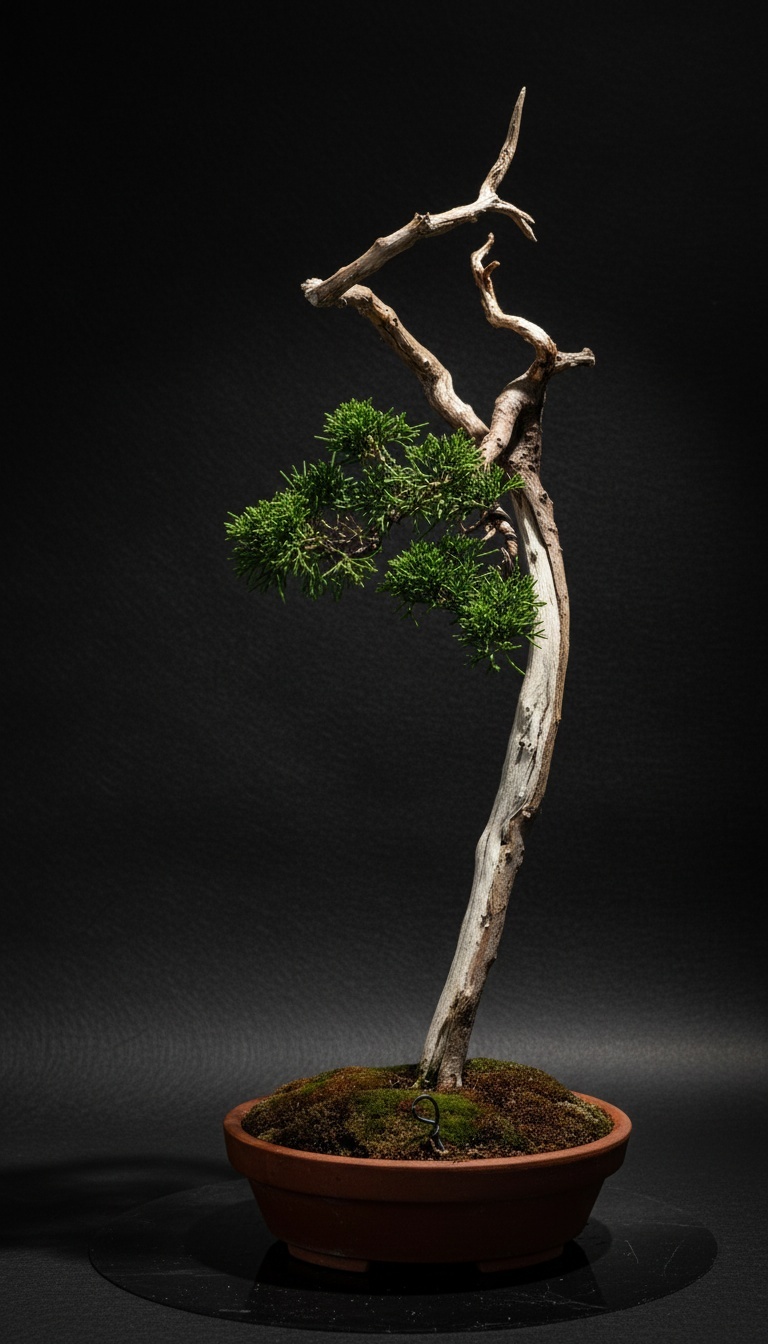
Stand in front of a well-grown shimpaku (真柏, "Chinese juniper," Juniperus chinensis) and the first thing the eye catches is usually not the foliage. It is the pale, twisting wood beside it — bark stripped away decades ago, bleached by sun and lime sulphur to something closer to bone than to timber. A thin ribbon of living bark, sometimes no wider than a finger, is often all that connects root to crown.
No bonsai species is asked to carry more visible dead wood, in more central view, than shimpaku juniper — and none turns that dead wood into more of its own beauty.
A pine relative that bends where pines break
Shimpaku is a form of Chinese juniper, most often identified in bonsai literature as Juniperus chinensis var. sargentii, named for the American botanist Charles Sprague Sargent, who described it on Hokkaido in 1892. Its Japanese botanical name is miyama-byakushin (深山柏槙, roughly "mountain juniper"); "shimpaku" itself is a name that grew up inside bonsai culture rather than botany. One well-told account traces it to 1889, when a juniper obtained by the collector Rokuro Ota reminded viewers of a painting of an ancient winter cypress, and dealers began calling it shin (真, "genuine") paku (柏, an old word covering cypress- and juniper-like conifers) — "the real article." The name stuck to the species as a whole.
What makes shimpaku useful to an artist, more than its name, is its wood. Its scale-like, soft blue-green foliage responds easily to pruning, and — more importantly — its young branches and trunk are unusually pliable, tolerating the tight coils and reverse turns that would splinter a pine of the same age. Growers prize a handful of regional cultivars for this quality above the rest, chief among them the Itoigawa and Kishu varieties collected from cliff sites on Honshu and Kishu Peninsula. We've written elsewhere about the wild cliffs where Itoigawa shimpaku originates and the wind and drought that shaped it there; here, the species itself is the subject.
Jin and shari: death kept in plain sight
Growers name shimpaku's deadwood with words borrowed from religion rather than horticulture. A dead, bleached branch or leader is jin (神) — the character used for a Shinto deity. A stripped, bleached vein running down the trunk is shari (舎利) — the same word used for the bead-like relics left behind after a Buddhist master's cremation. Japanese growing guides describe the pairing in exactly those terms: a tree in which death and life sit side by side in one pot, the white wood and the living green read almost as a small memorial. We touched on how bark and deadwood record a tree's age across species generally; on shimpaku, that record is not incidental. It is very often the main subject of the tree.
No other widely grown bonsai species is asked to give up quite so much of its trunk to this treatment and still thrive. A shimpaku can carry shari down three-quarters of its circumference, living on a strip of bark not much wider than the ribbons that keep the oldest wind-blasted mountain conifers alive on a single flank. We've looked at how that survival pattern shows up in nature itself, from bristlecone pines to wild Itoigawa cliffs; on a bonsai bench, an artist recreates it on purpose, judging exactly how much bark a given trunk can lose and still carry water to its crown.
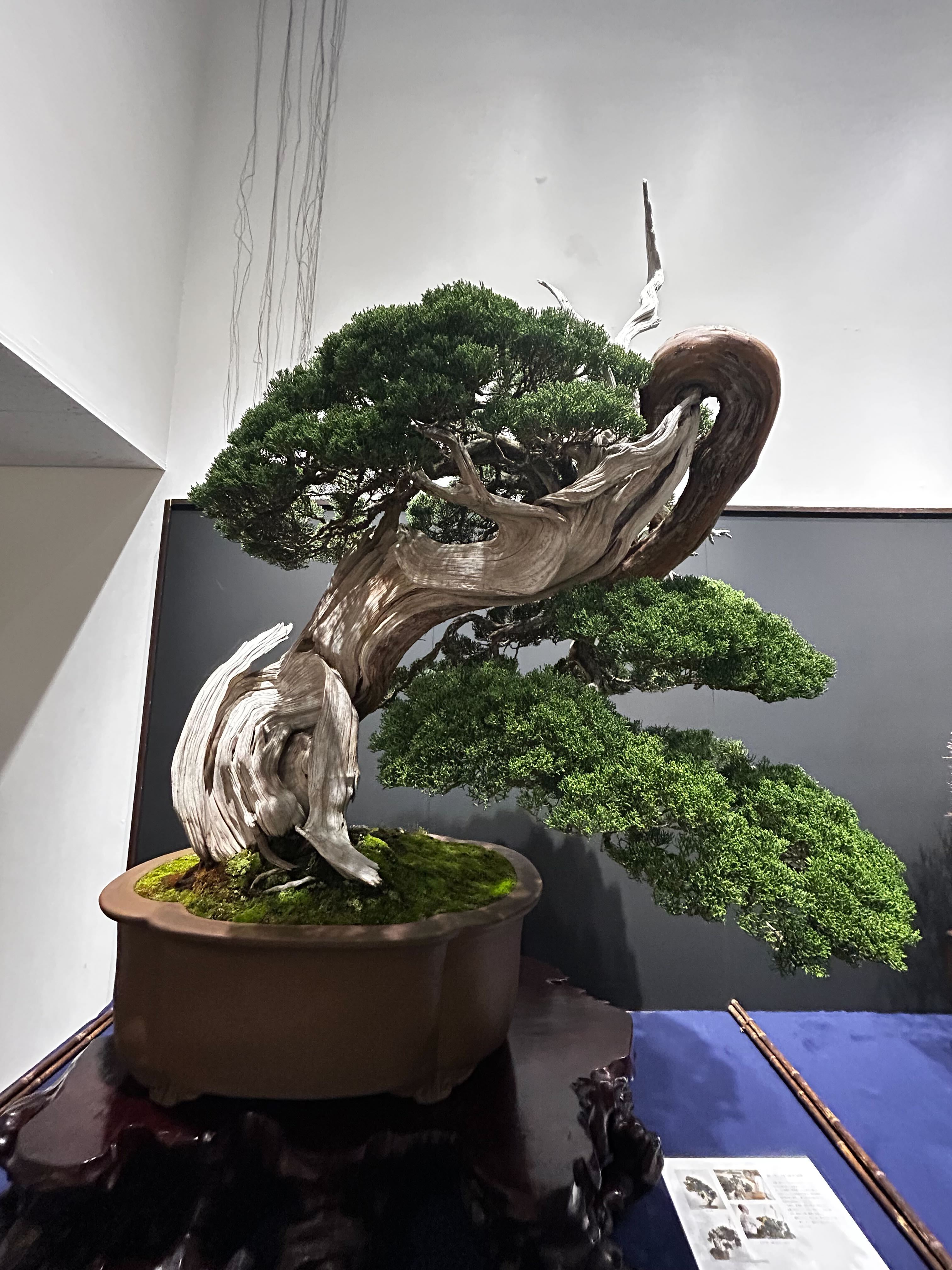
A shimpaku juniper with an extensively carved deadwood trunk, its coiling white wood set against a broad crown of living foliage. Photo: Azukari
Carving jin and shari
The work itself is slow and largely irreversible, so it is planned rather than improvised. Growers generally carve in early spring, once sap is moving again — commonly cited as mid-March to mid-April in Japan — or in late summer, when a wound has the rest of the growing season to begin closing. For jin, an artist strips the bark from a branch down to bare wood, then uses jin pliers to tear and crush the exposed fibers into an irregular, weathered texture rather than a clean-cut one, before rounding the edges with a knife or concave cutter. Shari is slower work: the outline is scored into the bark with a sharp knife, the bark peeled away in sections with pliers, and the exposed wood then carved and hollowed gradually, sometimes over several months, with chisels, gouges, or a rotary tool for larger areas. Both finish the same way — a coat of lime sulphur solution, typically diluted, brushed onto the healed, fully dried wood. It bleaches the surface toward white and, just as importantly, helps guard the exposed grain against rot and insects; growers generally wait until a cut has closed over before applying it, since raw wood treated too soon can suffer at the wound itself. The color is not permanent. It fades toward silver-grey with weather and sun, and most kept trees receive a fresh coat every year or so to keep the deadwood legible against the living foliage.
Where shimpaku stands among the conifers
Bonsai's conifer lineage, shohaku (松柏), is usually anchored by two pines — white pine for refinement, black pine for strength — but neither is asked to carry deadwood as its defining feature the way shimpaku is. As we noted in surveying the wider species map, shimpaku sits inside the same lineage as those pines, yet the register of skill it tests is different: not needle length or bark plating, but the artist's judgment over how much of a tree can be given to death without weakening what still lives. Kunio Kobayashi, founder of Tokyo's Shunka-en Bonsai Museum, has built much of his reputation on shimpaku specifically — he is a four-time winner of the Prime Minister's Award at Sakufu-ten, Japan's exhibition for professional artists, and among his best-known trees are shimpaku junipers reported to be in the range of 800 years old. Travel writing on the species' Itoigawa cultivar has gone further still, calling it, simply, "the king of bonsai." Titles like that are informal, and rank in bonsai is never fixed by species alone — an old tree can outrank a younger one of a "higher" species regardless — but few conifers are asked to hold this much visible death and this much visible life in the same trunk, year after year, and still be called beautiful for it.
Closing
A shimpaku is never really finished with this work. The living crown keeps growing and needs its yearly pruning; the deadwood keeps weathering and needs its yearly coat of lime sulphur to stay legible. Both halves of the tree are, in their own way, still in motion — one adding new growth, the other slowly aging in place, bleached a little paler by each passing year outdoors.
Azukari exists inside that same unhurried rhythm. A shimpaku stays in Japan under an artist's care, its living half pruned through the seasons and its dead half tended and touched up on its own separate schedule, while its owner joins one stretch of that record from wherever they live. Life and death were never meant to be resolved on this tree. They were meant to be kept, carefully, side by side.
References
- Wikipedia — Juniperus chinensis 'Shimpaku' — species classification as a form of Chinese juniper, its collection history in Japan, its association with jin and shari deadwood, and the Itoigawa and Kishu cultivars.
- Bonsai Empire — Deadwood on Bonsai (Jin, Shari and Uro) — definitions of jin and shari, the tools used to carve them, and lime sulphur as a bleaching and preservative treatment.
- Kisetsu-en Shohin Bonsai Europe — "The Story of the Shimpaku Juniper" — the 1889 Rokuro Ota origin story for the name "shimpaku," its botanical designation as Juniperus chinensis var. sargentii, and the distinction between Itoigawa and Kishu regional stock.
- Japan Travel (JNTO) — "Itoigawa Shimpaku, the King of Bonsai" — the Itoigawa cultivar's wild cliff habitat on Mt. Myojo and Mt. Kurohime, and its popular epithet among growers.
- Bonsai Bark — "Two Very Large & Very Famous Bonsai" — on Kunio Kobayashi's shimpaku junipers, reported to be in the 800-year range, and his four Prime Minister's Award wins at Sakufu-ten.
- きみのミニ盆栽びより — 「神と舎利」 — Japanese-language guide describing jin as a dead branch, shari as dead trunk wood, the life-and-death framing growers apply to the pairing, suitable timing, tools, and lime sulphur dilution and application.