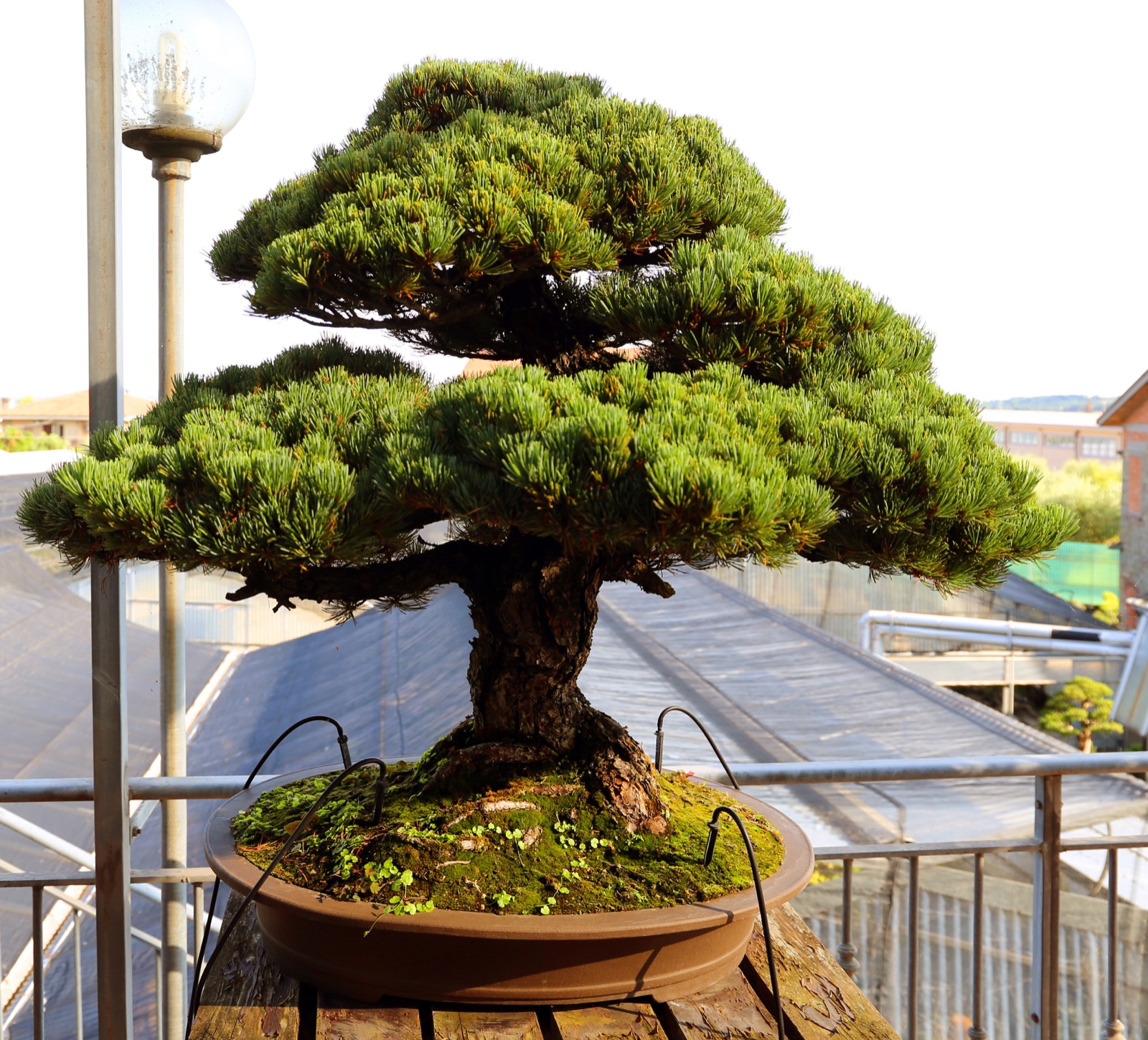
A Japanese white pine (Pinus parviflora var. pentaphylla) in the informal upright style, roughly fifty years old, at the Museo del Bonsai in Pescia, Italy. Photo by Sailko, CC BY-SA 4.0, via Wikimedia Commons — Source
,_dal_giappone,_circa_50_anni.jpg)
At the Kokufu-ten, Japan's most prestigious annual bonsai exhibition, one species is reported to draw more entries than any other conifer: goyomatsu (五葉松, "five-needle pine"), the Japanese white pine. Ask growers why, and the answer rarely points to one dramatic feature — a striking trunk, a bold piece of deadwood, a showy flush of color. It points to accumulation: nearly everything that makes a white pine's refinement visible took longer to arrive than almost any rival pine allows for.
Goyomatsu is treated, more than any other pine, as bonsai's standard of refinement — and every part of that standing, the foliage, the name, the centuries in the tokonoma alcove, even the tree's own vigor, turns out to have been earned on a longer clock than most growers are willing to wait out.
Refinement shows first in the needle, and only slowly
The first thing a grower checks on a white pine is its foliage. The species carries soft needles, roughly three to seven centimeters long, held in tight, rounded pads rather than the looser sprays typical of other pines. Each needle is faintly triangular in cross-section, blue-green on the outer face and marked with pale stomatal lines on the inner faces that give the whole canopy a soft, silvery cast in certain light. Unlike the stiff, almost sharp needles of black or red pine, a white pine's foliage is gentle enough to run a hand through without discomfort.
Bark tells the same story at a slower tempo. Where black pine develops a coarse, deeply plated bark and red pine a flaking, reddish one, white pine bark stays smooth and grey for decades, only beginning to roughen into an irregular, scaly texture after about thirty years of growth. Nothing about this tree announces itself quickly, and that includes the trait growers prize most: hasho (葉性, "leaf character," a tree's fixed foliage quality) is not something a grower can invent in a season. Professionals read a pine's leaf character in more detail elsewhere, but the short version is that it is selected for, not manufactured — one more mark of refinement that cannot be rushed into existence.
Name and reputation trace back to two different roots
The name itself is plainly descriptive. Go (五) means five, and yo (葉) means needle or leaf — five needles bound in a single sheath at each point along the branch. Japanese black pine (kuromatsu, 黒松) and red pine (akamatsu, 赤松) carry their needles in bundles of two; the white pine's five-needle fascicle is the clearest way to tell it apart from either at a glance, and it is the origin of both its Japanese name and its scientific one, Pinus parviflora — "small-flowered pine," a reference to its modest cones next to those of other pines in the genus.
Reputation traveled a separate route. Goyo matsu can also be read as a pun on goyo o matsu (御用を待つ, "awaiting a commission" or "awaiting patronage"), a phrase merchants took as a good omen for business arriving. Partly for that reason, the tree has long been placed in the tokonoma at New Year and at betrothal ceremonies — occasions where a plant standing for good fortune and quiet dignity was welcome. Etymology explains what the tree is called; the pun explains why it kept getting invited into the room that mattered. Neither fact alone accounts for the standing goyomatsu now holds — both had to run in parallel for centuries.
The tokonoma seat was won again every season, not once
Long before it became a bonsai staple, white pine was already a garden tree of some standing, planted at temples and shrines and prized in ornamental gardens as far back as the Heian period. As bonsai culture matured through the Edo period, growers developed numerous cultivars from it, and the species settled into the role it still holds today: the pine most often chosen to anchor a formal tokonoma (床の間, the recessed alcove used for displaying art in a traditional Japanese room).
That role has continued at the highest levels. A white pine said to have been kept by the third Tokugawa shogun, Tokugawa Iemitsu, is one of the meiboku still cared for today — one line of its descendant care leading to the Imperial Palace's own cultivation grounds, where white pine remains among the species displayed in the palace's reception rooms each season. No tree holds a seat like that by being chosen once. It holds it by being chosen again, generation after generation, by people with every reason to reach for something else instead.
Even the standard-bearer needed a hand
Ask a bonsai professional to name the two central pines of the tradition, and the answer is nearly always the same pairing: white pine and black pine, spoken of as the twin pillars of shohaku (松柏, the conifer lineage of bonsai). Bonsai master Kunio Kobayashi, founder of Tokyo's Shunka-en Bonsai Museum, describes the two as complementary opposites — black pine bold and masculine, white pine delicate and elegant. Among growers, there is even a saying that the path of bonsai eventually leads back to the white pine, as if it were the species a grower's judgment is ultimately tested against.
But the standing is not purely its own doing. White pine grows slowly, and true seedling-grown specimens can be slow to establish strong roots and vigorous new growth, so growers commonly graft choice foliage onto black pine rootstock — borrowing that species' hardier constitution while keeping the white pine's finer needle and softer color above the graft line. The tree most often held up as bonsai's standard of refinement, in other words, frequently reaches that standing on another species' roots. Rank in bonsai is not fixed by species alone, either — an old black pine can outrank a young white pine on the strength of its own record. What separates them is never the label on the pot. It is how much time the tree in front of you was actually given.
What a season can't buy
None of what sets a white pine apart happens quickly, and none of it happens alone. Its needles take a season of full sun to tighten into the short, dense growth a grower wants. Its bark needs decades before it shows any character at all. Its reputation in the tokonoma was not decided in one generation but built up, tree by tree, across centuries of people choosing it for the room that mattered most — and even its roots, in many cases, belong to a different pine altogether. Judged against that record, the question worth asking about any bonsai billed as refined is not how good it looks in a single photograph, but how much time, whose time, and how many seasons of it, actually went into the tree in front of you.
Azukari runs on the same clock. A goyomatsu under an artist's care in Japan is watched the way any grower watches one — foliage checked flush by flush, bark and form left to take their own time — and its owner, wherever they live, receives a seasonal record of that unhurried attention instead of a single photograph asked to do the convincing. Not fast, and not solitary — earned, the only way a white pine ever is.
Azukari exists inside that same rhythm.
References
- Wikipedia — Pinus parviflora — botanical description, including the five-needle fascicle and needle length of 3–7 cm.
- Bonsai School (盆栽の学校) — "What Is Goyomatsu?" — origin of the name from the five-needle bundle and the species' standing as classic bonsai material.
- Niwa-iro — "Goyomatsu: Its Auspicious Meaning" — the "awaiting patronage" wordplay and the tree's traditional use in New Year tokonoma display and betrothal ceremonies.
- Kunio Kobayashi — "Types of Bonsai" — white pine and black pine described as the twin pillars of shohaku bonsai, white pine's Kokufu-ten entry numbers, and the contrast between the two species' character.
- Bonsai Mirai — White Pine Bonsai Guide — bark maturing over roughly thirty years, and the practice of grafting select white pine foliage onto black pine rootstock.
- Wikimedia Commons — File: Pescia, museo del bonsai, pinus pentaphilia, stile moyogi — source and license (CC BY-SA 4.0, photo by Sailko) for the header image.