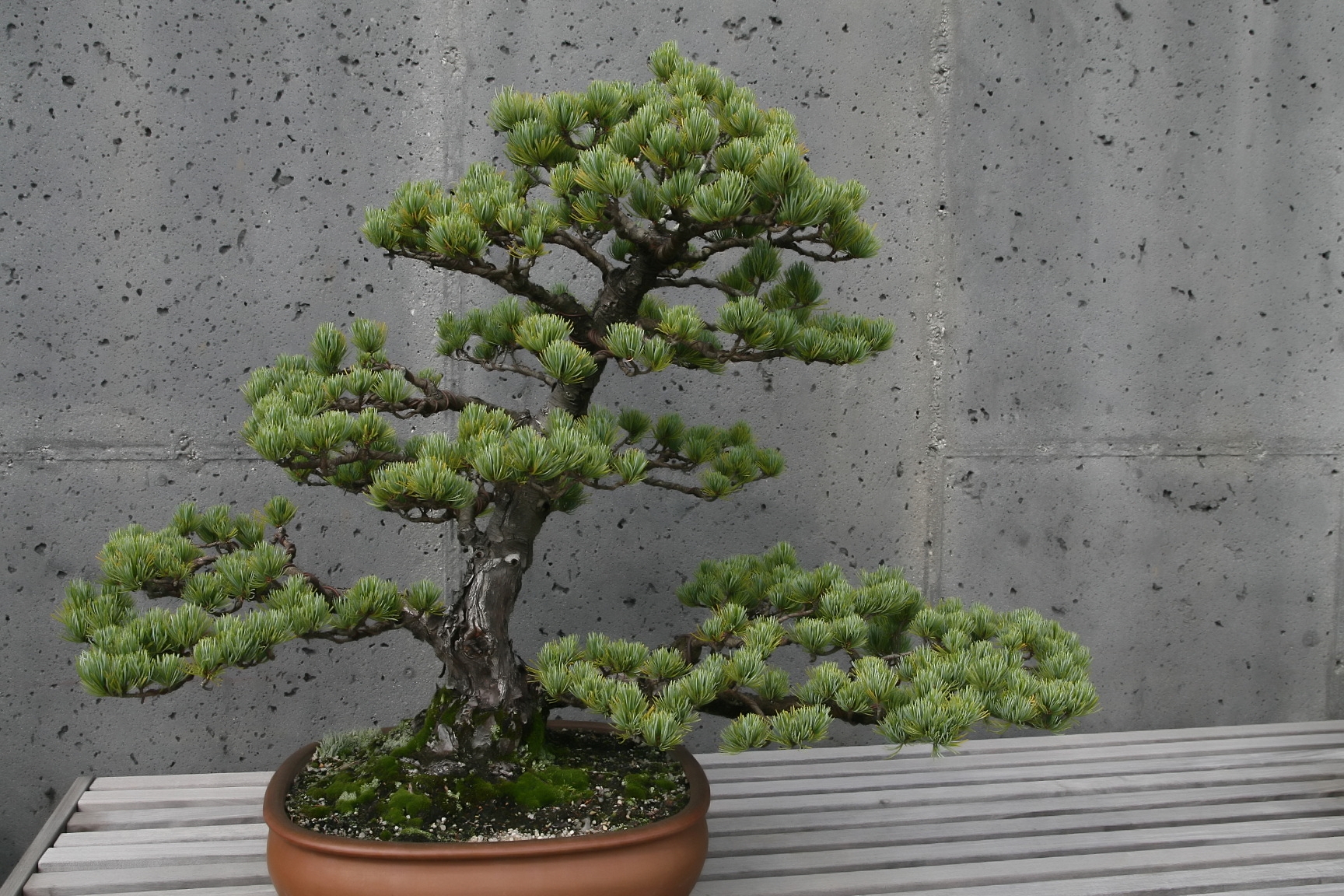
Japanese white pine (Pinus parviflora), North Carolina Arboretum. Photo by David J. Stang, CC BY-SA 4.0, via Wikimedia Commons — Source

Stand close to a well-grown pine and look past the trunk and the branches, straight at the foliage itself. What you are reading there is hasho (葉性, "leaf character," the inherent quality of a tree's foliage — its size, density, and color), and it is a trait that pruning can manage a little but cannot invent where it does not already exist.
A tree's leaf quality is one of the few qualities a bonsai artist can select for but cannot really create.
What hasho describes
In bonsai vocabulary, hasho covers more than leaf size. Growers use the word for the shape, color, and even the growth behavior of the foliage — how densely the needles or leaves are set, how short the gap runs between one node and the next, how bright the green stays through a season. The idea overlaps with how readily a tree buds and re-buds after being cut back, so a tree praised for "good hasho" is usually being praised for both at once: attractive foliage, and buds that cooperate with a grower's plans.
No two trees agree, even within one species
Two black pines grown from the same batch of seed can mature with visibly different needles — one dense and fine, the other longer and looser — because leaf character sits closer to an individual trait than a species-wide rule. Unless a tree has been propagated by cutting or graft from a single parent, its foliage is, in the words of one English-language bonsai guide, "as unique as a fingerprint." This is why nursery stock, wild-collected material, and seedlings destined for bonsai are inspected leaf by leaf rather than judged on species name alone. The same goyomatsu (五葉松, "Japanese white pine") label can describe a tree with coarse needles several centimeters long, or one with a fraction of that length. We look at the species itself in more detail elsewhere.
What counts as good hasho
The standard differs by category. Among conifers, favored hasho is short, straight, brightly colored, reasonably thick-bodied needles set in tight clusters, close to what the pine pictured above shows. Among broadleaf trees, it is small, glossy leaves with clear color and strong autumn or spring tinting. The clearest illustration among pines is Zuisho (瑞祥), a dwarf cultivar of goyomatsu whose needles run to roughly a third the length of an ordinary white pine's, packed densely and touched with a faint silvery sheen. Every Zuisho in cultivation is said to trace back, through cuttings and grafts, to a single mutated tree found in Japan in the early Showa era — proof that this kind of leaf character was found once, in one individual, and has been propagated ever since rather than bred into ordinary stock through training.
A trait cultivation cannot invent
That last point matters more than it first appears. Seasonal technique can manage foliage within limits. Decandling a black or red pine's new shoots in early summer, for instance, coaxes a shorter, finer second flush of needles that year, and restrained fertilizing keeps growth from coarsening. But these are adjustments at the margin, not a rewrite of the tree's underlying character. An ordinary-needled goyomatsu worked for decades will not become a Zuisho; a grower cannot train coarse hasho into fine hasho the way a trunk can be wired into a new line or a branch regrown after a cut. This is why the trait is treated as close to fixed once a tree has left the seedling stage, and why growers who want reliably fine foliage propagate proven individuals by cutting or graft instead of hoping training will improve a mediocre one.
Why growers look here first
Because hasho resists correction, it tends to be one of the first things a grower or buyer checks when evaluating unstyled material — often before trunk movement or branch placement, both of which can still be reworked over years of wiring, pruning, and regrowth. A trunk with an awkward bend can be corrected over time. Foliage with poor character generally cannot. Reading a tree's front, nebari, and deadwood is one part of learning to see a bonsai; learning to see hasho is a quieter, earlier step, closer to the ground floor of selecting material in the first place.
Closing
None of this shows up well in a photograph. Leaf character is a close, patient kind of looking — the sort done standing in front of a bench of young pines, or watching a single tree's new growth harden over the course of a season, rather than glancing at an image online.
Azukari keeps that close attention going after a tree changes hands. An artist in Japan continues to watch a tree's foliage the way any grower would — noting how a flush of new growth came in, whether it hardened fine or coarse — and folds that observation into the seasonal record its owner receives. A goyomatsu's hasho was set the day it germinated or the day it was grafted; what an artist's ongoing care can do is make sure the tree is never asked to be something its own leaves were never built for.
References
- 近代出版 — 盆栽用語集「はしょう【葉性】」 — Japanese glossary definition of hasho and the conditions for good leaf character in conifers versus broadleaf trees.
- Bonsai Harmony — "Hasho, happa and How to Choose a Good Leaf Type" — English-language explainer describing leaf type as "as unique as a fingerprint," generally difficult to improve through training, and the role of decandling in managing needle length on double-flush pines.
- 日本瑞祥愛好会 — 「瑞祥とは」 — history of the Zuisho white pine cultivar, propagated by cutting, graft, and air-layering from a single mother tree since the Showa era.
- KIDORI — 五葉松「瑞祥」用語辞典 — description of Zuisho's needle length (roughly one-third that of an ordinary Japanese white pine), density, and silvery coloring.
- Wikimedia Commons — File: Pinus parviflora 9zz.jpg — source and license (CC BY-SA 4.0, photo by David J. Stang) for the header image.