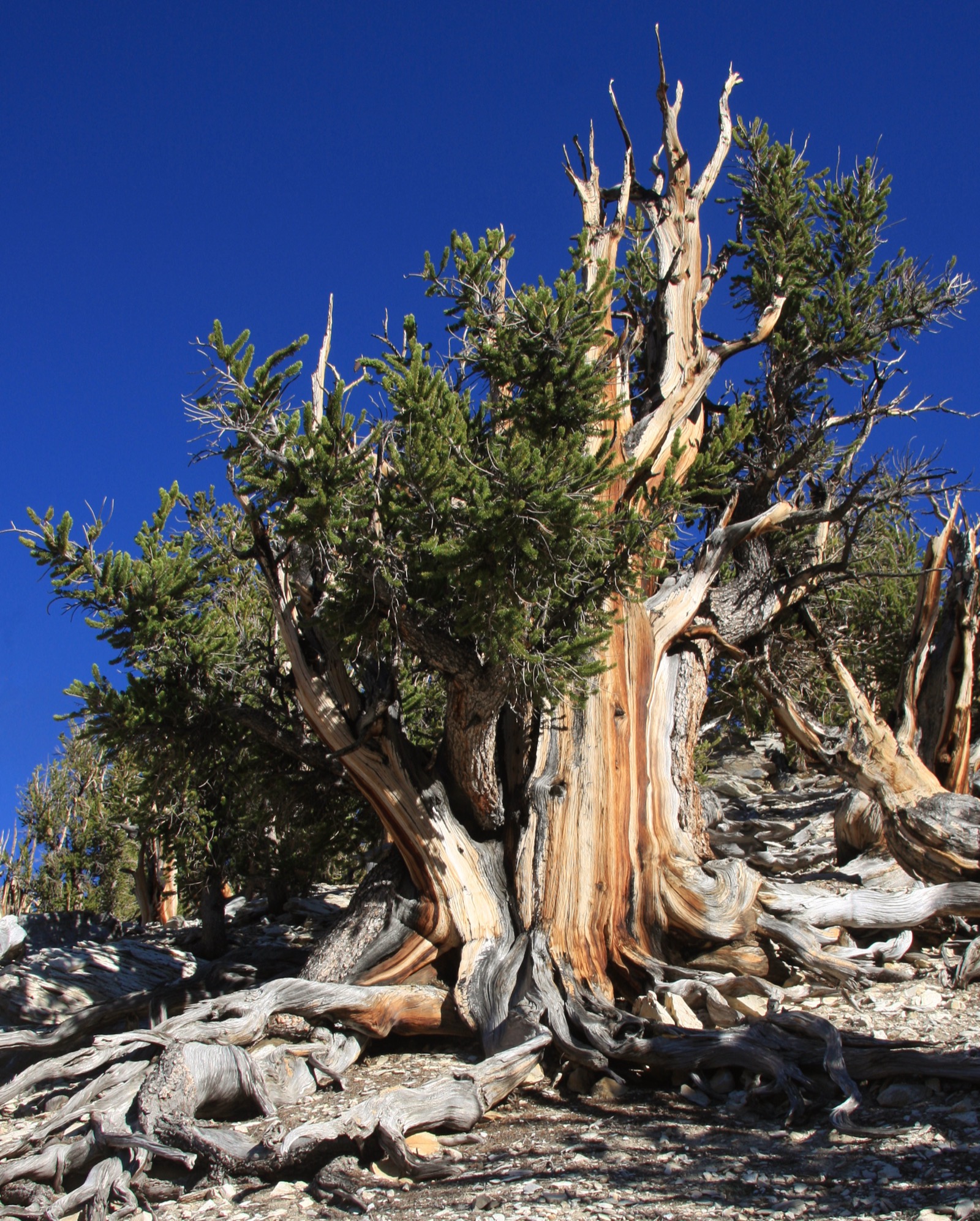
A bristlecone pine (Pinus longaeva) growing along the Methuselah Trail in the Schulman Grove of California's Ancient Bristlecone Pine Forest — a narrow strip of living bark carrying the crown, the rest of the trunk long since bleached and bare. Photo by Dcrjsr, CC BY-SA 3.0, via Wikimedia Commons — Source

The book that sent me into a bonsai garden has withering in its title. Kunio Kobayashi's Bonsai mo Hito mo Kareru Kara Omoshiroi (盆栽も人も枯れるから面白い) comes out roughly as "bonsai and people are both more interesting for withering." I read it one December, called his garden on Tokyo's eastern edge the next day, and have gone as an enrolled student since just after New Year last year. In bonsai, the withering is literal. On the conifers people stop longest in front of, a good share of the wood is genuinely dead — bleached, bare, and kept that way on purpose.
A tree standing alone above the treeline rarely looks like a tree in a valley. Its crown is thin and asymmetric, its trunk half bare, its living green pushed to whichever side the wind never quite reaches. No one designed that shape. Wind, snow, and centuries did.
Bonsai's most prized deadwood — the jin and shari of a shimpaku juniper — is not an artist's invention. It is a copy of what mountains have already been doing to old trees for a very long time.
What kills half a tree and leaves the rest standing
At altitude, a tree rarely dies all at once. Lightning strikes a leader and burns it back to bare wood. A branch snaps under the weight of winter snow, or is scoured by wind-driven ice, and the wound never quite closes. Years of drought stop water reaching one side of the trunk while the other side keeps drawing what little there is. The dead sections do not rot away — conifer wood dense with resin resists decay for centuries once it is exposed and dry — instead they weather to bare white or grey, standing beside the bark and foliage that is still alive. Bonsai has two words for this, borrowed directly from what mountains produce: jin (神, a stripped, whitened branch or leader) and shari (舎利, a stripped vein running down the trunk itself). An artist working a shimpaku or a pine does not invent this pattern; they judge where a real mountain tree would plausibly have died, and carve and bleach the wood to match.
No tree demonstrates the principle more plainly than the Great Basin bristlecone pine (Pinus longaeva) of California, Nevada, and Utah, individuals of which are reliably estimated at more than four thousand years old — among the oldest living things ever measured. Bristlecones survive that long partly through a growth habit botanists call "strip-bark": as the tree ages, bark and cambium die back across most of the trunk's circumference, leaving only a narrow ribbon of living tissue, usually on the side sheltered from the prevailing wind, to carry water up to a shrinking crown. The rest of the trunk stands as dead wood, sandblasted and ice-scoured smooth over centuries. The arithmetic is survival: reduce the living tissue a tree has to feed, and it can outlast almost anything. We have written elsewhere about how jin and shari are read on a finished bonsai; a bristlecone on an exposed ridge is the same logic with several thousand more years behind it.
A shape no wire can invent
Wind alone does not usually kill a mountain tree, but it decides which parts survive and what the survivor will look like. At the treeline, sustained cold wind and heavy snow load produce what foresters call krummholz (German for "crooked wood") — stunted, asymmetric conifers whose windward branches die back while their leeward growth stretches out, giving the whole tree a lopsided, banner-like silhouette. A branch loaded with snow winter after winter eventually breaks or bends permanently in one direction; a bud on the exposed side simply does not survive to open the following spring. Over enough winters, a tree's living outline stops being anything the tree decided for itself — it becomes closer to a record of which parts the mountain allowed to keep growing. A grower who wires a branch downward, or thins one side of a canopy to open space for light, is doing at a slower and gentler pace the same editing that wind and snow do on their own. The difference is that a mountain has centuries to work with, and no need to be gentle.
Where shimpaku's white wood comes from
Japan has its own version of this mountain, and it sits closer to bonsai's own history than any bristlecone forest. The Itoigawa shimpaku (糸魚川真柏), the juniper variety most prized for its deadwood, grows wild on the steep limestone and volcanic cliffs of Mount Myojo, Mount Kurohime, Mount Amakazari, and the Umidani Gorge near the city of Itoigawa on Japan's Sea of Japan coast — terrain that now lies within the Itoigawa UNESCO Global Geopark. On those cliffs, wild specimens naturally develop the same features growers now train into cultivated trees: hardy, twisted trunks carrying ribbons of bleached shari and small dead jin branches, shaped by the same wind, cold, and drought at work on any exposed ridge. A bonsai collector named Suzuki Tahei is credited with identifying this variety's distinct quality on Mount Kurohime near Shimizukura village around 1910; by the 1930s it had become sought after nationally, and demand only grew through Japan's postwar decades. By the 1970s, most of the large wild specimens on those cliffs had already been collected, and the wild population went into decline — enough that a local conservation effort, the Itoigawa Shimpaku Project, now works to protect what remains. We look separately at how trees are collected from mountainsides like these, and at the shimpaku itself as a species. The wood on a well-regarded shimpaku bonsai today carries, in a real sense, the memory of that cliff.
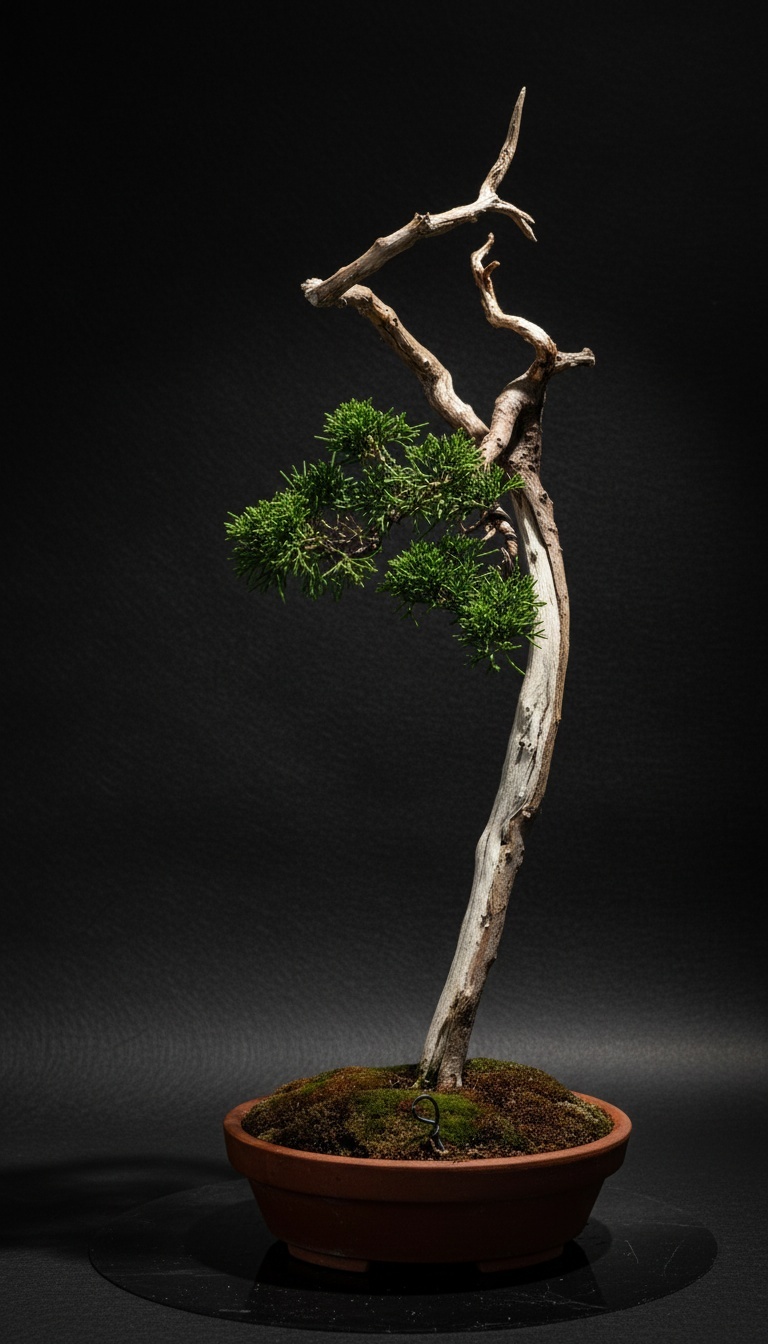
A cultivated shimpaku juniper, its bleached deadwood trunk carved and shaped to echo the same forms wind and cliff produce in the wild. Photo: Azukari
Nothing here can be hurried out of a workshop
A bristlecone's wood is dense and slow-grown — in the harshest sites a century is reported to add less than an inch of girth — which is part of why it resists rot for so long once it dies. A wild shimpaku on Mount Kurohime needed decades of hard wind before its deadwood had anything worth copying. What an artist studying a mountain tree brings home is a working rule: look first, invent nothing, and trust that the most convincing form is the one closest to what actually happened to a tree that lived through real winters. Japan's whole vocabulary of bonsai styles works the same way — observed first, and only named afterward.
The white wood should look like something that happened
An old mountain tree does not know it is teaching anyone anything. It has simply survived, one hard winter at a time, in a place with no shelter and no one watching. A tree's most honest form is the one that time and weather were allowed to finish.
That leaves a viewer something to use. Standing in front of a tree carrying jin and shari, ask whether the damage is plausible before asking whether the carving is skilful. Does the living vein run up the side a prevailing wind would have spared? Could one event — a lightning strike, a branch snapped under snow, a drought that starved a single flank — have left that pattern? Wood that answers those questions reads as a record of weather. Wood that cannot reads as decoration, however cleanly it was cut.
I came to bonsai through a book about withering, and the part I have not been able to get past is that the finished-looking wood is the part nobody can hurry. Azukari is arranged around that pace: a tree stays in Japan under an artist's care through the seasons that actually shape it, while its owner joins one stretch of a record already underway. The mountain does the teaching either way; the artist, and the owner after them, keep watching.
References
- The Gymnosperm Database — Pinus longaeva (Great Basin bristlecone pine) — on the strip-bark growth habit, high-elevation habitat, and age records including the Methuselah tree.
- Bonsai Empire — Deadwood on Bonsai (Jin, Shari and Uro) — definitions of jin and shari and the natural causes (lightning, drought, ice, wind, snow load) they imitate.
- Krummholz — Wikipedia — on wind- and snow-driven asymmetric growth at the treeline.
- Itoigawa Shimpaku Project — "What is the Itoigawa Shimpaku?" — on the variety's wild cliff habitat, its identification by Suzuki Tahei around 1910, and its 20th-century decline from collection.
- Japan Travel (JNTO) — "Itoigawa Shimpaku, the King of Bonsai" — on the limestone cliff habitat of Mount Myojo and Mount Kurohime, and on the decline that decades of harvesting have caused.
- Bonsai Mirai — "Ancient Bristlecone Pines" — a bonsai artist's account of visiting the ancient bristlecone groves in California's White Mountains, and of the bleached, wind-worn deadwood found there.