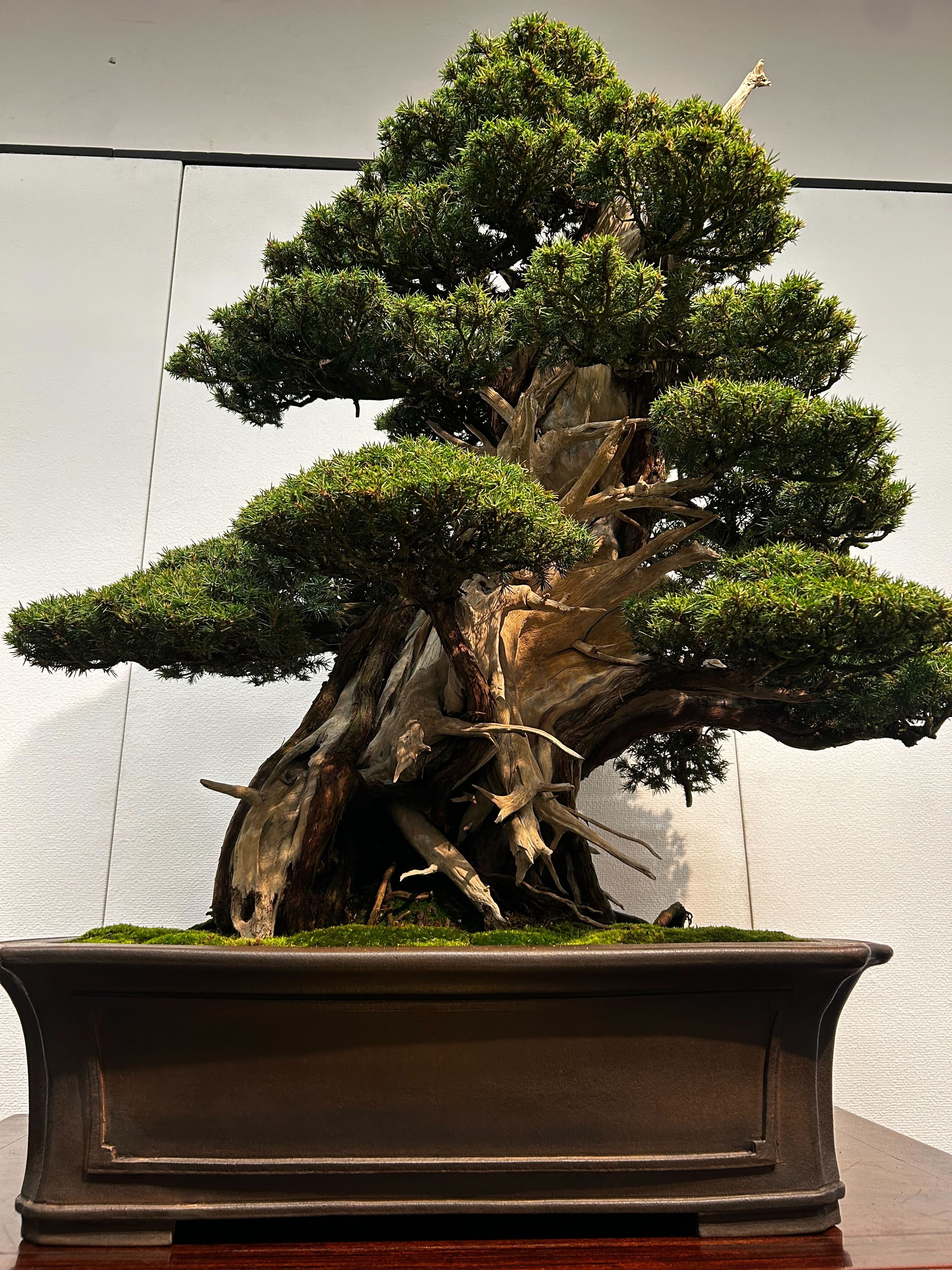
Juniper, styled after the weathered, tiered growth of a tree that has spent decades exposed to wind and cold. / Photo: Azukari
A yamadori (山採り, "collected from the wild") pine, taken from a Japanese mountainside rather than a nursery row, may be no taller than a person's arm and still older than anyone tending it — its trunk thickened and its bark cracked deep by decades of thin soil, hard wind, and short growing seasons that no cultivated tree had to survive.
Every named bonsai style began as a description of a real tree, already alive and already shaped, growing somewhere no person put it.
The vocabulary was found, not invented
Bonsai keeps a working vocabulary of named forms: the straight trunk of chokkan (直幹, "formal upright"), the curving trunk of moyogi (模様木, "informal upright"), the falling trunk of kengai (懸崖, "cascade"), and others besides. None of these were drawn up first and then hunted for in nature. The order ran the other way: a straight pine standing alone in open ground, a maple leaning gently over a garden path, a juniper pouring off the lip of a cliff — growers saw the shape, and only afterward gave it a name. It is easy to assume, standing in front of a finished exhibition tree, that the design came first and the plant was trained toward it. The mountainside pine described above says otherwise, and so does everything else in this vocabulary: an artist styling a young tree is not inventing a form and asking the tree to wear it. They are trying to remember, closely enough to reproduce, a form nature already showed someone once.
Wind bends the trunk; stone bends the root
On the coasts of Honshu, Shikoku, and Kyushu, Japan's kuromatsu (黒松, "Japanese black pine," Pinus thunbergii) grows into a permanent lean — decades of salt wind and thin sandy soil pressing against one side of the trunk until the bend stops being temporary. Bonsai's fukinagashi (吹き流し, "windswept style") — a trunk and every branch swept in a single direction, as if the wind had never stopped — is a copy of that pine, not a shape someone dreamed up on paper.
A mountain valley teaches close to the opposite lesson. Kaede and momiji (楓・紅葉, the two common names for Japanese maple, Acer palmatum) are understory trees, most often found on the moist slopes of low mountains, in the filtered light beneath taller trees, where roots have to find their way around whatever stone is already in the ground. Where a root meets a rock too large to grow through, it grows over it instead, gripping the surface as it thickens with age. Bonsai's ishitsuki (石付き, "root-over-rock style") copies exactly that: a tree planted so its roots visibly wrap a stone before reaching soil, the two growing old together. The next piece in this series looks more closely at what a mountain valley's trees can teach a grower.
The best material is already old when it is found
Yamadori is the most direct expression of this principle: taking a tree not from a nursery row but from the mountainside itself, where decades of thin soil, hard wind, and short growing seasons have already done work no cultivated tree matches in a comparable span, as the pine described at the start of this piece shows. Its deadwood — the bleached jin and shari a mountain tree earns through frost and lightning — is written about at length elsewhere. None of that age can be manufactured quickly. A grower who wants it has one honest option: go and find a tree that has already lived it. We look separately at how that search and collection actually happens.
A wild original turns the shape into a claim you can check
Once a viewer has spent real time in front of a coastal pine or a valley maple, a bonsai stops reading as decoration and starts reading as a claim: this trunk says it survived wind; this root says it grew around stone. Unlike a claim about taste, this one can be checked, against the tree it is quoting. The next time a trunk's lean or a root's grip catches your eye, the more useful question is which wild tree taught it — a coastal pine, a valley maple, a mountainside survivor — rather than whether the shape happens to look pleasing. That question is the judgment worth carrying out of an exhibition hall, and it is why growers still walk coastlines and mountainsides rather than working from a catalogue of approved forms. The catalogue only exists because someone walked there first.
The classroom was never a book
A bonsai artist's education does not finish with technique. Long after wiring and pruning are second nature, an artist keeps returning to open ground — a coastline, a ravine, a stand of old trees on a ridge — because the textbook was never a book to begin with. It was the trees.
That habit of returning outdoors is also what Azukari asks of the artists who keep its trees: a tree stays in Japan under someone who, years into the craft, is still checking a trunk's line against a mountain they can picture. An owner elsewhere does not lose that habit of looking. They simply join a tree whose form was not designed once and repeated since, but noticed once, in the wild, and carried forward with care.
References
- Bonsai Empire — Bonsai Tree Styles — description of the windswept (fukinagashi) style: "trees that must struggle to survive... the branches as well as the trunk grow to one side as if the wind has been blowing the tree constantly in one direction."
- Bonsai Empire — Collecting Trees from the Forest (Yamadori) — on why wild-collected trees are prized: naturally stunted growth from harsh conditions gives them qualities cultivated stock takes far longer to develop.
- Bonsai Empire — Rock Planting — on the ishitsuki / sekijoju root-over-rock style and the "struggle to find nutrients in a harsh environment" that shapes trees growing on rock.
- Seattle Japanese Garden — "Pine Trees, Part Two: Matsu, the Pines of Japan" — on kuromatsu as a seacoast native and the "dwarf, contorted forms created by battering seacoast winds" that bonsai styling represents.
- 三河の植物観察 — イロハモミジ — on Acer palmatum subsp. palmatum growing naturally "山地のやや湿った場所" (in somewhat moist mountainous places).