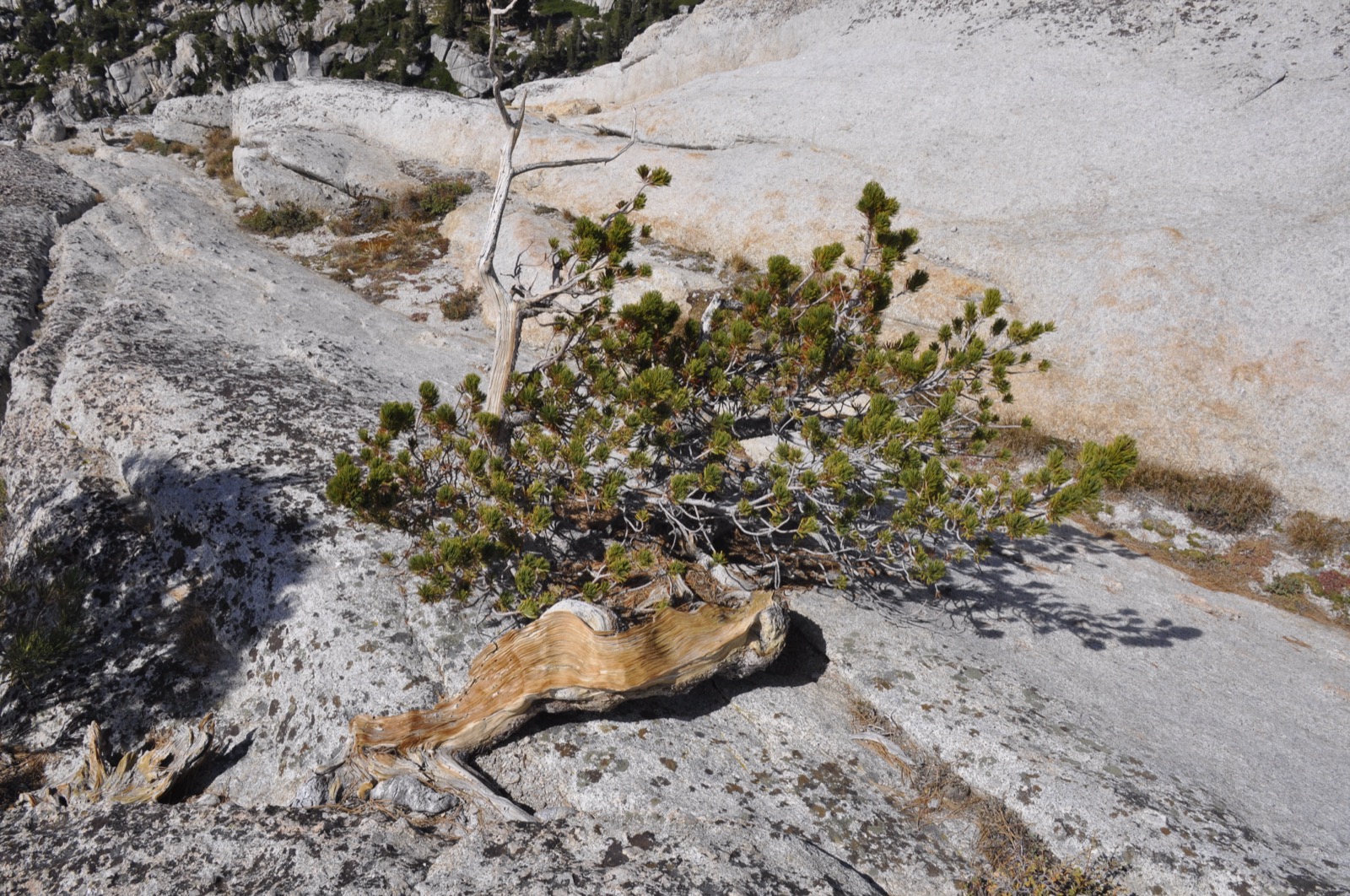
A whitebark pine (Pinus albicaulis) on the summit of Pywiack Dome, Tuolumne Meadows, Yosemite National Park — its trunk flattened and grain-twisted by wind and granite rather than by any tool. Photo by Jarek Tuszyński, CC BY 4.0, via Wikimedia Commons — Source

On the summit of a granite dome in the Sierra Nevada, a whitebark pine grows sideways along the rock instead of up into the wind. Its trunk is a flattened, corkscrewed plank of pale wood, its living crown barely knee-high, its exposed grain running in ribbons no chisel produced. Nothing about that shape was designed. Decades of wind, snow load, and almost no soil to draw from did it.
A yamadori tree does not begin its life in a nursery or under an artist's hand. It begins on a mountain, shaped by conditions that spend decades doing, slowly and without intention, what a bonsai artist can only ever try to approximate.
What the mountain builds
Yamadori (山採り, literally "mountain-gathered") is bonsai's term for material collected from the wild — a tree dug from a cliff, ridge, streambank, or exposed slope and brought into cultivation, rather than one raised from seed or cutting under a grower's care from the start. What makes such a tree recognizable is written into its structure before it ever reaches a pot: a trunk thick at the base and tapering fast, bark scarred by wind and drought, foliage reduced to whatever the site's poor soil and short growing season could support. None of it is stylistic — a tree rooted in a crack thickens its base out of necessity, not design, and sheds branches the way any survivor sheds what it cannot afford to keep. We've written elsewhere about the bleached, weathered deadwood — jin and shari — that this kind of hardship produces on old mountain trees; a yamadori specimen frequently arrives already carrying an early version of it.
A curve no wire can invent
Wiring persuades a young, still-pliable branch toward a shape over a season or two. A wild trunk's curve is the residue of an actual event — a boulder it grew around, a decade under a snowpack that pinned one limb flat, a lightning strike that killed half a crown and left the rest reaching sideways for light. Growers who work with collected material describe an almost immediate honesty to it: a wild tree "expresses the struggle for survival through its appearance and bark" in a way even a carefully trained, decades-old seedling rarely manages to fake.
That honesty comes at a cost. A plant shaped this severely by hardship is often barely holding on, and removing it from the one set of conditions that let it survive is a serious risk in itself. Reports from experienced collectors are blunt on this point: in many cases, a newly collected tree does not survive the first year. Outcomes turn on species, timing, and — above all — aftercare: the root ball wrapped and kept moist, replanted with soil from the original site, then left undisturbed through a full growing season before any styling begins. A yamadori tree's first year in a pot is recovery, not design.
Permission first, restraint always
Nothing about collecting a wild tree happens on a whim; permission is a prerequisite, not a formality. On private land, explicit consent from the owner is required. On protected land the answer is often simply no: a tree like the whitebark pine on Pywiack Dome, inside a national park, cannot be collected at all, however striking its trunk. Even where public land does allow limited removal — some United States National Forest districts issue a permit for a small number of specimens, for a modest per-tree fee that varies by forest — the process runs through a ranger district office, not a shovel and good intentions.
Restraint runs deeper than paperwork. Bonsai's own community is unsparing about collectors who take without judgment: one widely told account describes a mature pine reduced to a fraction of its branches, its roots severed carelessly, killed by collectors who, in the words of one grower, "understood nothing about Bonsai." The more demanding view holds that some trees simply are not meant to be taken — too exposed, too weak, or too slow to recover, better admired than removed. In Japan, this restraint has become close to the norm: suitable material on both public and private land has grown scarce after a century of collecting, and the general professional view now treats restraint, not extraction, as the responsible position.
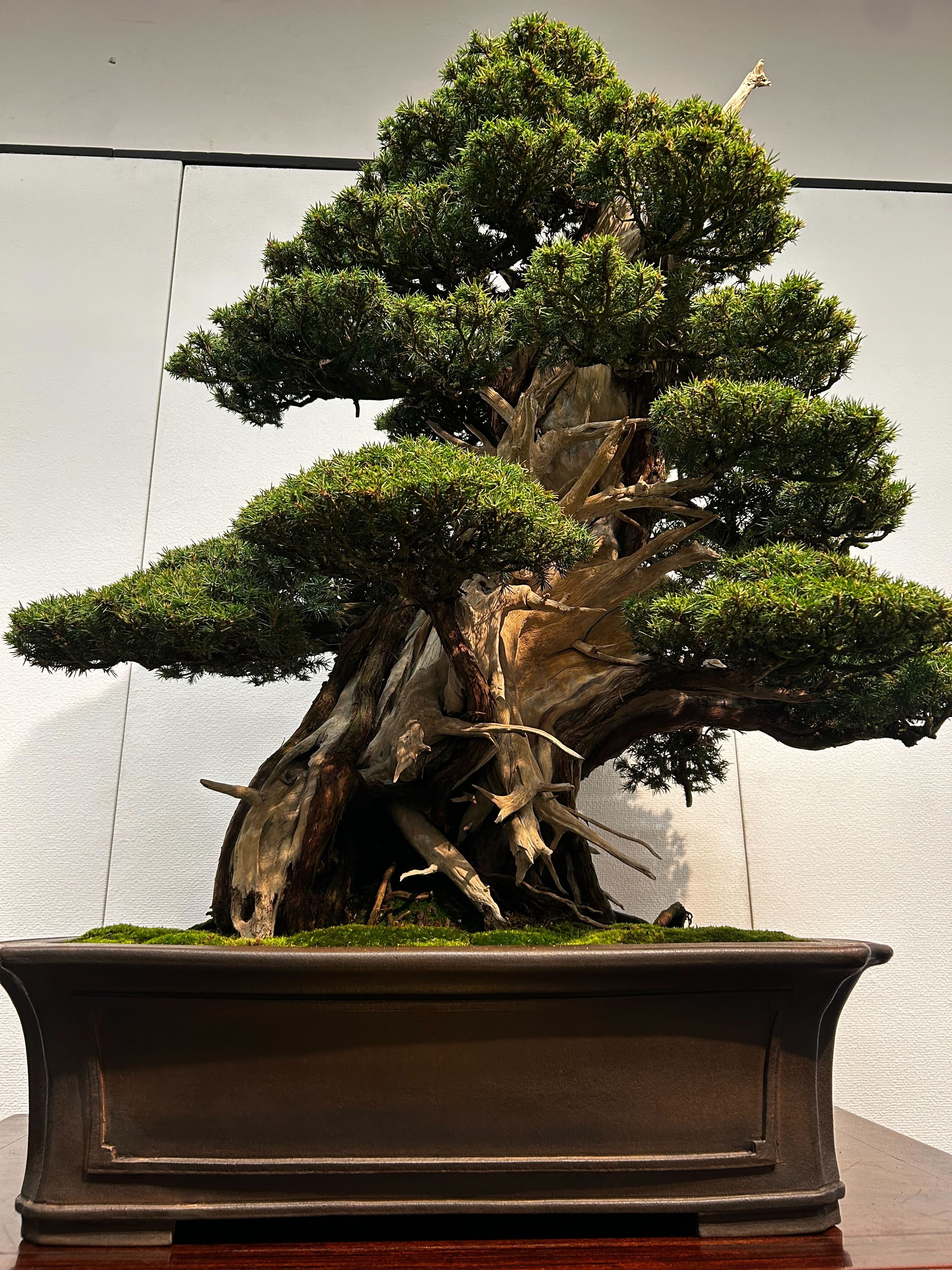
A tosho needle juniper bonsai, its wide, deadwood-heavy trunk showing the kind of movement collectors prize — the mountain's decades of work, still visible after years of cultivation. Photo: Azukari
A gift that keeps working
Collection is not where a yamadori tree's story ends; its wild decades are only the first chapter. After that first undisturbed year, training continues for years or decades more — wiring, pruning, and repotting under a grower's hand before the tree resembles anything meant for display. Bonsai practice has its own name for that second stretch of time: mochikomi (持ち込み, roughly "years brought into the pot"), the span a tree spends developing under cultivation once it has left the wild. We look separately at how that second kind of time is read on a finished tree. Some of Japan's most storied bonsai carry both kinds of time in a single trunk: the white pine known as "Higurashi," now held at the Omiya Bonsai Art Museum, is said to have been found growing wild in Shikoku in the early Showa era, its later decades under a named artist's care built on top of what the mountain had already done. A tree does not stop being shaped by time once it leaves the slope. It simply changes hands, from weather to a person.
Closing
A collected tree carries two kinds of time a nursery-raised one cannot separately claim: the unrecorded decades a slope spent shaping it before anyone noticed, and the recorded years a grower spends afterward making that shape legible as bonsai. Most bonsai in cultivation today are not yamadori at all — they are grown from seed, cutting, or graft, patiently, under a grower's care from the start, and that path carries no less honest a record. But where a wild-collected tree does enter a garden, permission secured and the site left as though no one had ever stood there, it arrives already carrying a record it did not ask anyone to write.
Azukari tends trees of both origins under the same principle: whatever years a tree carried in before it reached a garden, the seasons after that point are recorded, not assumed. A trunk shaped by a mountain and one shaped patiently over decades of training ask the same thing of whoever takes them on next — attention, continued for as long as the tree keeps growing.
References
- Bonsai Empire — "Collecting Trees from the Forest (Yamadori)" — on the definition of yamadori, collection technique, and aftercare.
- Bonsai4Me — "Collecting Trees from the Wild, Part One" — on why wild-collected trees are prized, survival rates, and the ethics and permissions collecting requires.
- Bonsai Empire — "Yamadori Collecting: Vandalism" — an account of careless, unethical collecting and the restraint responsible collectors hold themselves to.
- USDA Forest Service, Pacific Southwest Region — "Searching for Bonsai: 'Every Tree Has a Story'" — on permits for collecting bonsai material on US National Forest land.
- Bonsaimyo — Bonsai Dictionary: "Yamadori" — on the definition of yamadori and its rarity in present-day Japanese practice due to depleted material and conservation norms.