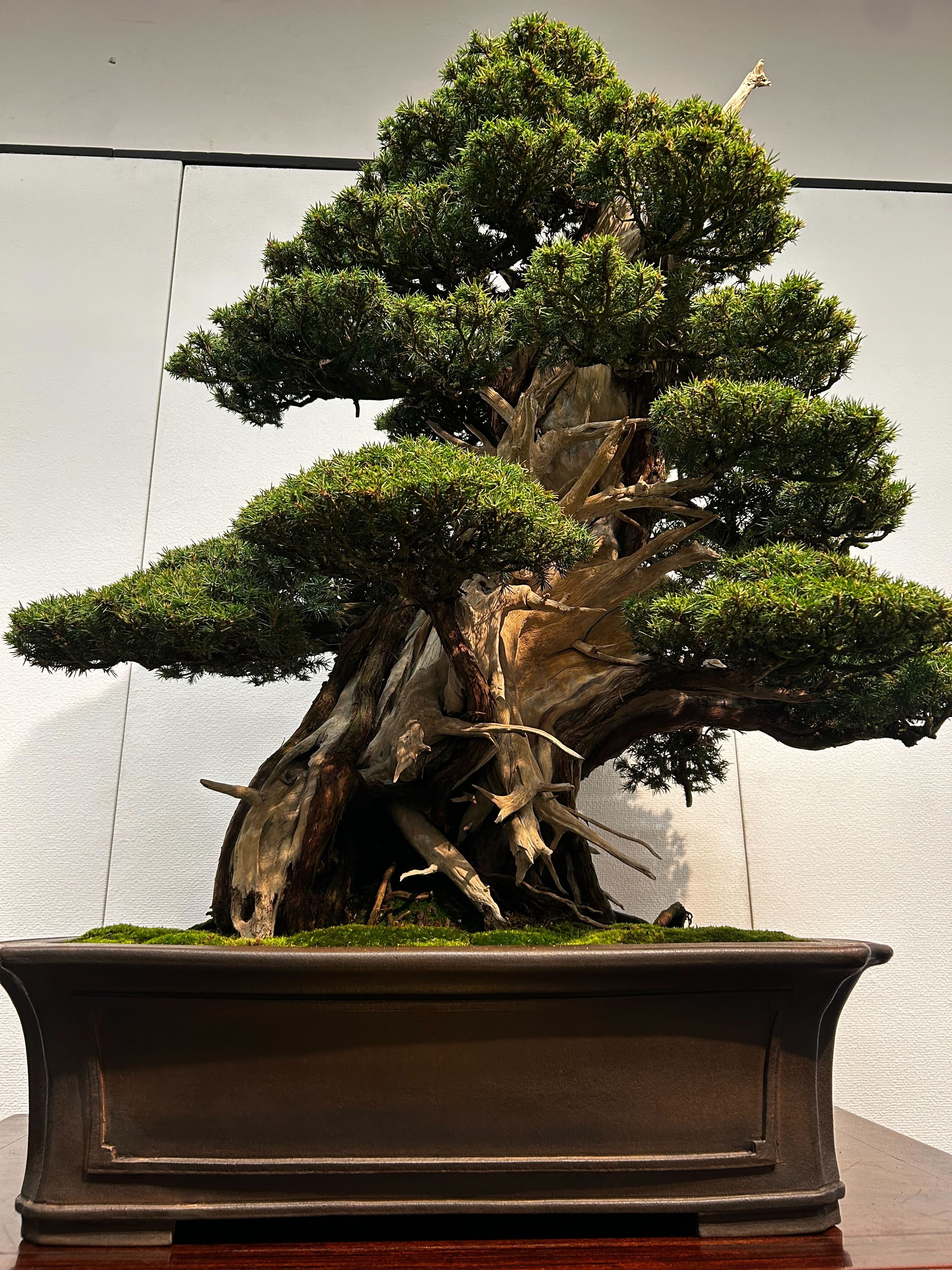
A century-old pine pulled from a coastal cliff and a nursery-raised white pine potted forty years ago can stand side by side at a bonsai exhibition, and by one particular measure, the nursery tree is the "older" of the two. That measure is mochikomi (持ち込み, "the years a tree has spent trained and cultivated inside a pot"), and it runs on its own clock, indifferent to how many rings might be hidden inside either trunk.
A bonsai's mochikomi does not record how old a tree is. It records how long it has been worked in a pot, and that second number, more than the first, is what a grower is actually reading when they look at a tree.
What the word actually counts
Japanese glossaries define mochikomi plainly: the years, and the progress, a tree has spent potted and under baiyo (培養, "sustained cultivation") as a bonsai. The count does not start when a seed sprouts, and it does not start when a tree is first noticed growing wild. It starts on the day a tree enters a pot and its life as bonsai — under a grower's shears, wire, and eye — actually begins. A seedling raised in open ground for its first fifteen years and potted only afterward has, at the moment of potting, a mochikomi of zero, whatever its age by then.
Growers speak of mochikomi the way a trade might speak of years served: "this tree's mochikomi is old" (持ち込みが古い) is a compliment about accumulated handling, not a claim about how many seasons the tree has survived on earth. It is kept apart from age precisely because the two so often diverge — and because mochikomi is the part of a tree's history a grower can actually claim credit for adding.
A separate clock from the tree's age
Nowhere is that gap more visible than with a yamadori (山採り, "a tree collected from the wild"). A pine collected from a coastal cliff can already be a century or more old on the day it is dug up, its trunk shaped by decades of salt wind before any bonsai artist ever touched it. Its age, by any reasonable count, is considerable from that very first day in a nursery pot. Its mochikomi is not. It starts at zero, the same as a cutting struck from a garden hedge, because mochikomi is not measuring how long the tree has lived — it is measuring how long someone has been training it.
The reverse happens just as often. A tree propagated from a cutting or grown from seed inside a nursery, potted early and trained without interruption for forty or fifty years, may be genuinely young by any ordinary count of age, and still carry a long, well-regarded mochikomi. We have written elsewhere about the several imperfect ways growers estimate a tree's age — bark texture, root spread, a written record kept alongside the tree — and mochikomi sits on that list only awkwardly, because it is not really trying to answer the same question. It answers a narrower one: not how long has this tree lived, but how long has it been worked.
The years in the pot are the work itself
Those years are not passive. A trunk left alone in a pot for forty years without training does not develop a long, respected mochikomi — it develops an overgrown shrub. What actually fills a mochikomi is a specific, repeated cycle of technique, carried out season after season until its cumulative effect becomes visible in the tree's outline.
A mature bonsai is repotted roughly every three to five years, its roots trimmed back and reset in fresh soil each time — frequent enough to keep the tree healthy in a shallow container, infrequent enough that its trunk can go on thickening at its own slow pace. Between repottings, a grower prunes and wires the tree's main branches into position, and once that structure holds, moves to the slower work of pinching new growth back through the growing season, a technique that redirects the tree's energy inward and, over years, produces the fine, layered branching — ramification — that reads at a glance as "old." None of it happens quickly, and none of it happens by accident: growers who study the process are explicit that a tree simply left to grow and then cut back to where it started stays stagnant no matter how many years pass, while a tree worked through the same cycle with intention moves, by degrees, toward the dense, settled silhouette a long mochikomi is known for. Mochikomi, in other words, is not a stretch of time a tree survives. It is a stretch of time a tree is worked, one repotting and one round of pinching at a time — and the years only count if the work was actually done in them.
Why a longer mochikomi carries more rank
Because mochikomi tracks work rather than the calendar, a long one is read as a mark of standing. Bark thickens and takes on a texture it could not have shown a decade earlier. Foliage divides into finer, denser pads. A trunk's outline settles into the kind of quiet, unhurried shape Japanese aesthetics group loosely under wabi-sabi (侘び寂び, "beauty found in age and imperfection"). None of it can be rushed by feeding a tree harder or carving its bark to look old; growers are candid that such shortcuts show under close inspection, while a genuinely long mochikomi does not.
That is also why formal judging treats mochikomi as a criterion in its own right, distinct from a tree's species or the drama of its trunk. In describing how it selects its top honor, the Nippon Bonsai Association's own guide to the Kokufu Bonsai Exhibition lists judges weighing, among other things, a planting's overall composition, its kaku (格, "rank," the bearing by which a tree is judged), the harmony of its pot and stand — and, named separately, its baiyo no jotai (培養の状態, "the state of its cultivation"). A tree collected only recently from the wild is judged differently from one that has spent decades under a single, continuous line of careful training, however dramatic either trunk. Rank here has nothing to do with price. It is closer to seniority within a craft: a tree earns its standing the same slow way an apprentice earns a teacher's trust, one season of real work at a time.
Closing
A bonsai's mochikomi is one of the few things about it that cannot be inherited, bought outright, or shortened by wanting it sooner. It has to be spent, season after season, inside an actual pot, under an actual pair of hands.
That is close to what Azukari is built around. A tree continues its training in Japan under an artist's ongoing care, and every season added to its mochikomi is recorded as it happens — a repotting here, a round of pruning there — so an owner is not simply holding a finished object but joining a tree partway through the very years that are still shaping it.
For more, see "Meiboku: Japan's Historic Bonsai," which follows trees whose long mochikomi has passed through generations of hands, and "Nebari: What the Roots Say," on the one other place in a bonsai where years cannot be shortcut.
References
- Shikoku Shimbun — "Mochikomi" (BONSAI glossary) — English-language definition of mochikomi as the years a bonsai has been cultivated in a pot, distinct from the tree's raw age.
- Bonsai Myo (盆栽妙) — "持ち込み" glossary entry — Japanese-language definition of mochikomi as the years and progress of a tree's cultivation in a pot, and its effect on bark texture and branch density.
- Bonsai Mirai — "Pinching vs. Pruning" — on how repeated, seasonal pruning and pinching over years builds fine ramification, and why simply letting a tree grow and cutting it back does not produce the same result.
- Bonsai Empire — "Repotting Bonsai, How to Repot Your Tree" — on repotting frequency, noting that mature, older bonsai are typically repotted every three to five years.
- Nippon Bonsai Association — Event Guide — official description of the Kokufu Award's judging criteria, including a planting's rank (格) and its 培養の状態 ("state of cultivation").