
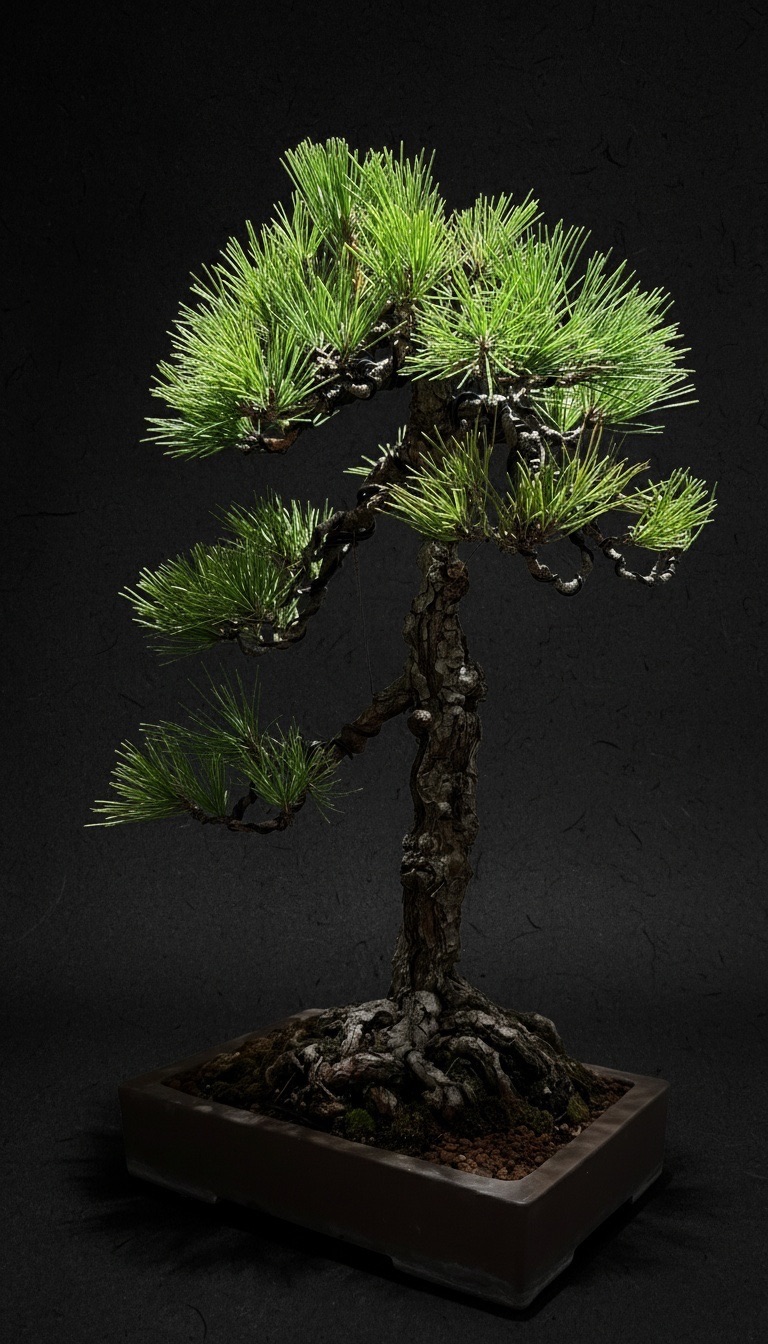
A cross-section through the trunk would settle the question within an afternoon: count the rings, and the tree's age is a fact rather than a guess. No bonsai owner does this, since the only way to see the rings is to cut into wood that is still alive, and no one destroys a tree to date it. What remains, once that option is off the table, is a small set of visual and documentary clues — none conclusive alone — that let a grower speak of a tree's age with confidence, but rarely with certainty.
A bonsai's age is not measured. It is read, from bark, from roots, from years spent in the pot, and from whatever record was kept alongside the tree.
Why the rings stay hidden
A living trunk keeps its growth rings sealed inside itself. The one genuine ring count available to a specialist requires a cross-section, typically taken from a large branch or root that has already been removed from the tree, then sanded, polished, and studied under a microscope — sometimes at extreme magnification, when a slow-growing species has packed decades into a few centimeters of wood. Even collectors who do this on wild-collected trees describe the result as an estimate, a growth rate applied to the trunk's full radius, not an exact count. For a tree still being trained in a pot, cutting it open is not an option at all. So "how old is this bonsai" is, in practice, always answered from the outside — from what a trunk, a root, or a piece of paper can show without harming the tree that carries the answer.
What bark and roots can tell you
Bark is the part of a bonsai that age cannot skip past. A young trunk, whatever its girth, tends to keep a smoother, tighter skin; only years of standing and thickening produce the deep fissures, plating, and flaking that read, at a glance, as old wood. Growers are blunt about this: a trunk can be fattened and carved to look venerable within a few seasons, but bark resists shortcuts, since it is laid down one thin layer at a time. We have written elsewhere about reading a bonsai's trunk and deadwood in more detail.
The other place age shows itself is at the base of the trunk, in the nebari (根張り, "the surface roots that radiate outward from the trunk across the top of the soil"). A tree repotted again and again over many years tends to show a wide, settled spread of roots gripping the soil surface — a spread that, as we explored in an earlier piece, simply cannot be built quickly, no matter the technique. Bark and nebari are read together: old-looking bark above a thin, undeveloped root base is a signal to look closer, not a settled answer.
Mochikomi: a second, separate clock
Bark and roots point toward a tree's age, but bonsai practice keeps a related idea distinct from it: mochikomi (持ち込み, "the years a tree has spent potted and trained under a grower's care"). A tree's age is usually counted from seed or from the day it was found in the wild. Its mochikomi is counted from a later, narrower starting point — the day it entered a pot and began its life as a bonsai.
The two numbers can diverge sharply. A pine collected from a coastal cliff may already be a century old the day it is dug up, yet its mochikomi starts at zero from that point forward. What mochikomi tracks is not raw age but the years of repeated repotting, pruning, and pinching that give a trunk the branch density and settled bearing of a long-cultivated tree — qualities that only accumulate at their own pace. A grower calling a tree's mochikomi "old" is making a narrower, in some ways more demanding claim than age alone: time spent specifically under a bonsai artist's hand. We look at this yardstick in more depth elsewhere. With certain conifers, growers also count the distance between a pine's annual whorls of branches as a rough early guide, though the method holds only loosely, and mostly in a tree's first decade or so.
Where the written record settles what the eye cannot
Bark, roots, and mochikomi leave a grower with an informed estimate. What turns an estimate into something closer to a fact is a written record kept alongside the tree — who collected it, who trained it, when it was last repotted, what it looked like the year before.
Japan has a formal version of this. Since 1980, the Nippon Bonsai Association has run a registration process for what it calls kicho bonsai (貴重盆栽, "a bonsai formally registered for its documented form, history, or rarity"), and more than 1,200 trees have been accepted into it, each recorded with photographs taken at the time of registration, so a tree's condition on a given date stays checkable long after, even if it later changes hands or dies. Most bonsai never go through anything this formal — a nursery ledger, a dated photograph, or a grower's own notes on a repotting serve the same purpose at a smaller scale. We wrote separately about why this kind of record, more than age alone, is what a tree's worth is ultimately read from. Here the record is doing narrower work: not proving what a tree is worth, but anchoring a guess about how old it is to a date and a name someone else can check.
Living with an estimate
None of this adds up to a single trustworthy number, and growers have made a kind of peace with that. A bonsai's age is usually spoken of as "around" a figure, qualified, open to revision if a better record turns up. That comfort with an estimate held loosely, rather than insisted on, is close to how bonsai is practiced day to day — a discipline built less on fixing a tree's condition once and for all than on tending it, season after season, and writing enough down that the next person does not have to start from bark and roots alone.
Azukari keeps that written record as a matter of course. As a tree continues its training in Japan, each season's work is entered as a dated note — what was pruned, when it was repotted, how it looked that year — so an owner's sense of a tree's age never rests on bark and roots alone, and the next person to hold it inherits a paper trail, not just a guess.
References
- Stone Lantern — "Bark and Bonsai" — on bark as the surest visible sign of a bonsai's age, and why bark texture cannot be artificially aged the way deadwood can be carved.
- In Vivo Bonsai — "A Lesson in Dendrochronology" — on how collectors estimate a tree's age from a polished cross-section of a removed branch or root, and the limits of that method.
- Bonsai Empire — "The Visible or Surface Roots of Bonsai (Nebari)" — on why a developed nebari takes years to form regardless of technique.
- Bonsai no Gakko (盆栽の学校) — "Mochikomi" glossary entry — Japanese-language definition of mochikomi as the years a tree has spent potted and cultivated as a bonsai.
- Bonsai Navi (盆栽なび) — "How to Find Out a Bonsai's Age" — Japanese-language overview of age-estimation methods, including counting a pine's annual branch whorls, and their limits.
- Nippon Bonsai Association — About the Association — on the kicho bonsai registration system running since 1980, with more than 1,200 trees recorded by photograph.