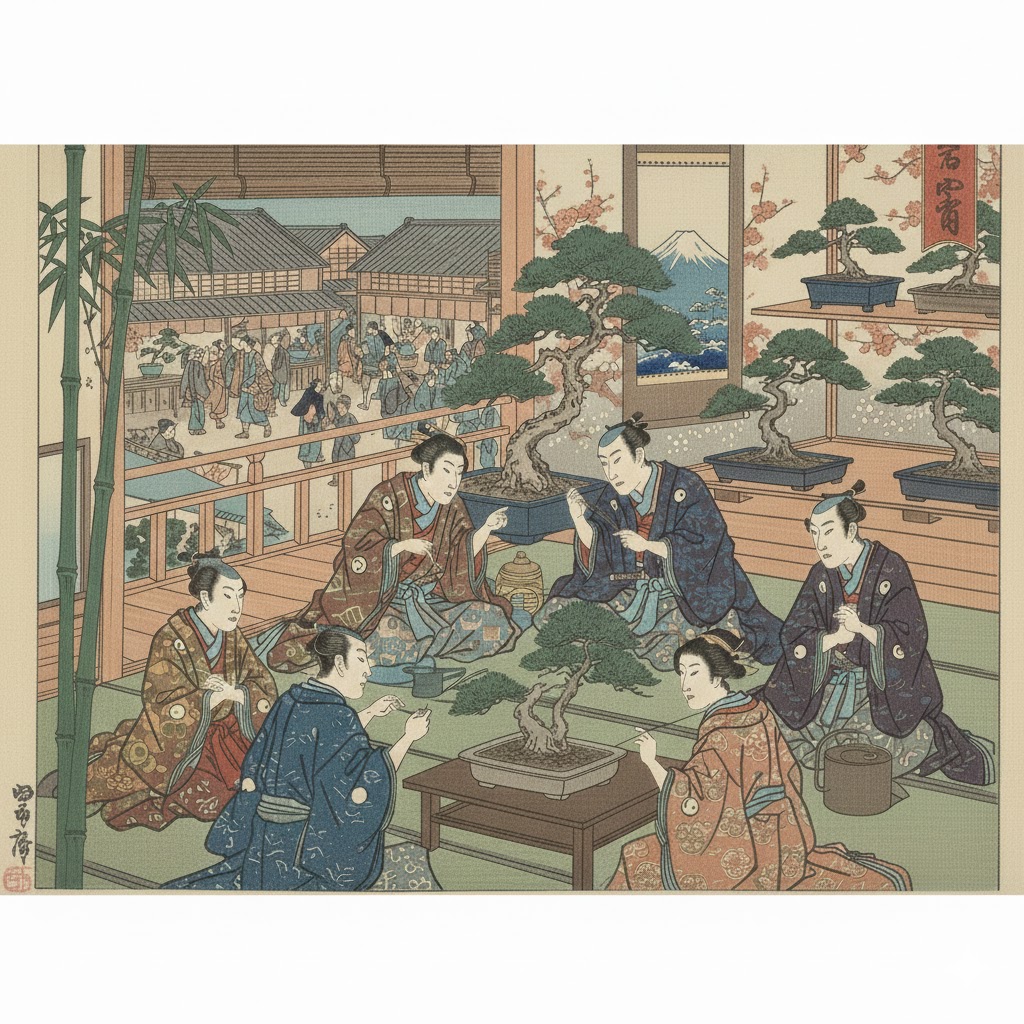
An artistic rendering of connoisseurs gathered to examine a tree together — the kind of shared, ongoing judgment that a bonsai's record is built from.
Stand two bonsai of the same species and roughly the same age side by side, and a stranger often cannot tell them apart. But one of them arrives with a folder: the ground it was collected from, the artist who trained its first branches, the owner who kept it through a difficult decade, the show where it was exhibited. The other arrives with nothing but its shape.
A bonsai's value is not read from the tree alone. It is read from the record of who raised it, who kept it, and for how long.
The record of hands
A tree usually outlives any single person who tends it, so its record is rarely the work of one hand. It is layered: the grower who first collected and potted it, the artist who gave it its early branches, the next artist who reworked its front thirty years later, the owners who kept it through wars, moves, and family changes, the shows it stood in and the years it disappeared from view entirely.
In Japanese bonsai culture this traceable line of custody is called keireki (経歴, "a tree's record of who has shaped and held it"). It is close to what a museum calls an object's chain of custody, except that a bonsai's keireki is still being written, because the tree is still alive and still changing hands. We wrote about one striking example of this — a three-thousand-year-old shinpaku juniper passed from a mountain collector, to the bonsai master Saburo Kato, to its current owner — in our piece on why a bonsai carries a name. A meiboku, the subject of an earlier article, is really just a tree whose keireki has grown long and well documented enough to be worth telling.
Without that record, a tree is only a shape, however striking. With it, a tree is a shape plus a story that can be checked.
Time builds value, not a price
It would be easy to assume that an older bonsai is simply worth more than a younger one, the way people sometimes assume that anything kept long enough must grow more valuable on its own. That is not quite the claim here, and the difference matters.
A long record does not promise that a tree's price will rise, and a documented keireki is not a promise of anything at all. What it does is narrower and more useful than that: it makes a tree's worth legible. Age, refinement of branching, the steadiness of a trained silhouette — these qualities are hard to judge from a single glance, especially for someone who has not spent years looking at bonsai. A record turns that judgment into something a person can trace and reason about, the way a dated series of photographs of the same tree lets you see forty years of patient work rather than guess at it.
Put differently: time does not set a price. Time, recorded, lets value be seen and argued about on its merits, tree by tree, rather than assumed. How that judgment actually turns into a number on a nursery's price tag is its own question — one we take up separately in how bonsai prices are set.
The same evaluation logic as fine art
This is where bonsai and fine art genuinely rhyme, and it is worth being precise about what the parallel is and is not.
In the Western art market, a work's documented ownership history — its provenance — is treated as central to both its authenticity and its standing. Sotheby's describes provenance as an object's "chain of ownership," an "alchemy of condition, custodianship, quality and rarity" that gives a piece its historical weight, distinct from the raw cost of its materials. Japan has its own long-standing version of the same idea in the tea world: a hakogaki (箱書き, "a box inscription authenticating an object's history") is written by a recognized tea master or the head of a school directly on the box that holds a tea bowl or utensil, identifying the piece and vouching for it. According to the Omotesenke school, a hakogaki both confirms an object's authenticity and carries forward "the charm of the object's history" for the next person who receives it.
A bonsai's keireki works the same way. It is not the wood, the pot, or even the trained silhouette alone that gives a tree its standing — it is the documented, checkable history behind that silhouette, the same way a documented painting or a tea bowl with a trusted hakogaki stands apart from an otherwise identical object with no traceable past.
None of this makes a bonsai, a painting, or a tea bowl a financial instrument, any more than the objects themselves are. The parallel is about how worth becomes legible to an outside observer — through documented history and recognized judgment — not about how quickly that worth might be converted into money. A tree's record is closer to a genealogy than to a balance sheet.
Why a record needs a way to be proven
A record that only lives in memory is fragile. An owner forgets a detail, a nursery closes, a family disperses a collection, and a keireki that once could have been traced becomes a story nobody can confirm. This is why Japan built a formal system for it.
Since 1980, the Nippon Bonsai Association has run a registration process for what it calls kicho bonsai (貴重盆栽, "a bonsai formally registered as a tree of documented value") — trees reviewed and accepted for their form, history, or rarity. More than 1,200 trees have been registered under this process, and the association has published a record book using photographs taken at the time each tree was registered, so that even a tree that later dies or changes hands still has a fixed, dated record of its condition and status. The Japanese white pine cared for by students at Tokyo Metropolitan Engei High School — a tree with a documented line back to the Tokugawa shoguns — was itself added to this registry in 1999, giving an already well-known tree a formal, checkable status beyond word of mouth.
Most bonsai will never go through a process this formal, and most do not need to. But the underlying need is the same at every scale: a record is only as strong as the ability of someone outside the story to verify it. An oral history, however true, is not the same thing as a record that can be checked.
Where this leaves the practice
None of this changes what a grower does on any given morning — water, light, wire, patience, the same teire (手入れ, "daily care") a tree has always needed. What it changes is how that work is remembered once it is done. A pruning cut, a repotting, a season of recovery after a hard winter: each is a small, ordinary event, and each is also a line that belongs in a tree's keireki, if anyone troubles to write it down — a habit we look at more closely in the record as inheritance.
Azukari treats that habit of writing it down as part of the work itself, not an afterthought. As a tree is tended in Japan, each season's care is entered as a dated record — who did what, and when — so that whoever holds custody of the tree next inherits not just a shape, but a story that can be checked. It is the same old idea behind a keireki or a hakogaki, carried into a form that a tree's current custodian, wherever they live, can actually read.
References
- Sotheby's — "What Is Provenance? How Celebrity Drives the Luxury Market" — on provenance as a chain of ownership that shapes an object's authenticity and historical standing.
- Omotesenke — "Hakogaki (Box Inscriptions) on Tea Utensils" — on how a hakogaki authenticates a tea utensil and carries its history forward.
- Nippon Bonsai Association — About the Association — on the kicho bonsai registration system, running since 1980 with more than 1,200 trees registered and a published record book.
- Tokyo Metropolitan Engei High School — "The School's Educational Assets" — on the school's Tokugawa-linked white pine and its 1999 registration as a kicho bonsai by the Nippon Bonsai Association.