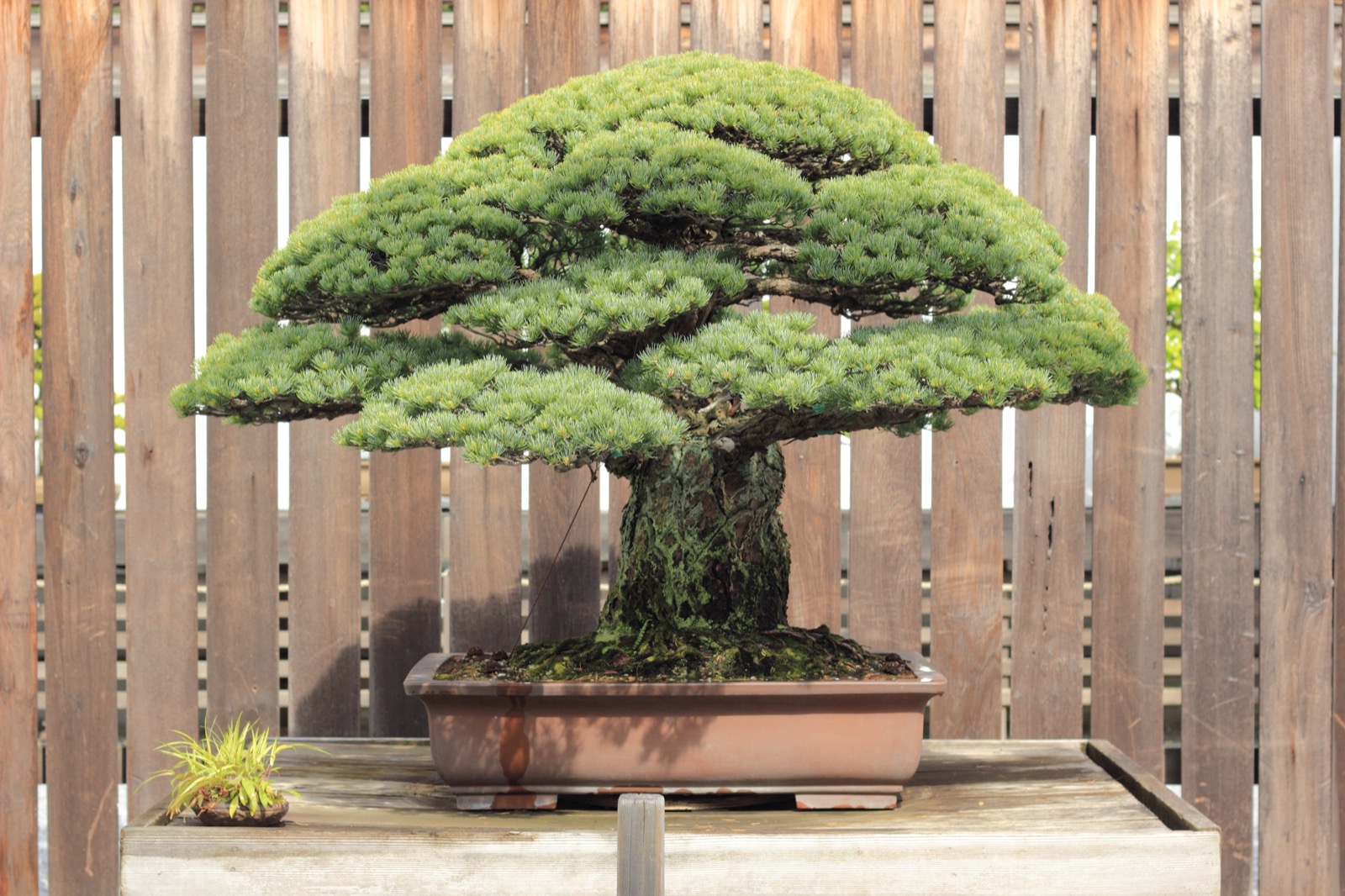
Photo by Sage Ross, CC BY-SA 3.0, via Wikimedia Commons — Source. The Yamaki Pine, in training since 1625, sat at a Washington museum for twenty-five years before anyone there learned what it had survived.

For a quarter century, the United States National Arboretum cared for one of the oldest bonsai in North America without knowing what it had lived through. Its own record, entered when the tree arrived as a gift in 1976, gave a donor's name and a date. Nothing more.
A bonsai's care record is not written to prove its worth to a stranger. It is written for whoever tends the tree next — and that person is usually someone the writer will never meet.
What a record actually holds
Strip away the mystique and a working bonsai record is a plain document. A repotting logged by season and year, not just "recently." Which roots were cut back and which were left alone. When a wire went onto a branch and, just as important, when it came off — a detail that matters more than it sounds, since a wire left on too long cuts a scar that outlives the decision behind it. A note on how the tree answered a hard winter, a dry summer, or a move to a new grower's care. The exhibitions it stood in, and the seasons it was kept out of view to recover instead.
None of this is written for effect. It is written because a tree's needs next season depend on what was done to it last season, and the person deciding is very often not the person who decided last time. A good record answers the question a new caretaker cannot answer by looking alone: not just what the tree looks like now, but what has already been tried, and why.
Recorded by whom, and for whom
Japan has more than one formal system for this. Since 1934, the annual catalogue of the Kokufu-ten, the country's most prestigious bonsai exhibition, has photographed and listed every tree shown that year, recorded under its owner's name — since the owner and the artist who trained the tree are often different people. Roughly ninety volumes now trace individual trees across nine decades of exhibitions. Since 1980, the Nippon Bonsai Association has separately registered kicho bonsai (貴重盆栽, "bonsai formally recognized for their documented history"), over 1,200 of them so far, explicitly to "preserve valuable bonsai for future generations" — a system we describe more fully in our piece on why a bonsai's worth lives in its record, and one that has grown out of the same instinct that keeps a meiboku's name and history attached to the tree itself.
Both systems exist to make a tree's standing legible to an outside judge — a buyer, a jury, a historian. That is real and useful. But it is not the only reason a grower writes something down, and arguably not the oldest one. In several of Japan's traditional arts — martial arts, tea ceremony, flower arranging — a teacher issues a student a mokuroku (目録, "a document listing what has been formally transmitted from teacher to student"). It is not written to impress an outsider. It exists so the next person in the line has an exact account of what was passed down, by whom, and in what order. A bonsai's working record does the same job: less a certificate of value, more a technical letter addressed to a reader the writer cannot picture.
The record that almost wasn't
The clearest case of what is lost when that letter goes unwritten belongs to a single Japanese white pine that has been in training since 1625.
Masaru Yamaki, the bonsai master who kept it, was in his home in Hiroshima, roughly three kilometers from the blast, when the atomic bomb detonated on August 6, 1945. He, his family, and the walled nursery sheltering the tree all survived. In 1976, as part of a gift of fifty-three bonsai the Nippon Bonsai Association sent to the United States for its bicentennial, Yamaki donated the pine — by then a tree that had already passed through five generations of his family — to what is now the National Bonsai & Penjing Museum in Washington, D.C.
For the next twenty-five years, the museum's own record said nothing about Hiroshima. Then, in March 2001, two of Yamaki's grandsons made an unannounced visit, looking for the tree they had heard about their entire lives. Through a translator, they told the museum's staff what its own files did not contain: that this pine had survived the blast, that their grandfather had kept its story within the family across generations, and that the photographs and records confirming it had been kept by his son. Without that visit, without a family choosing to speak, the pine's most significant chapter would simply not exist as far as any institution was concerned.
A tree cannot carry its own history in a form a stranger can read. Bark, deadwood, and the trained line of a branch tell a careful observer that time has passed and that hands have worked here — we've written elsewhere about what that physical evidence can and cannot say — but none of it names a city, or a family, or explains a choice. Only a person, speaking or writing, can do that. For a quarter century, that information lived only inside a family's memory, one missed visit away from the kind of loss that eventually meets most oral history.
Why Azukari writes it down
This is the gap a written record exists to close, and it is why Azukari treats writing as part of the care itself, not paperwork filed once a season's work is finished. As a tree is tended in Japan, each season's work is entered as a dated note — what was done, by which hand, and why — before it can slip into the kind of memory that depends on someone happening to visit and happening to explain. Whoever holds the tree next inherits that note along with the tree, whether they are in Kyoto or somewhere the artist who wrote it will never travel.
None of this changes the daily discipline of the craft itself — water, light, a season's patience, the same teire (手入れ, "day-to-day care") a bonsai has always required. What it changes is what survives that discipline once the person doing it has moved on. A record kept this way is not a certificate. It is closer to a letter, written now, addressed to whoever is holding the tree when its writer can no longer be asked.
References
- National Bonsai Foundation — "Yamaki Pine" — on the tree's 1625 origin, five generations of Yamaki family stewardship, the 1976 Bicentennial donation, and the March 2001 revelation of its Hiroshima survival by Masaru Yamaki's grandsons.
- Smithsonian Magazine — "The Bonsai Tree That Survived the Bombing of Hiroshima" — on the tree sitting at the museum for twenty-five years with its history "largely unknown" before the 2001 visit revealed it.
- Bonsai Empire — "Kokufu-ten Exhibition, Tokyo" — on the exhibition's catalogue, published annually since 1934, recording each shown tree under its owner's name.
- Nippon Bonsai Association — About the Association — on the kicho bonsai registration system, running since 1980 with more than 1,200 trees registered to preserve documented bonsai for future generations.
- Wikipedia — "Menkyo" — on the licensing and transmission system in traditional Japanese arts, including the mokuroku document recording what has been formally passed from teacher to student.