A well-kept bonsai almost always outlives the person who shapes it. That single fact changes what the work is — not a piece an artist completes, but a piece an artist is handed, adds to, and eventually hands on.
A painter finishes a canvas within a career, sometimes within a season. A bonsai artist rarely gets that luxury, and the good ones do not expect it. The tree they are training today was very likely started by someone else, and the tree they leave behind will very likely be trained further by someone they will never meet.
A career is short, a tree is long
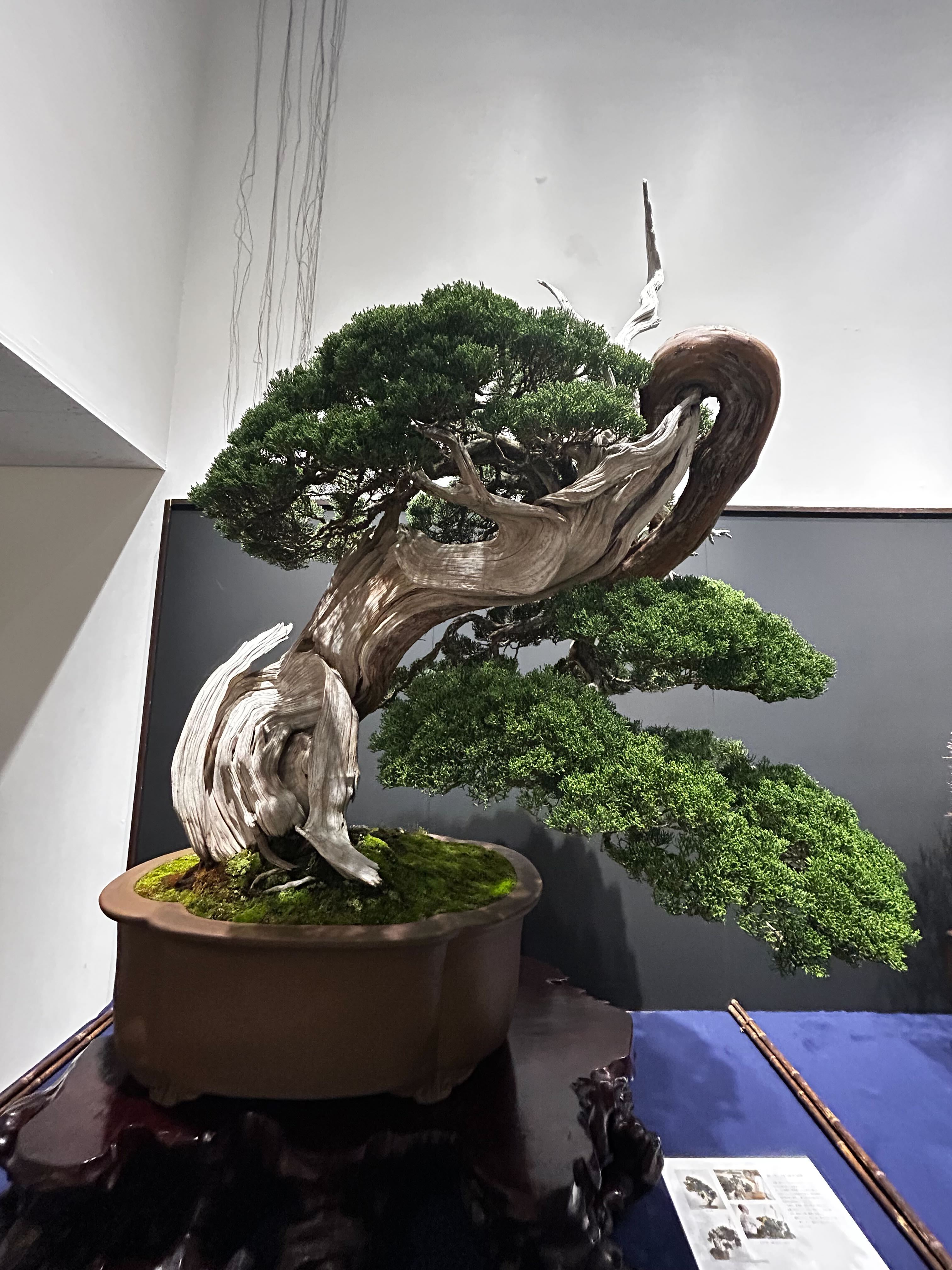
The imbalance is not subtle. A Sargent juniper kept at Mansei-en, one of the historic nurseries of Omiya Bonsai Village near Tokyo, has been tested at more than a thousand years old — collected from the wild long before it ever reached a pot — and bonsai reference sources still describe it as "rough material," a tree still in training. A thousand years is not a figure any single artist's working life comes close to.
Set beside that, a human career is brief. In one detailed account of a Japanese apprenticeship, a young bonsai trainee, Takahiro Mori, began studying under a master in 2002 and did not become independent until 2006 — four years before he was even considered ready to work unsupervised, and he notes that in earlier generations the same step was sometimes made in two or three. Add a working life of four or five decades after that, and the total is still a rounding error against a tree that measures its age in centuries.
What this means in practice is unglamorous but important: no single artist finishes a serious bonsai. What one person can do, across an entire career, is shape one chapter — sometimes the roughing-out of a young tree's line, sometimes the refinement of an old one's silhouette, sometimes simply keeping a tree alive and unharmed until it can be handed to someone with more time left. As we've written elsewhere, a bonsai has no final draft. The corollary is just as true: no bonsai artist has a final say.
Reading what came before
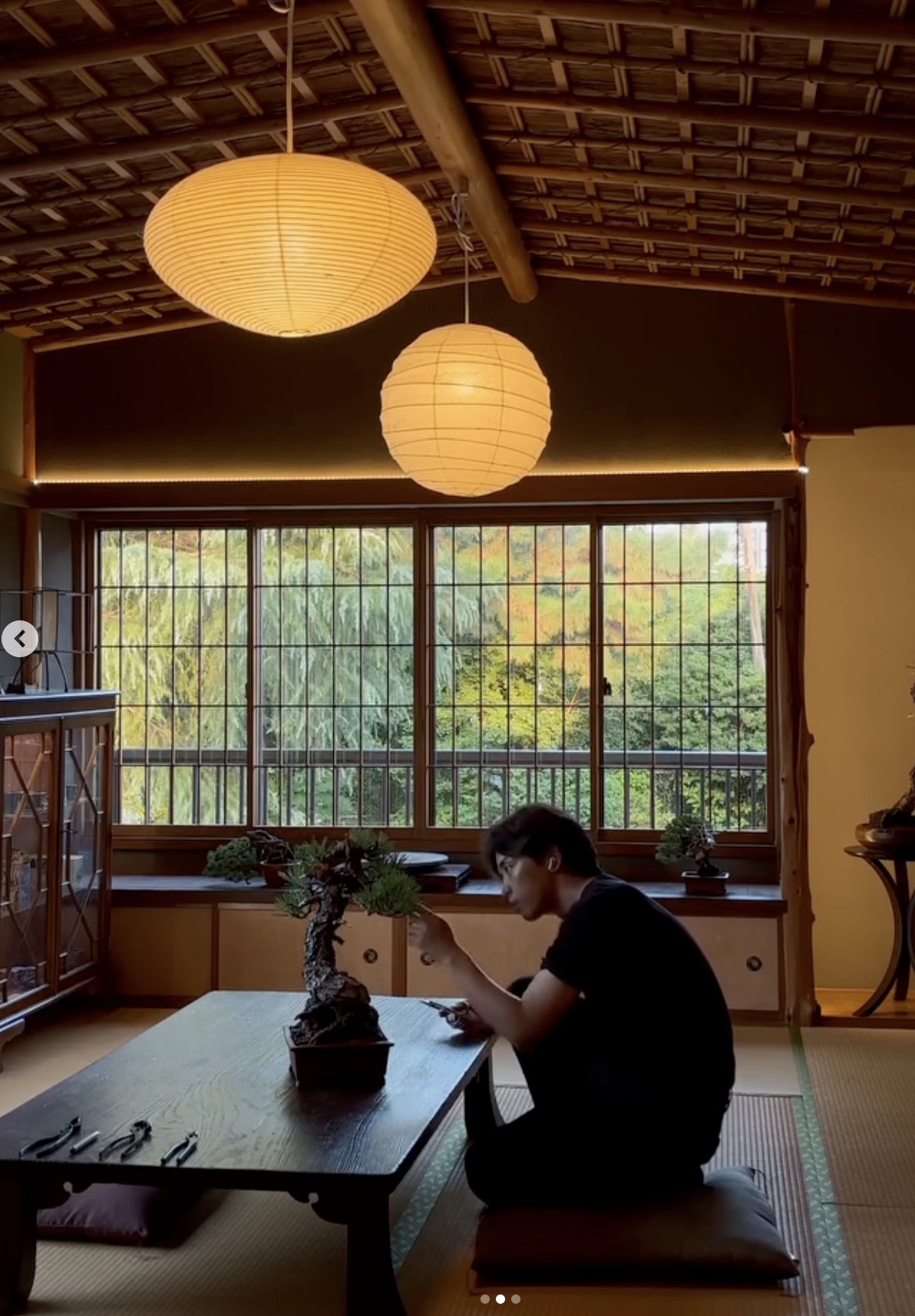
The daily, unhurried attention a tree of any age requires — much of it spent reading decisions someone else already made.
Most trees an artist works on today were not started by them. That means a large part of the job, before any new decision is made, is reading an old one.
Bonsai has a vocabulary for reading a tree's history — the nebari (根張り, the surface roots that show how long a tree has held its ground), and the jin (神) and shari (舎利), bleached deadwood left where a branch or a section of trunk has died back. But some of the clearest evidence of a predecessor's hand is less poetic: a wire scar. Wire is wound around a branch to bend it into a new position, and over a matter of months live tissue sets around the bend so the shape holds once the wire is cut away. Left on too long, that same wire cuts into the bark and leaves a mark that does not disappear. An artist inheriting a tree reads those scars the way an editor reads a manuscript's margin notes — not as damage to correct, but as evidence of a judgment someone else already made about where this branch was meant to go.
A documented recent case makes the same point without any of the ambiguity of a centuries-old tree. A Chinese cork bark elm grew for more than eighty years in an Oregon nursery field before the land was sold for development. Bonsai artist Ryan Neil rescued it and began training it as bonsai; the shaping was then carried forward by a second artist, Sergio Cuan, who has described his approach to a tree already partway shaped by someone else in a simple line: he does not arrive with a fixed idea of the final form, but listens to what the tree, and the work already done on it, is telling him it wants to be. That is not a mystical claim. It is a precise description of what reading a predecessor's work requires — enough humility to treat an inherited shape as information, not an obstacle.
Building a shape someone else can continue
Knowing that a tree will likely outlive you changes how you work on it, not just how you think about it.
An artist racing to finish a tree within their own hands tends to cut decisively, close options early, and aim for a single, final-looking silhouette. An artist who expects to hand the tree on tends to do the opposite: leaving a branch a season longer before deciding its fate, favoring a cut that keeps a future option open over one that looks more resolved today, resisting the temptation to impose a signature so personal that a successor would have to work against it rather than with it. This is close to what the shokunin tradition describes as working for "we" rather than "I" — a discipline measured by a lineage of hands rather than by any single career.
None of this makes the current artist's decisions less real. The branch removed this year is removed for good; the line chosen this season will be visible for decades. But those decisions are made with a particular kind of restraint — the restraint of someone building toward a shape they know they will not be the one to complete.
The record closes the gap
A wire scar, a jin, the angle of a trunk — these tell a later artist what was done. They rarely explain why. Two very different intentions can leave nearly identical marks on a branch, and a tree cannot be asked to clarify which one was meant.
This is the limit of reading physical evidence alone, and it is why the oldest bonsai gardens keep more than the trees themselves. A written record — who worked a tree, in which season, toward what end — turns a guess into a fact for whoever holds the tree next. It does for the next artist what the wire scar alone cannot: it tells them not just where a branch was bent, but what the person bending it was trying to do.
Closing
A bonsai artist's working life is a chapter, not a book. What makes that bearable — what makes it, in fact, the whole point — is that the book keeps being written by hands the artist will never see.
At Azukari, a tree stays under one artist's ongoing care, and the seasonal record kept alongside it exists for exactly this reason: not to mark a finished state, but to give whoever tends the tree next, and whoever holds it next, something more reliable to read than the wood alone. For more on what a tree carries forward across generations, see our piece on meiboku, Japan's historic named bonsai.
References
- Bonsai Empire — "Top 5: Oldest Bonsai Trees" — on the Sargent juniper at Mansei-en, Omiya Bonsai Village, tested at more than 1,000 years old and still described as rough training material.
- Bonsai Empire — "Wiring Bonsai Trees to Shape and Bend the Branches" — on how a branch sets into a new position over one to four months of wiring, and how wire left on too long cuts permanent scars into the bark.
- Wochi Kochi (The Japan Foundation) — "A Path for a Bonsai Master Opened through Passion and Energy Alone" — on bonsai artist Takahiro Mori's apprenticeship, begun in 2002 and completed in 2006, and on shorter apprenticeship terms in earlier generations.
- Longwood Gardens — "Continuing the Journey of a Storied Bonsai" — on a Chinese cork bark elm rescued by bonsai artist Ryan Neil and subsequently shaped by Sergio Cuan, including Cuan's description of listening to a tree's existing form rather than imposing a fixed idea.