The question I hear most often from people outside Japan is not which tree to buy. It is how anyone arrives at the number in the first place. I live in Tokyo and spend my weeks on both sides of this trade — with the people who name figures and with the people deciding whether to accept them — and the plainest answer I can give is that nobody looks the number up. Ask a nursery here what a specific tree costs and you will rarely get a figure before they have seen it, or at least a good photograph of it. There is no ticker to check, and no published list fixing what a hundred-year-old black pine should cost this season.
A bonsai's price is not read off a list. It is named tree by tree, by someone whose eye the trade already trusts — which is why the same tree can be quoted two different figures on the same afternoon, and neither one is wrong.
A nursery's answer names five things, and only four of them are the tree
Ask what goes into a number and the answer tends to circle the same short list. The Japanese bonsai site BonsaiQ names five: species, jurei (樹齢, "the tree's own age, counted from when the tree began growing"), the refinement of its form, who trained it, and the value of the pot. A Western introduction to the same question, from Bonsai Empire, arrives at a near-identical set from the outside: how mature the tree looks, the thickness and taper of the trunk, how difficult the species is to grow, the pot, and above all how much time has gone into that specific tree.
Four of those five describe the tree. The fifth is priced almost as a separate object — antique Chinese and Japanese pots run into thousands of dollars where factory pots cost less than one, so a tree and its container can each carry a figure of their own.
Underneath the four that do describe the tree, three threads run through everything else on this site, and they are worth separating because they are frequently collapsed into one word.
Jurei is the tree's own age, and it is not the same number as how long the tree has been trained as bonsai — a trunk collected from a mountainside at two hundred years old is a two-hundred-year-old tree in its first year of training. Age matters because it cannot be manufactured, a claim we look at in more depth in why a tree's age carries value. Two trees of identical age can still be priced very differently once kaku (格, "a tree's standing, judged from its trunk, bark, and the years of handling behind it") is weighed in, a distinction we go into in rank as a guide. And a tree with keireki (経歴, "a documented record of who has grown and kept a tree") behind it is priced differently from an identical-looking tree with no paper trail at all, a point covered at length in a bonsai's value is in its record. The hand that trained it runs through all three: a tree from a name collectors already recognize, in the tradition of the named, generation-spanning trees called meiboku, tends to be quoted above an identical tree of unknown authorship.
Nothing is published, but the trade knows its own rates
At most Japanese nurseries, BonsaiQ notes, the majority of trees carry no price tag at all. What a visitor is given instead is an iine (言い値, "an asking price named by the seller," rather than one read off a list) — a starting point for a conversation.
That is not the same as saying no rates exist. The same site is direct about it: every tree has a going rate, and that rate drifts slowly over time. What is missing is not the rate but its publication. It lives in the collective memory of a few hundred professionals rather than in a table a buyer could consult before walking in, which is why outwardly similar trees can be quoted differently from one nursery to the next. Each owner is naming a figure from their own read of the tree, against a sense of the market they carry in their head.
Japan settles a tree's standing in one building and its price in another
The country's most prestigious exhibition, the Kokufu-ten (国風盆栽展, "the national-style bonsai exhibition"), reached its hundredth edition in February 2026 at the Tokyo Metropolitan Art Museum, shown in two periods across that month. The Nippon Bonsai Association describes the criteria for its Kokufu Award in terms with no number in them at all: the overall beauty and dignity of the display, harmony among the tree, its pot, its stand and its accompanying pieces, and the tree's cultivation condition. That is a verdict on standing.
Buying happens at a separate address. During the same stretch of February, dealers from across the country — from Aomori in the north to Kagoshima in the south — fill the Ueno Green Club for the Risshun bonsai market (立春盆栽大市), a sales fair held in the same Ueno park as the judged show but in a different building, across overlapping dates. A tree's kaku is settled by consensus among judges in one hall; its price is negotiated, tree by tree, by individual dealers in the other. Japan does not fold the two into a single figure, and the separation is itself part of how pricing works here.
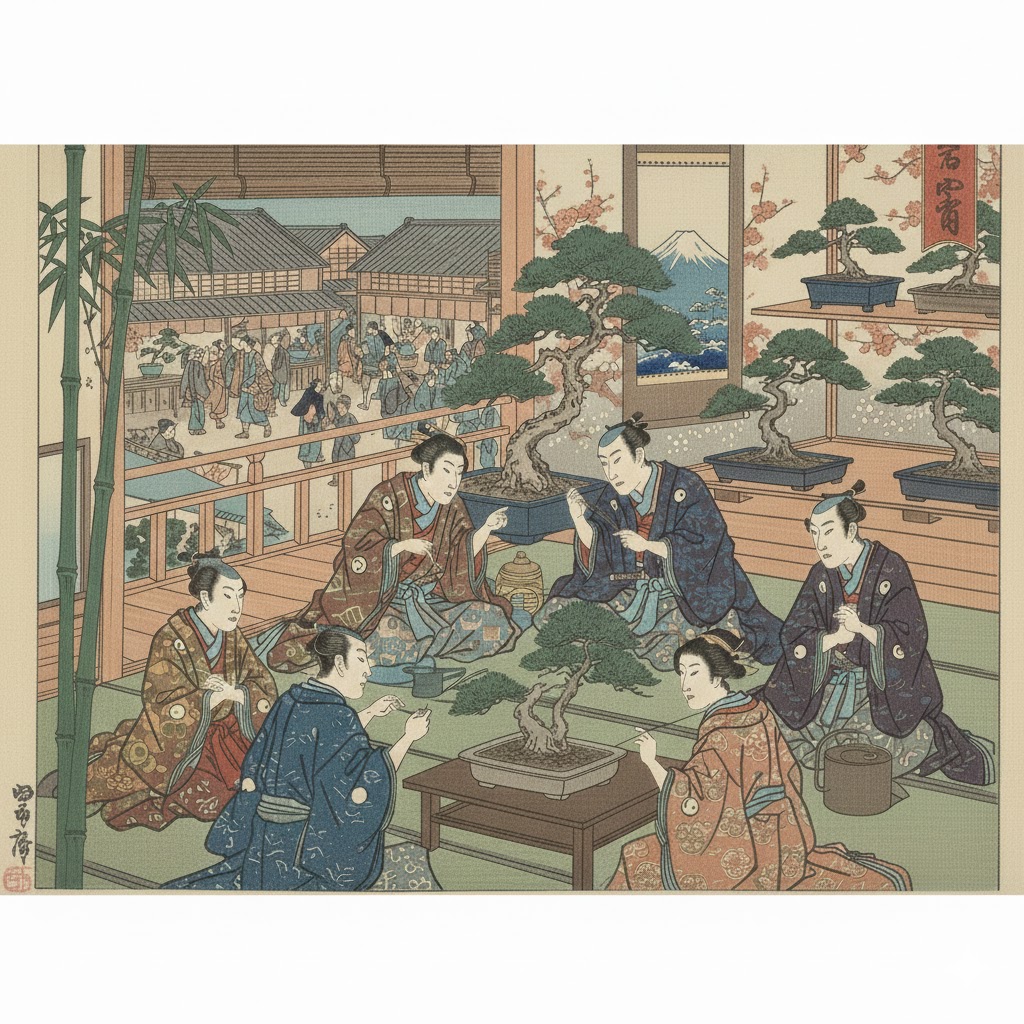
An artistic rendering of connoisseurs gathered to examine a tree together — the kind of individual, tree-by-tree judgment a bonsai's price is built from, rather than a quoted rate.
A record price is one event, not a rate
A pine described as centuries old is reported to have sold for around 1.3 million dollars at the International Bonsai Convention in Takamatsu — a figure worth naming carefully. It is an exception, not a benchmark. Most bonsai of comparable age, standing and record will never come close to it, because that sale reflected what one buyer was willing to offer one seller for one specific tree on one particular day. None of this makes a bonsai a financial instrument, and a reported sale price is not a signal about where any other tree's price is headed.
This is the same distinction drawn in a bonsai's value is in its record: a documented history makes a tree's worth legible, but it does not promise that a price will rise. A price is a single, local event — what a nursery named and a buyer accepted, once. Value, in the way bonsai culture uses the word, is closer to standing: age, kaku and keireki, read and argued about on the tree's own terms.
No index does this work; a trained eye does
The person actually naming a figure is usually the nursery's owner, or one of a small circle of dealers and judges whose opinion the trade already trusts — a mekiki (目利き, "a trained, discerning eye for judging what is genuine"). Japan's tea world has a close cousin of this role. A hakogaki (箱書き, "a box inscription") is written by the head of a tea school or a well-known tea master on the inside of the lid of the box holding a bowl or utensil; in the Omotesenke school's own description, it vouches for what the box contains and shows the history the piece carries with it. No index performs that function for either a tea bowl or a bonsai.
That is also why the same tree, shown to two nurseries, can come back with two figures. Each reflects one appraiser's read, on one day, in one conversation.
What to ask before you look at the number
If you are ever handed a figure for a tree, the useful question is not whether it is the right one. It is what the figure is standing on, and how much of that is written down. Age can be estimated from the trunk. Standing is argued, and a serious seller will argue it in front of you. A record either exists on paper or it does not — and that is the one part of a price you can check yourself, before anyone's eye is involved.
That last part is what I find myself looking at first, and it is the part that travels worst across a border: a tree can be photographed from any distance, but its record has to be kept by whoever has hands on it that season. Azukari is built around keeping that record in the open — a tree continues its training in Japan under an artist's daily care, and each season's work is entered with a date, so the person entrusted with it can see plainly what any figure would be standing on.
References
- Bonsai Empire — "Bonsai Prices" — on the factors behind a price: how mature the tree looks, trunk thickness and taper, species difficulty, the pot, and the time invested in a specific tree.
- Bonsai Empire — "The Most Expensive Bonsai Tree" — reporting a centuries-old pine sold for around $1.3 million at the International Bonsai Convention in Takamatsu, Japan.
- BonsaiQ — "盆栽は本当に高いのか!?盆栽の値段の決め方" — on the five pricing factors (species, age, form, artist, pot), on most nursery trees carrying no tag and being sold at an asking price (iine), and on every tree having a going rate that shifts slowly.
- Nippon Bonsai Association — Kokufu-ten Exhibition and Events — on the Kokufu Award's criteria: the overall beauty and dignity of the display, harmony with pot, stand and accompanying pieces, and cultivation condition.
- Gendai Bonsai — "第100回『国風盆栽展』" — on the 100th Kokufu-ten at the Tokyo Metropolitan Art Museum in February 2026, and on the Risshun bonsai market held at the Ueno Green Club across the same period, with dealers from Aomori to Kagoshima.
- Omotesenke — "Hakogaki (Box Inscriptions) on Tea Utensils" — on how a box inscription written by a tea school's head or a noted tea master vouches for the utensil inside and shows the history it carries.