More than a thousand trees stand inside the walls of Shunkaen BONSAI Museum in Edogawa, Tokyo, where I have been an enrolled student since just after New Year last year. Spend enough time walking those rows and one thing becomes obvious fast: species alone tells you almost nothing about which tree in front of you is actually good. Ask a bonsai enthusiast to sketch the field's pecking order among species, though, and an answer comes quickly — conifers at the top, deciduous and flowering trees below them. Few people are taught this as a formal rule. It travels the way most bonsai convention travels: through which tree gets the best spot at a show, which one a teacher reaches for first, the shorthand growers use without quite meaning it as law. Treated as a fixed order, it falls apart the moment a well-trained old tree from the "lower" half of that list stands beside a young, unfinished tree from the top.
A species carries a general reputation in bonsai — conifers are usually named first — but an individual tree's actual standing is set by its age and the years of training behind it, and a well-kept old tree from a less-favored lineage can outrank a young tree from bonsai's most esteemed one.
Conifers earn the first look, not the final verdict
Bonsai species divide, in the broadest terms, into shohaku (松柏, "pine-and-cypress," the conifer lineage — pine, juniper, cypress) and zoki (雑木, "mixed wood," the deciduous, flowering, and fruiting trees grown alongside them). The Omiya Bonsai Art Museum, one of the field's reference institutions, describes conifers as ranking "as the prototypical bonsai," with pine and juniper — together called shohaku — singled out as especially prized. We have looked at the fuller range of lineages elsewhere: the reasoning holds up. Shohaku stays evergreen, its needles and branching read cleanly at a fine scale, and a well-grown specimen can be trained toward the same silhouette for a century or more without the seasonal upheaval a deciduous tree goes through every year. These are real, defensible reasons why a newcomer is handed a black pine or a shimpaku juniper before almost anything else, and why black pine and white pine are so often spoken of as the twin pillars of the tradition.
None of that, though, describes a scale that any single tree is measured against. It describes where a beginner's eye is pointed first — not a verdict on any one specimen standing in the growing yard.
Kaku is read from bark and taper, not a birth year
The word growers use for a tree's standing is kaku (格, "rank" or "class"), sharpened in trade writing to jukaku (樹格, "a tree's own rank") — the term one bonsai magazine used in a 2019 feature on the branch work needed to raise it. What raises kaku is fairly specific: a trunk with natural, unforced movement, and bark that has begun to crack, fissure, or roughen into what growers call kobokukan (古木感, "the feel of an old tree," from koboku, 古木, "a tree aged by many years"). A general guide to reading a bonsai puts the emphasis plainly: chronological age itself is not what growers weigh most; the visible impression of age is. A forty-year-old tree pushed hard for early bulk can read thinner in kaku than an eighty-year-old tree grown slowly and left to develop its own bark and taper.
Japan's most prestigious exhibition judges its top honor the same way. The Nippon Bonsai Association describes the Kokufu Award as weighing "the overall beauty and dignity of the display... harmony between the bonsai, pot, stand, and accent plants, and the cultivation condition" — a judgment made on the whole tree and its presentation, not a form that starts by sorting entries by lineage. Species sets an expectation. It does not cast a vote.
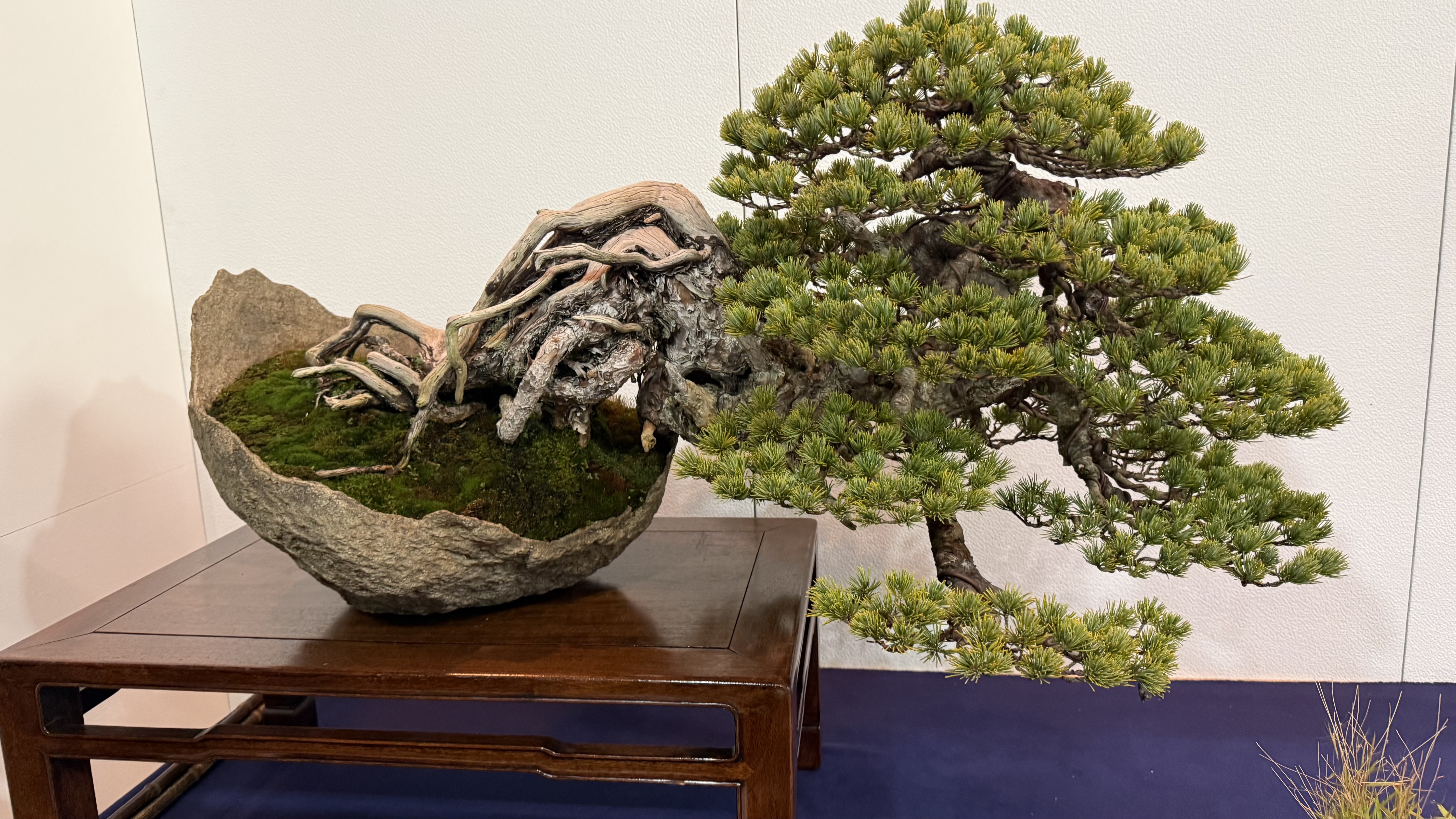
A young white pine carries its lineage's reputation for refinement — but reputation is not the same as record, and record is what growers actually judge.
An old black pine can pass a young white pine
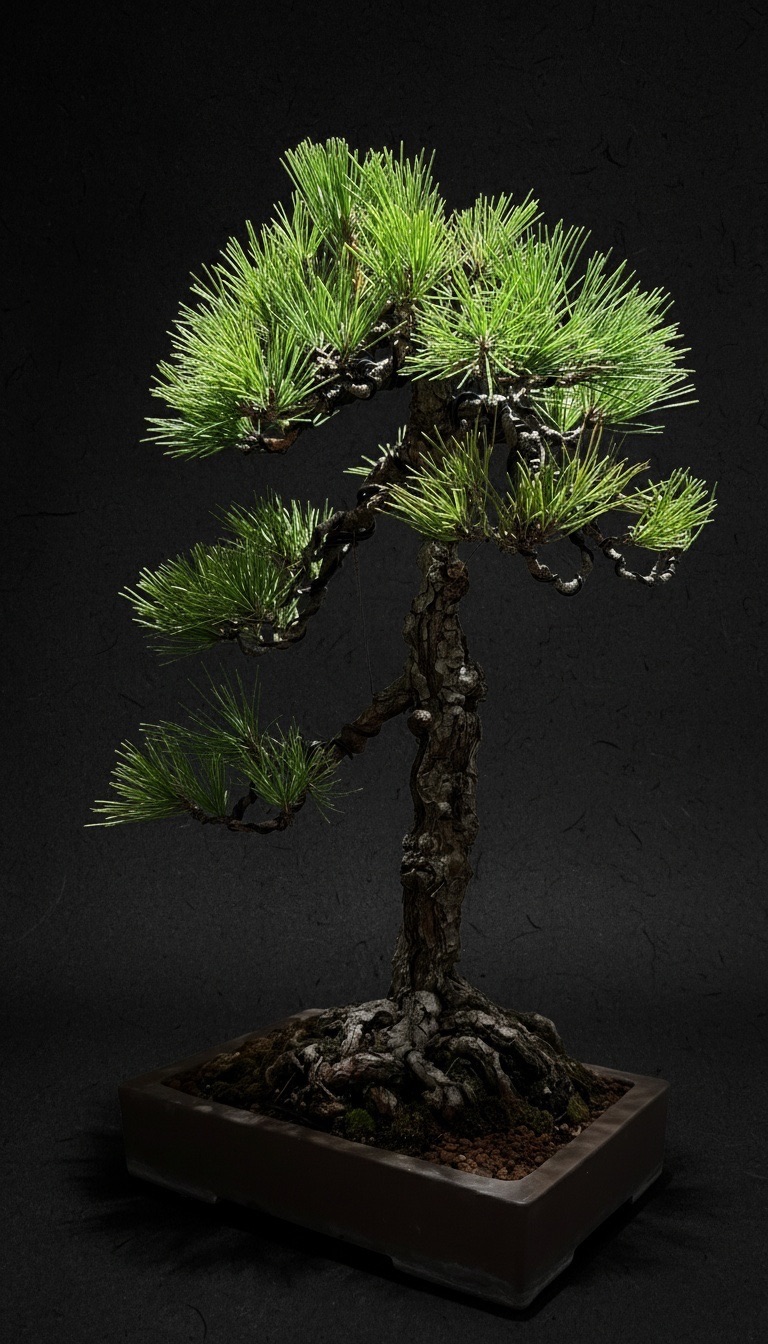
Within shohaku itself there is a further, finer convention: goyomatsu (五葉松, "Japanese white pine") is usually called the more refined of bonsai's two central pines, kuromatsu (黒松, "Japanese black pine") the bolder and more physically forceful. Kobayashi draws the pair this way in his own writing on the craft: black pine's rough bark and rigid needles read as masculine strength, white pine's fine, soft foliage as delicacy and elegance. It is a genuinely useful distinction. It is not, on its own, an order of merit.
Put a black pine that has spent sixty unhurried years developing plated, fissured bark next to a white pine only five years into its training, and the black pine's kaku reads as the deeper of the two, whatever the species' general reputations suggest. The record of years and handling in front of you outweighs the reputation of the species behind you. This is where the "conifers first" habit and the actual practice of looking at a tree quietly part ways — a young goyomatsu does not inherit its lineage's high standing automatically, any more than an old kuromatsu is held back by belonging to the lineage some regard as the less delicate of the two.
Judge the record in front of you, not the shelf
None of this makes species meaningless. It remains a genuinely useful first filter — a fast way to guess, before looking closely, what kind of tree is likely standing in front of you. But a filter is not a verdict, and the next time you are comparing two trees, the working question is not which species ranks higher on the old list. It is this: which trunk shows more unforced years — bark that cracked because it aged, not because it was pushed?
That is close to how Japanese bonsai culture treats a tree's worth more broadly — read from its record, tree by tree, rather than assumed from a category. It is also, I have come to think, the first thing a season at Shunkaen actually teaches a student, before anything about wire or shears: to stop asking what a tree is supposed to be and start looking at what it has become. Azukari is built around that same habit. A tree under an artist's care in Japan is not introduced by its lineage first; it is documented season by season — bark, branching, the trunk's own record of years — so that whoever holds it can see, rather than assume, what actually stands in front of them.
References
- Omiya Bonsai Art Museum — "About: Bonsai Trees" — on conifers (shohaku) ranking as "the prototypical bonsai," with pine and juniper singled out as especially prized, and zoki deciduous trees valued for seasonal change.
- Nippon Bonsai Association — Kokufu-ten Exhibition and Events — on the Kokufu Award's judging criteria: overall beauty and dignity of the display, harmony with pot and stand, and cultivation condition.
- Botanica — "What Is Bonsai?" — on kaku (rank) being read from a trunk's natural curve and cracked, fissured bark rather than from chronological age, and the term kobokukan (the feel of an old tree).
- Kunio Kobayashi — "Types of Bonsai" — describing black pine and white pine as the twin pillars of shohaku, contrasting black pine's bold, masculine bark and needles with white pine's delicacy and elegance.
- Kindai Shuppan (近代出版) — 月刊「近代盆栽」2019年1月号 — magazine table of contents using the phrase jukaku kojo (樹格向上, "raising a tree's rank") in a feature on branch styling, confirming the term as established trade vocabulary.