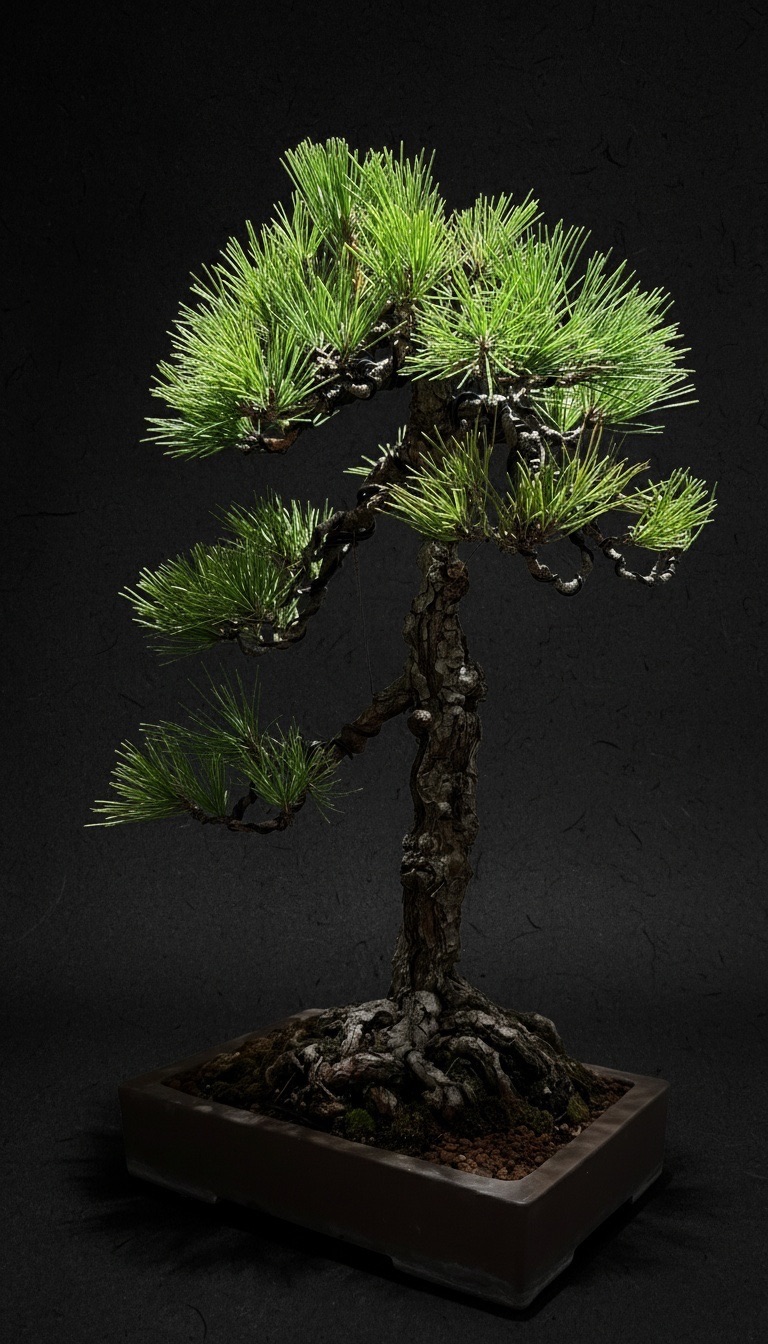
On the exposed coastlines of Kyushu, Shikoku, and Honshu, Japanese black pine holds ground that most conifers avoid: salt spray, hard wind, thin soil. Bonsai growers call it kuromatsu (黒松, "Japanese black pine," Pinus thunbergii), and the same toughness that lets it survive there is what an artist spends decades trying to keep visible on a tray a few centimetres tall — thick bark, stiff needles, a bearing that refuses to look delicate no matter how hard it is cut back.
Kuromatsu carries its reputation in two places a grower cannot fake: bark that only plates with real age, and needles disciplined into shortness by a cut repeated every summer.
Growers pair it with a "female" pine, and mean it literally
Japanese growers have long set kuromatsu against akamatsu (赤松, "Japanese red pine," Pinus densiflora) as a matched contrast, and the vocabulary leaves no room for doubt: kuromatsu is otoko-matsu (男松, "male pine"), akamatsu is onna-matsu (女松, "female pine"). The distinction rests almost entirely on bark and bearing. Akamatsu bark stays thin, reddish, and flaky even with age, and the tree's outline reads slender and soft. Kuromatsu bark, by contrast, turns gray to black and thickens into hard, deeply fissured plates, giving the whole tree a blunt, weighty presence that Japanese bonsai literature routinely calls masculine. None of this is a technique imposed from outside — it is closer to what the species already is, brought forward by time and restraint rather than invented. We looked at akamatsu on its own terms elsewhere.
A needle this stubborn only shortens under the knife
Kuromatsu needles grow two to a cluster, dark green, sharply pointed, and rigid, typically 7 to 12 centimetres — longer and stiffer than the soft, five-needled clusters of goyomatsu (五葉松, "Japanese white pine"), and longer than akamatsu's slimmer pair. We cover the five-needle pine separately. Left alone, a mature kuromatsu's needles overwhelm a bonsai's proportions, so each early summer a grower performs mekiri (芽切り, "candle cutting"): the spring growth is cut back in June or July, and a second flush, with less season left to elongate, hardens into shorter needles by autumn. Because kuromatsu is pushed toward an even shorter needle than akamatsu, its candles are typically cut later in the season — once the tree's vigor is judged strong enough to carry the stress of growing twice in one year. It is a negotiation repeated annually with a needle that would rather stay long, and length still varies tree to tree even after the cut.
Bark is the one clock a grower cannot rush
Age shows on a kuromatsu mostly in its bark. As the trunk thickens over decades, the surface breaks into hard plates, and Japanese growers name a few distinct patterns this can take: kikko (亀甲, "tortoise-shell") bark, where the plates fracture into small, roughly hexagonal blocks; a rockier, irregular form; and a coarser, simply rough-fissured type. A young, vigorously grown kuromatsu has none of this — its bark is closer to smooth gray skin. A kikko-plated trunk cannot be forced into being; it is one of the clearest outward signs that a tree has spent a long span of years in the pot, under a grower's unhurried care rather than under any shortcut. We wrote separately about how bark records a bonsai's age more broadly.
If there is one shortcut to judging a kuromatsu by eye, it is this: read the bark for years spent, and the needles for a grower's yearly discipline. A wide trunk carrying smooth bark and long needles has been fed, not kept.
It sits at the top of bonsai's classical pine lineage
Among conifers, kuromatsu stands alongside goyomatsu at the top of shohaku (松柏, the pine-and-cypress lineage long considered bonsai's classical core), and English-language bonsai literature has called it, without much exaggeration, "the king of bonsai." Where goyomatsu is prized for refinement, kuromatsu is prized for boldness — a thick trunk, angular movement, bark and needles that read as strength from across a room. Within the shohaku lineage itself, kuromatsu is consistently named as one of its defining species.
The same species also frames Mount Fuji
That reputation is not confined to the bonsai bench. Along the coast at Miho no Matsubara in Shizuoka, a roughly seven-kilometre stretch of shoreline planted with some 54,000 kuromatsu forms part of the UNESCO World Heritage listing for Mount Fuji, its pines framing views of the mountain painted for centuries. One tree there, known as the second-generation Hagoromo no Matsu — named for a Noh legend of a celestial robe left hanging on a pine branch — is reported to be roughly 650 years old: the same species, and often something close to the same silhouette, as the trees trained to a few centimetres on a bonsai bench.
Azukari keeps that proof running instead of letting it end at a nursery gate. The tree stays in Japan under an artist who makes the same call every June — cut now, or hold the tree back a season — and, season by season, its owner receives the record of which choice was made and why.
References
- Wikipedia — Pinus thunbergii — species facts on native range, needle length and fascicle count, and bark development from gray and smooth to black and plated with age.
- Bonsai Mirai — Japanese Black Pine Bonsai Guide — on the species' reputation as "the king of bonsai," its thick trunk and masculine styling, and its two-flush growth habit.
- 盆栽妙 — 「黒松の育て方」 — on kuromatsu's longer, stiffer needles compared with goyomatsu, and its standing as a "male" bonsai species alongside goyomatsu.
- 盆栽.com — 「盆栽育て方 黒松は幹肌がポイント」 — describes the kikko, rock-type, and rough-bark classifications used for aged kuromatsu trunks.
- 盆栽Q — 「【短葉法】黒松と赤松の短い葉を作る!芽切りを徹底解説」 — on the mekiri candle-cutting technique, its June–July timing, and why kuromatsu is cut later than akamatsu to achieve shorter needles.
- Wikipedia (Japanese) — 三保の松原 — on the kuromatsu pines of Miho no Matsubara, part of the UNESCO World Heritage listing for Mount Fuji, and the roughly 650-year-old second-generation Hagoromo no Matsu.