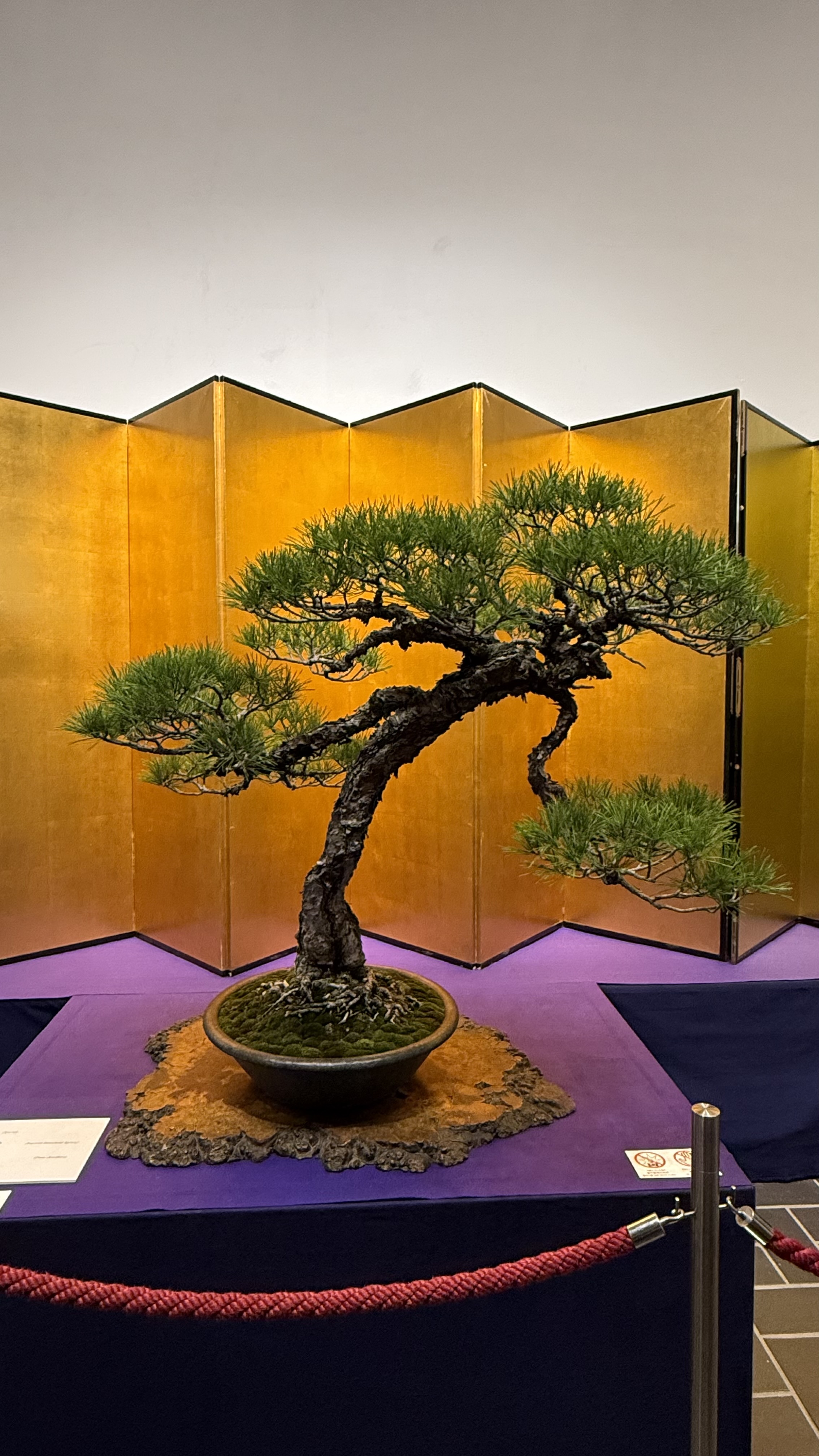
A red pine (akamatsu) bonsai trained in the informal upright style. Photo: Azukari
At many shrine gates and garden entrances in Japan, the pine is not planted alone. Look at the pair standing to either side and one is usually the heavier tree — bark cracked nearly black, needles thick enough to prick an unguarded hand. The tree beside it leans softer: bark carrying a warm reddish cast, needles fine enough to gather into loose tufts rather than jut straight out. Japanese gardeners settled on this contrast long before botanists gave the two species Latin names, and gave the pair a name of their own.
Akamatsu, the Japanese red pine, is bonsai's other great conifer — softer in the needle, warmer in the bark, and traditionally read as the gentle counterpart to the black pine's strength.
Gardeners named the contrast before botany did
Akamatsu (赤松, "red pine," Pinus densiflora) and kuromatsu (黒松, "black pine," Pinus thunbergii) have been planted, painted, and discussed together for so long in Japan that neither species is usually introduced without the other. Traditional garden vocabulary even gendered the pair: kuromatsu as otoko-matsu (男松, "male pine") and akamatsu as onna-matsu (女松, "female pine"). The labels describe an aesthetic contrast rather than a biological one, and they have stayed in use mostly because the contrast is so easy to see once someone has pointed it out — which is exactly why the two trees ended up flanking so many gates.
The softness lives in the needle, and survives the same pruning knife
Look closely and the difference sits in the foliage. Both species carry their needles in bundles of two, but kuromatsu's are stout, sharply pointed, and hold themselves out stiffly; akamatsu's are noticeably thinner and more pliant, gathered in soft tufts that soften the whole crown's outline even from a distance. Both are also what growers call two-flush pines — vigorous enough to push a second round of growth within a season — which is why akamatsu and kuromatsu, almost alone among pines grown as bonsai, can be decandled: the season's new candles are cut back in early summer to force a finer, denser second flush. The technique is identical on both trees. What differs is only how soft the result looks once the new needles have hardened off.
The color that names the tree takes years to show itself
Akamatsu earns its name from bark rather than foliage. On a young tree, the bark carries an orange-red cast and peels away in thin, papery scales; only at the base of an old trunk does it thicken into the grey, plated bark that kuromatsu wears from root to upper branch. It is that reddish upper bark, catching the light on an otherwise ordinary conifer, that is thought to have given the species its common name. The color is also a slower witness than most: a tree confined to a container for years can hold a duller bark for longer than one left to grow in open ground, so growers read a strongly reddened trunk as a sign of real age rather than assume it of any akamatsu on sight. It is the one detail worth checking on any red pine you are offered — the bark, not the label, tells you how long it has actually been growing.
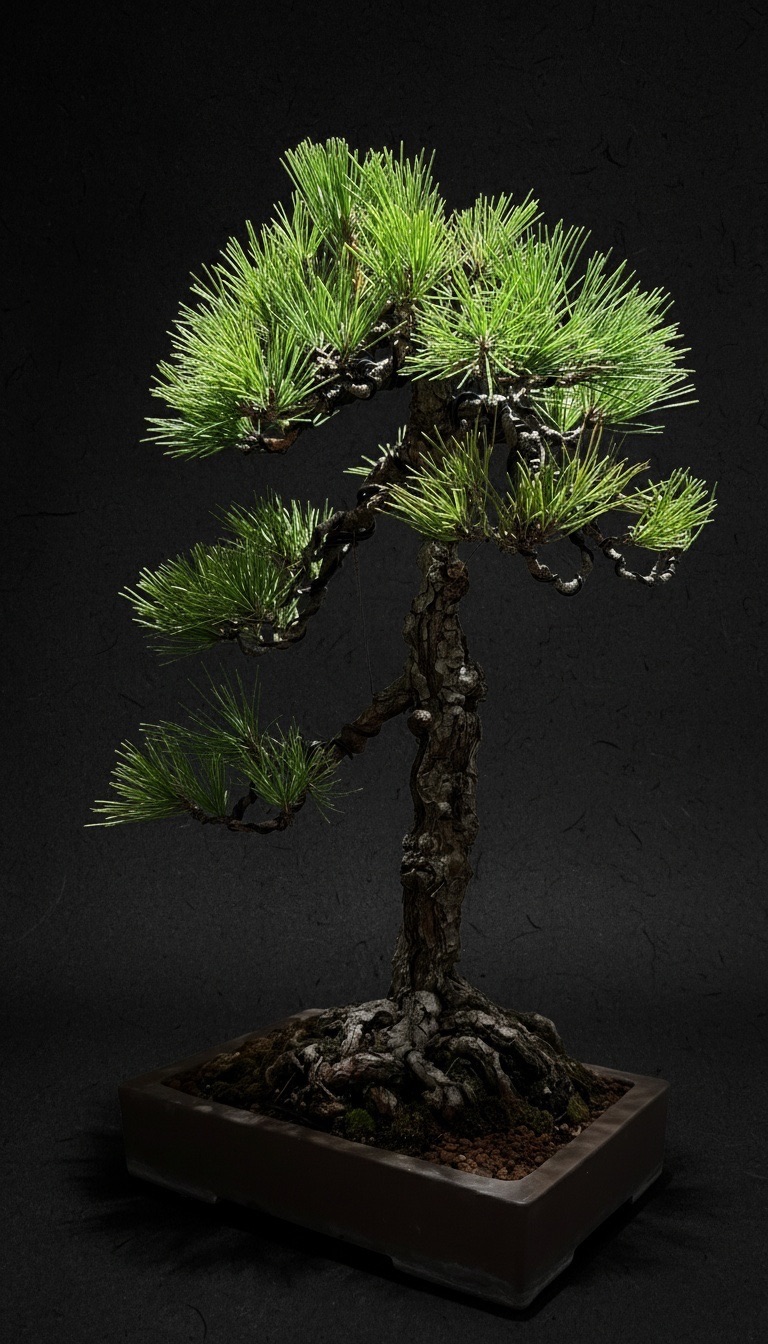
Kuromatsu, the black pine — akamatsu's traditional pair, with thicker needles and bark that fissures dark grey from the base up. Photo: Azukari
Akamatsu kept to the mountains, and the matsutake followed
The two pines part ways in the wild as clearly as they do at a garden gate. Kuromatsu tolerates salt spray and onshore wind well enough that it became Japan's default coastal pine, planted for centuries along dunes and shorelines as a windbreak. Akamatsu keeps mostly to drier ground further inland — thin-soiled ridges and low mountainsides where little else takes hold first. One consequence of that habitat: in Japan and Korea, the prized matsutake (松茸, a highly valued autumn mushroom) grows in a mycorrhizal partnership chiefly with akamatsu's roots, fruiting in the same red-pine woodland the tree has favored for as long as anyone has been gathering mushrooms there. A black pine forest does not offer the same thing. The two species, so often spoken of as a matched pair, have kept to different ground all along.
The pairing was never a ranking
None of this makes akamatsu the lesser tree. Otoko-matsu and onna-matsu were never meant to rank one pine above the other — they were meant to be read together, planted in pairs at shrine gates and garden entrances precisely so the contrast would be the point. A collection built entirely of kuromatsu can read as one register held too long; a single akamatsu placed nearby gives the eye somewhere softer to rest. The two pines share nearly every technique a grower uses on either one — the same decandling, the same seasonal rhythm of watering and repotting — and diverge mainly in what the finished tree is asked to say.
A collection that keeps both keeps the whole range
Holding both pines in one collection is not a hedge between two options. It is the black pine's weathered strength and the red pine's quieter warmth, kept in the same place the way Japanese gardens have kept them for centuries — not a hierarchy, but a range. Azukari works with artists in Japan who tend both species side by side, each one trained toward the register it does best. An owner who joins that seasonal record inherits a tree whose bark, if you know to read it, will eventually tell you something no photograph at purchase ever could.
For more on akamatsu's counterpart and its wider family, see "Kuromatsu: Japanese Black Pine," "Goyomatsu: Japanese White Pine," and "Types of Bonsai." For the coastal conditions that shaped kuromatsu specifically, see "What Coastal Pines Teach."
References
- The Gymnosperm Database — Pinus densiflora — native range, bark description ("red-brown, in large plates" on old trees, "flaky and papery" when young), and needle measurements.
- Seattle Japanese Garden — "Pine Trees, Part Two: Matsu, the Pines of Japan" — the male pine/female pine distinction between kuromatsu and akamatsu, and comparative needle and bark description.
- Bonsai Empire — Pines (Pinus) — needle comparison between the two species, the two-flush decandling technique they share, and the coastal-versus-inland habitat note.
- Wikipedia — Matsutake — the mushroom's mycorrhizal association with Pinus densiflora in Japan and Korea.
- Bonsai / The Shikoku Shimbun — "Akamatsu" — bonsai cultivation notes, including the slow reddening of bark on container-grown trees and sensitivity to over-fertilizing.