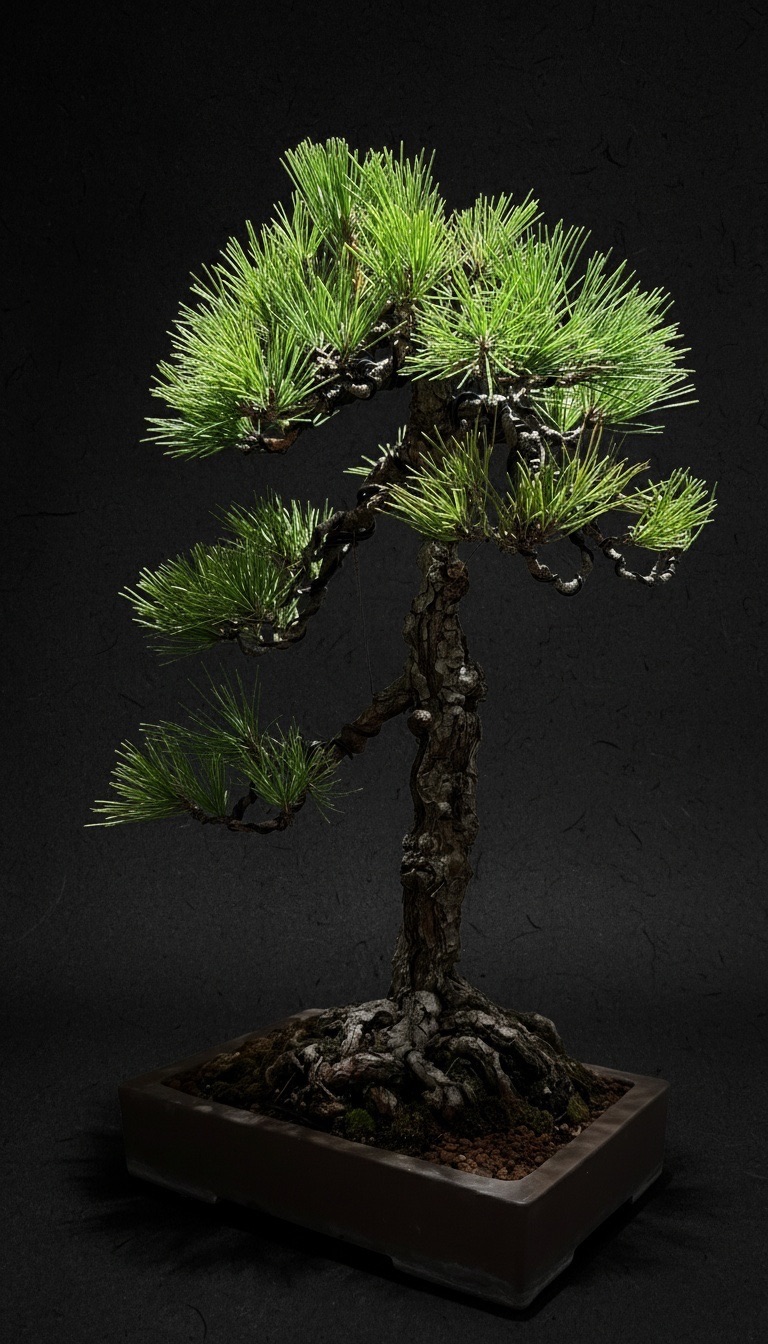
Japanese black pine, the coastal species behind fukinagashi / Photo: Azukari
Early in the seventeenth century, Terazawa Hirotaka, the daimyo of Karatsu Domain, had pines planted along the dunes of Saga's coastline. The purpose was not beauty; it was to keep wind and blown sand off farmland his domain had just reclaimed from the sea. Four centuries later, the grove he started, Nijinomatsubara, still runs roughly five kilometers along that shore and is reported to hold as many as a million black pines — and every one of their trunks leans the same direction. No one bent them. The wind did, blowing off the water toward the land, for longer than any single tree in that grove has been alive.
The same lean shows up on pine-backed coastlines all over Japan, not only at Karatsu. Where a pine grows exposed to open water, its branches thin on the side that meets the wind and thicken on the side that is sheltered from it, until the whole tree — and, after enough generations, the whole grove — reads as a single gesture pointing inland.
Bonsai's windswept style, fukinagashi, is not an artist's invention. It is a transcription of what centuries of coastal wind write onto a pine, brought into a pot so the lesson does not depend on standing on a beach to see it.
A coastal pine gives way on one side only
Kuromatsu (黒松, "Japanese black pine," Pinus thunbergii) is the species most responsible for that silhouette. It grows natively along the coasts of Honshu, Shikoku, and Kyushu, as well as in South Korea, and it is prized specifically for its resistance to salt and pollution — a large part of why it, rather than a more delicate species, ended up defining the look of Japan's shoreline. A pine rooted at the edge of open water is pushed from one direction for its entire life. Rather than resisting evenly on all sides, it gives way on the windward face and puts on extra growth to leeward, so that decade after decade the trunk settles into a single, permanent lean and the branches on the weather side thin out. What can look like injury at first glance is closer to a record of adaptation, and learning to tell the two apart is the first thing a grower has to see clearly on a real coastline.
Fukinagashi is one rule, applied to every branch
That leaning silhouette has a name in bonsai practice: fukinagashi (吹き流し, "windswept," literally "blown and streaming," the same word used for the tubular streamers flown at festivals). It sits alongside forms like chokkan and moyogi in bonsai's vocabulary of trunk shapes, and it comes down to a single rule: branches emerge on all sides of the trunk, as they do on any pine, but every one of them is eventually bent to run the same way. A trunk slanted 60 to 80 degrees off vertical is typical of the style, but the lean alone does not make a fukinagashi — a moyogi can lean too. What makes a fukinagashi is that branches which would naturally reach upward or outward on the "wrong" side are wired down and swept back into line with the rest, so the whole tree reads as a single gesture rather than a trunk with a few windblown branches on it. It is not an easy style to bring off: it takes patient pruning, wiring, and shaping to arrive at something that reads as a real tree rather than a merely bent one.
The same wind shaped Miho no Matsubara too
Nijinomatsubara, the grove Terazawa Hirotaka planted at Karatsu, is not an isolated case. It is one instance of a pattern repeated up and down the coast: groves planted for defense that were later kept and visited for their beauty.
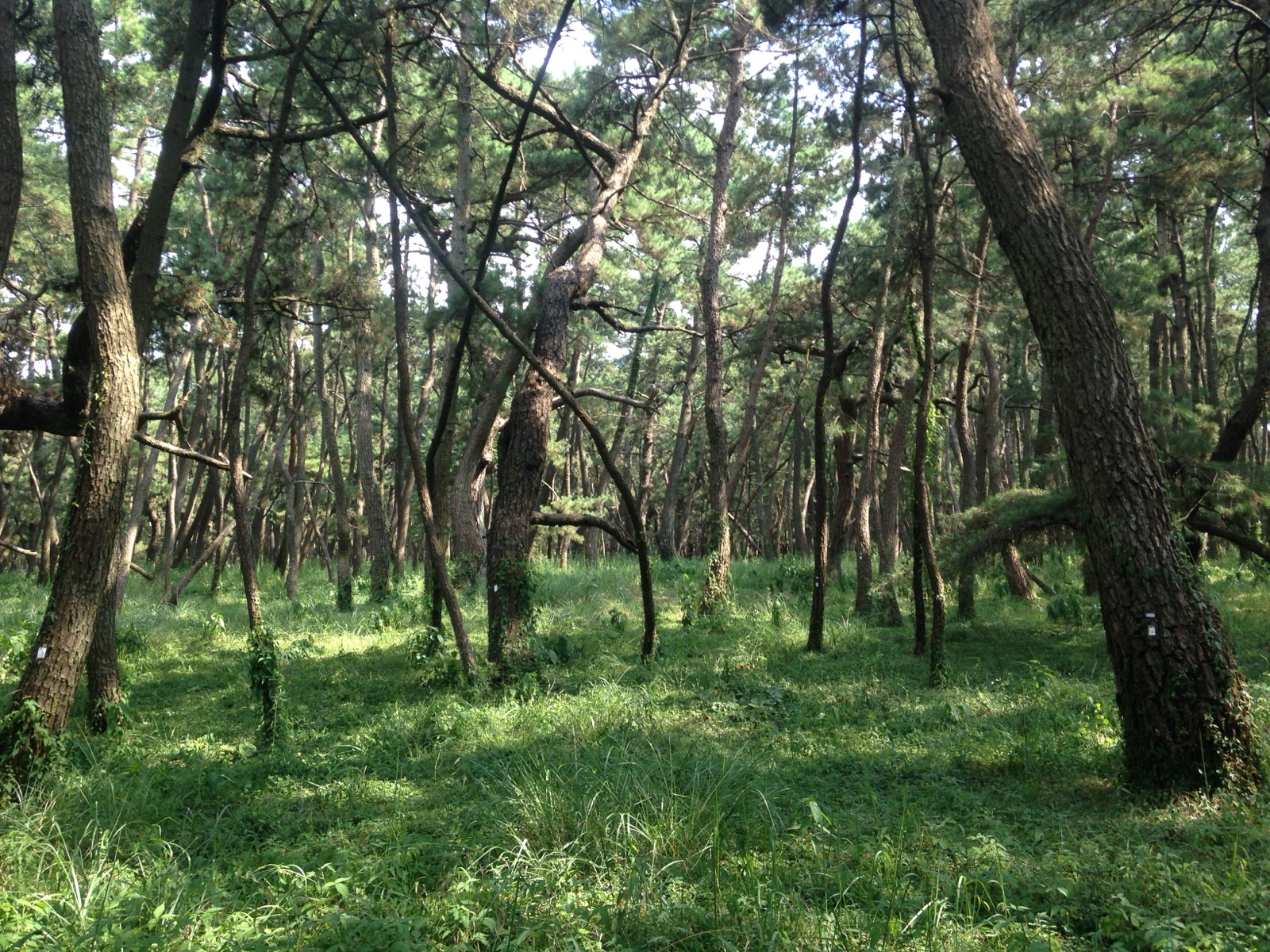
Inside Nijinomatsubara, Karatsu: four centuries on, the trunks still lean and curve rather than rise straight. / Photo by そらみみ (Soramimi), CC BY-SA 4.0, via Wikimedia Commons — Source

Miho no Matsubara, on the Shizuoka coast, tells the same story from a different shore: a seven-kilometer band of pines and white sand facing Mount Fuji across Suruga Bay, designated a National Place of Scenic Beauty in 1922 and added in 2013 to the World Heritage List as part of the Fujisan Cultural Site. Both groves began as practical infrastructure, planted to make a stretch of coastline livable. Neither was designed to be admired. That it turned out to be admirable was not something the trees planned, or something the people who planted them could have fully foreseen — it took the wind, working on the pines for generations after the planting was done, to finish the job.
The hardship is the form, not a decoration on it
This is the part a bonsai artist takes most seriously: a coastal pine's beauty is inseparable from what it endured to earn its shape. A pine grown in a sheltered valley, spared the wind, never develops a fukinagashi silhouette — it has no reason to. The lean, the one-sided branching, the sparse, wind-combed foliage are all a direct record of resistance, written into the wood over years the tree had no say in. A grower training a fukinagashi in a pot is studying what real hardship does to a trunk, branch by branch, and building a shape that carries the same logic honestly, rather than decorating a tree to merely look wind-battered. That is a large part of why the style is difficult to fake and easy to get wrong. Wire that forces a branch downward without regard for where that branch would plausibly sit on a real windward tree reads as arbitrary. Wire that follows the coastal pine's own working logic reads as true.
The coast sets the standard the pot is judged against
None of this can be studied from a photograph alone, which is why growers who train fukinagashi seriously make a point of walking real coastlines — Miho no Matsubara, Karatsu Bay, any working bofurin (防風林, "windbreak forest") where the wind is still doing its work — before they wire a tree. What they bring back is a set of observations rather than a fixed template: how far the lean typically runs before a trunk stops looking natural and starts looking broken, where a coastal pine still puts out a branch even on its sheltered side, how the crown thins rather than vanishing outright.
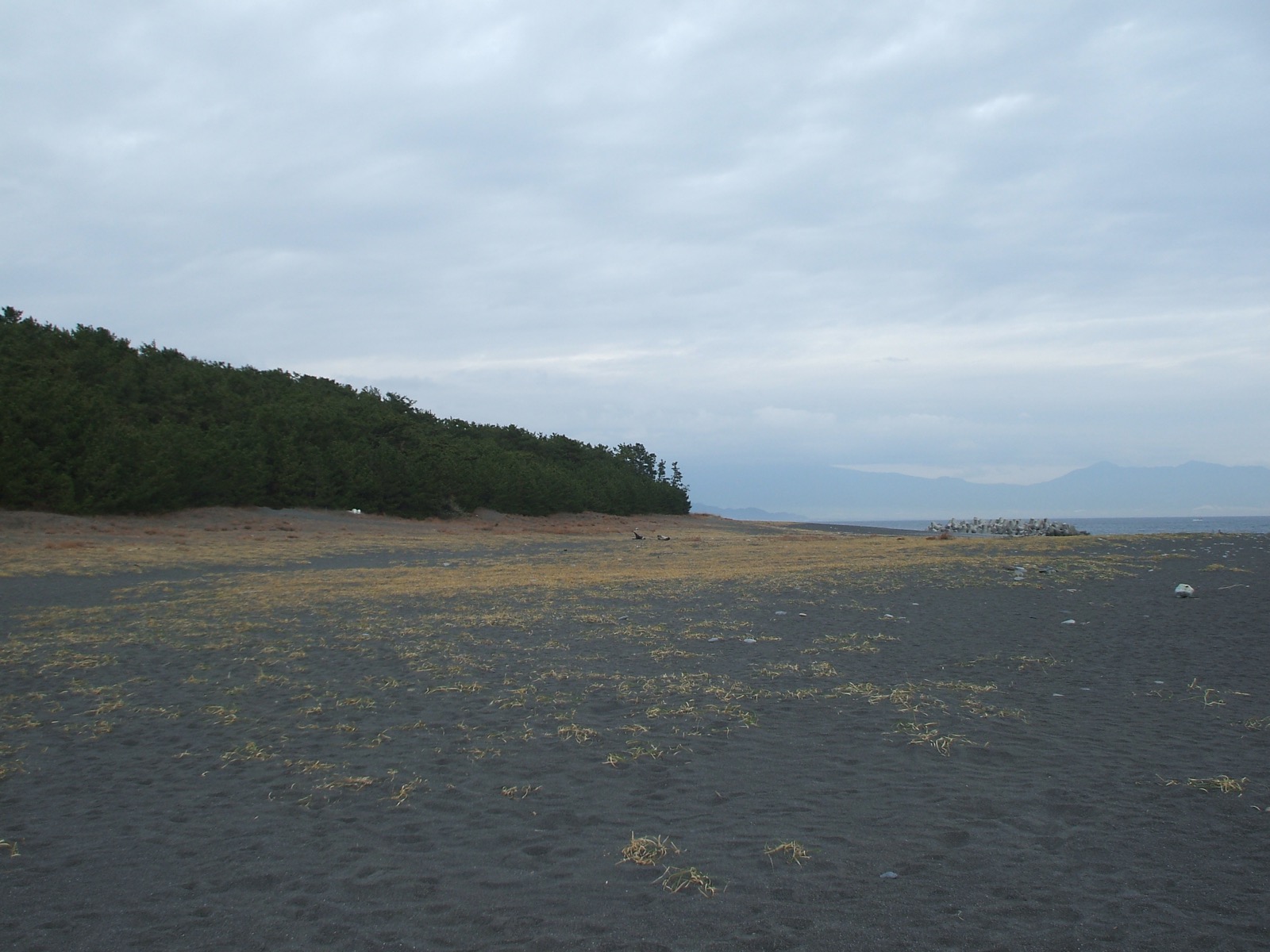
Miho no Matsubara, Shizuoka, where the grove meets the beach — the kind of edge growers walk before they wire. / Photo by Twilight2640, CC BY-SA 3.0, via Wikimedia Commons — Source

Those observations become the standard a fukinagashi in training is measured against, season after season, long after the artist has left the coast behind. They also give anyone looking at a windswept tree a usable test: check whether every branch answers the same wind, including the ones on the sheltered side, and whether the crown has thinned rather than disappeared outright. A single branch still reaching back the other way is usually the sign that the wind in that tree was applied at the bench rather than read from a coastline.
The form was already written; the work is reading it
A bonsai grower does not invent the windswept form. It already exists, written slowly into pines along coastlines that have been enduring the same wind for longer than any nursery has been in business — the way Nijinomatsubara's trunks still carry Terazawa Hirotaka's seventeenth-century wind four hundred years on. The grower's task is closer to translation than invention: reading what hardship already produced in nature, and building a pot-sized version honest enough to carry the same weather in it. A translation is only as good as the translator's access to the original, which is why the artists who train fukinagashi keep going back to the coast rather than trusting memory. Azukari keeps that access built into how a tree is kept, not occasional: it stays in Japan, a few hours from the coastlines its form answers to, in the hands of an artist who can return to them whenever the reading needs checking. What reaches an owner, season by season, is not the wind itself but a faithful account of it.
For more on how a tree's form is chosen and read, see "Reading a Bonsai's Form," "Nature Is the Textbook," and "Kengai: The Cascade."
References
- Bonsai Society of Greater Cincinnati — Windswept "Fukinagashi" — trunk slanted at an angle of 60 to 80 degrees, branches growing mostly on one side opposite the wind direction, sparse elongated foliage, and the statement that the style is not easy to achieve.
- Bonsai Empire — Bonsai Styles — the windswept style described as branches growing out on all sides of the trunk but all eventually bent to one side, as if the wind had blown constantly in one direction.
- Wikipedia — Pinus thunbergii — native range along the coasts of Kyushu, Shikoku, and Honshu and in South Korea, the species' value for its resistance to salt and pollution, and its standing as a classic bonsai subject.
- Wikipedia — Miho no Matsubara — the seven-kilometer pine-lined seashore, the view of Mount Fuji across Suruga Bay, its 1922 designation as a National Place of Scenic Beauty, and its 2013 addition to the World Heritage List as part of the Fujisan Cultural Site.
- Wikipedia — Nijinomatsubara — the grove's planting by Terazawa Hirotaka, daimyo of Karatsu Domain, in the early 17th century as a windbreak and sandbreak as part of a land reclamation project, its roughly five-kilometer length, and its reported count of as many as a million Japanese black pines.
- Wikimedia Commons — image sources and licenses: Niji Pine Grove 4.jpg (Photo by そらみみ / Soramimi, CC BY-SA 4.0) and Shizuoka Miho no Matsubara pine grove.jpg (Photo by Twilight2640, CC BY-SA 3.0).