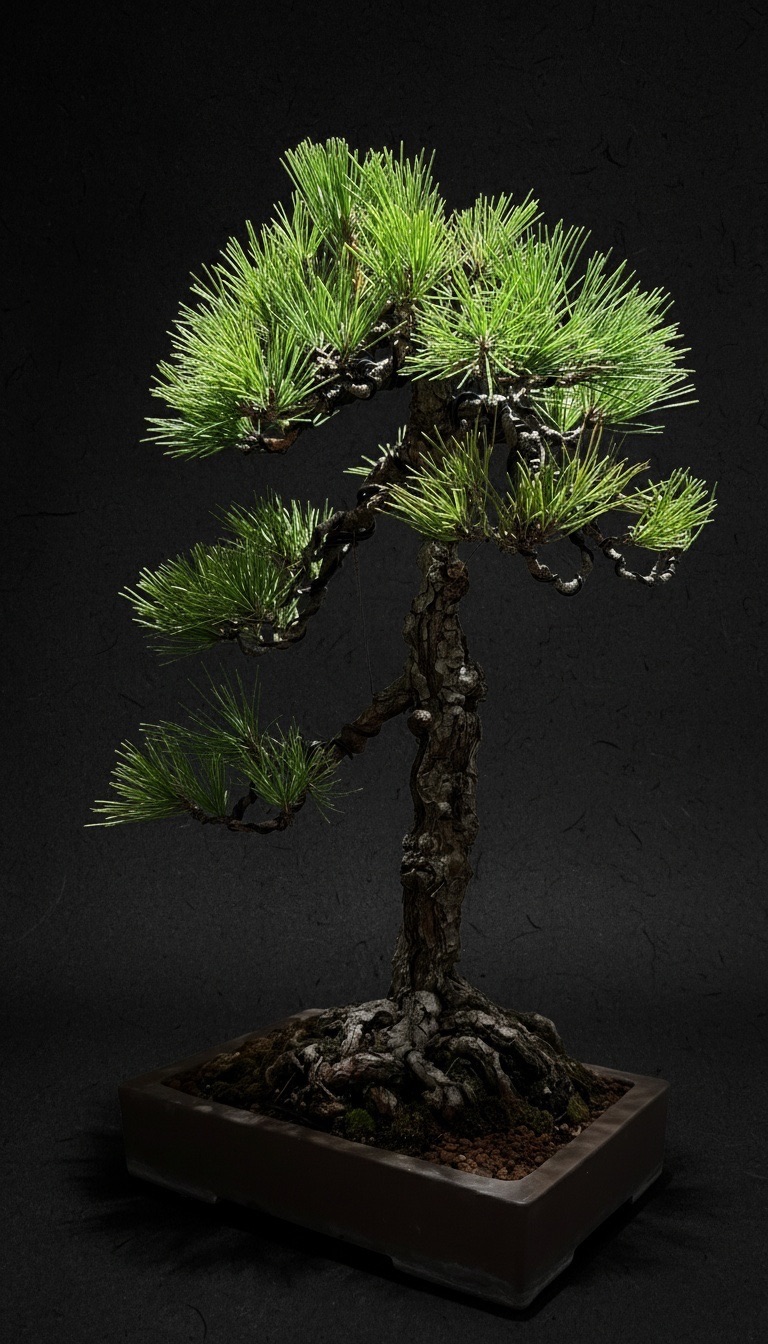
Japanese growers have a specific word for one way old black pine bark cracks: kikko (亀甲, "tortoise-shell"). Long fissures running the length of the trunk are common enough on an aged conifer. Kikko is a finer pattern than that: small blocks, close to hexagons, breaking across a surface already plated and dark with age. Nobody can talk a young tree into that pattern. A black pine can be wired into a convincing shape within a decade; the bark that would make a viewer believe the shape takes considerably longer, and there is no way to hurry it along from outside the tree.
A bonsai's bark is the one part of it that keeps, in plain sight, a record of exactly how long it has been alive — legible to anyone who has learned to read it.
Foliage can be trained dense within a single growing season, with wire and a pair of shears. Bark cannot be trained at all. It just keeps recording, whether anyone is paying attention to it or not, and that is what makes it useful to anyone sizing up whether a tree said to be old actually is one. A silhouette can be built quickly. The trunk's surface is where that claim gets backed up, or quietly contradicted.
Only years crack a trunk this way
On almost every woody species, young bark starts out thin and smooth, not far in texture from the twig it once was. What happens next is mostly a function of time rather than technique. Over years the outer layer thickens, dries, and cracks under its own tension, and on many conifers those cracks deepen into distinct plates. Japanese black pine (kuromatsu, 黒松) is one of the more dramatic examples: with age its bark darkens and breaks into hard, raised plates, and growers sometimes single out kikko among these patterns, where the plates fracture into small blocks rather than long vertical strips — distinct from the coarser, more irregular bark of a younger or less refined tree. None of this can be shortcut from outside the tree. A young black pine reads as trained. An old one reads as old because the bark itself has spent decades recording what wire and pruning never touch.
Bark's story can end in absence
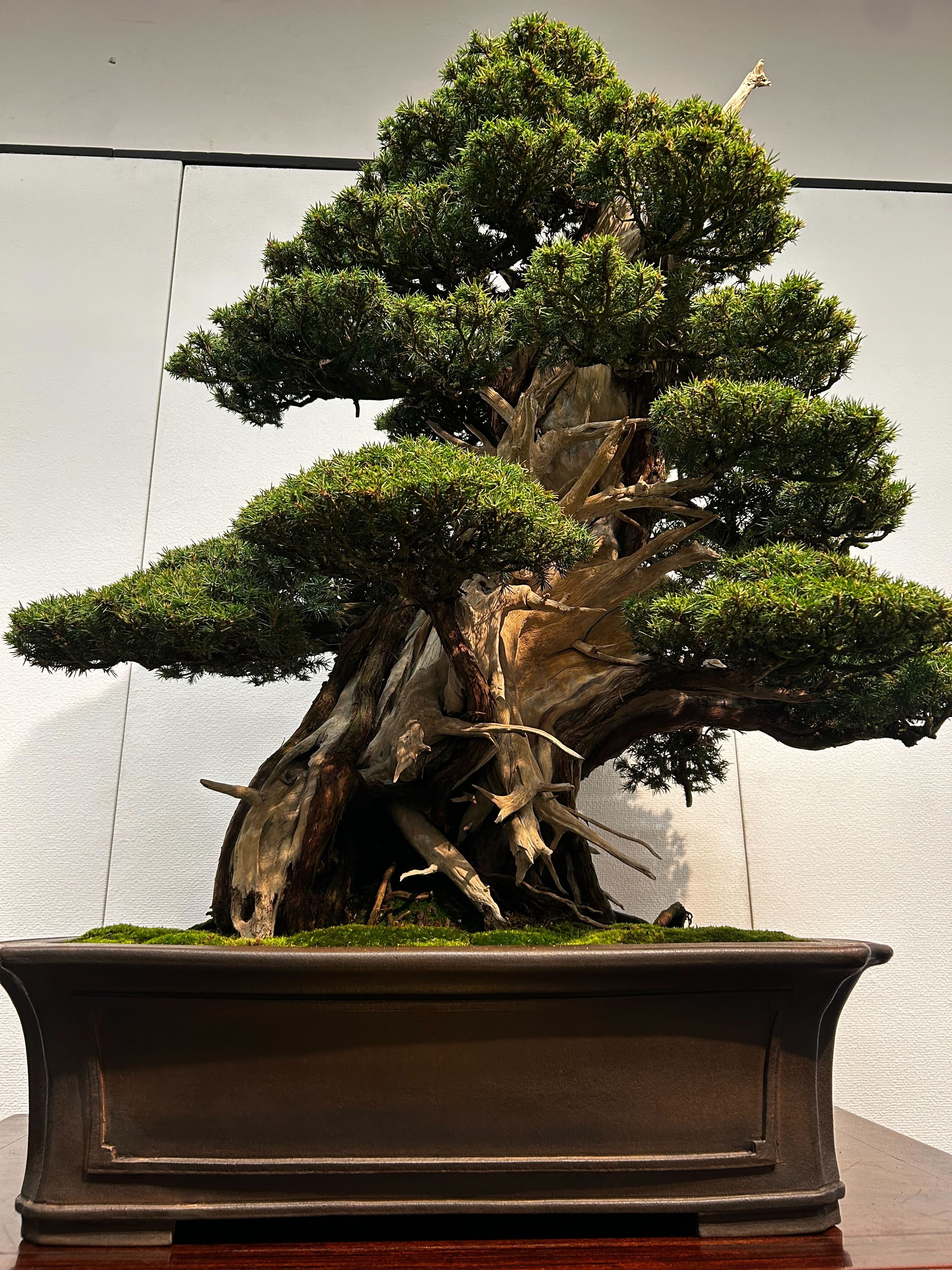
On conifers especially, that story sometimes goes further than roughening: bark disappears completely from part of a branch or the trunk, leaving bare wood bleached bone-white by years of sun and wind. Growers use two words for this, depending on where it sits. Jin (神) is a stripped, whitened branch or leader; shari (舎利) is a stripped vein running down the trunk itself. Both echo something that happens in nature on old pines and junipers growing on exposed ridgelines, where lightning, drought, or decades of wind kill part of a tree while the rest keeps living around it. On species with wood durable enough to resist rot — juniper and pine chief among them — an artist can carve and bleach a jin or shari directly, finishing the cut wood with lime sulphur to hold its white color and slow decay. Even carved deadwood only really convinces once it has weathered outdoors for years afterward, softening under sun and rain into something closer to what a tree would have made on its own. We looked more closely at how jin and shari read on a living shimpaku juniper; here it is enough to say that they mark the point where bark's aging story reaches its far edge, where roughening finally gives way to absence.
Growers leave the scars in view
Bark also carries a tree's smaller injuries, and they are read the same way as its overall roughness. A branch removed years ago leaves a wound that the trunk slowly closes over as it thickens, often leaving a fold or a change in the grain where the bark healed around the cut. Growers do not usually try to erase this kind of mark. A visible old scar, like a patch of shari or a run of aged, plated bark, is generally left to become part of the tree's face rather than hidden behind new growth. A broader idea in Japanese craft runs alongside this: a well-used ceramic or wooden object is said to have acquired jidai (時代, literally "an era," used here for the specific patina that only years leave on a surface) once age has visibly marked it — the same word applied to an old tea bowl sits just as naturally on an old trunk. We wrote separately about kintsugi, the ceramic repair that leaves a crack in gold rather than hiding it; a bonsai's bark works on a related logic, marking the years a tree has been through rather than concealing them.
The oldest bark has the most to say
A young tree's bark has almost nothing to report yet — a smooth surface simply has not had time to accumulate a record. An old one is the opposite: plated bark, a run of shari, a healed scar from a branch cut two owners ago, all sitting on the same trunk, all legible to anyone who has learned to read them. A tree's roots keep a similar record below the soil line; bark keeps it above ground, on the part of the tree every visitor sees first. If you want to check a claimed age rather than take it on faith, this is where to look. Wire and pruning can build a convincing silhouette within a season; the surface underneath it can only be written by years.
One grower's hand writes the whole record
None of this comes from a single dramatic session, and it does not come from more than one caretaker working at cross purposes either. A trunk's plates, its shari, its healed scars accumulate under one continued hand, season after season, deciding each year which wound to leave and which cut to make. Azukari is built around exactly that continuity: a tree stays in Japan with one artist, who keeps adding to this same record year after year, while its owner holds one stretch of a story that is still being written on the trunk. What arrives with each season's update is not a finished photograph but bark still in the process of forming — proof, to anyone who checks, that the years actually happened.
References
- Bonsai Empire — Deadwood on Bonsai (Jin, Shari and Uro) — definitions of jin and shari, the species they suit, and the carving and lime-sulphur process used to create and preserve them.
- Stone Lantern — Bark and Bonsai — on bark as a visual marker of a bonsai's true age and the limits of artificially aging it.
- Kisetsu-en Shohin Bonsai Europe — Bonsai Trees and the Importance of Bark — on what bark does for a tree (shielding it from damage and carrying nutrients through the phloem beneath), why mature, textured bark reads as age, and how growers protect bark during cultivation.
- 盆栽.com — 「黒松は幹肌がポイント」 — describes the kikko ("tortoise-shell"), rock-textured, and rough-bark classifications used for Japanese black pine.
- Kotobank — 「時代が付く」 — dictionary definition of jidai ga tsuku, the patina an aged object is said to acquire.