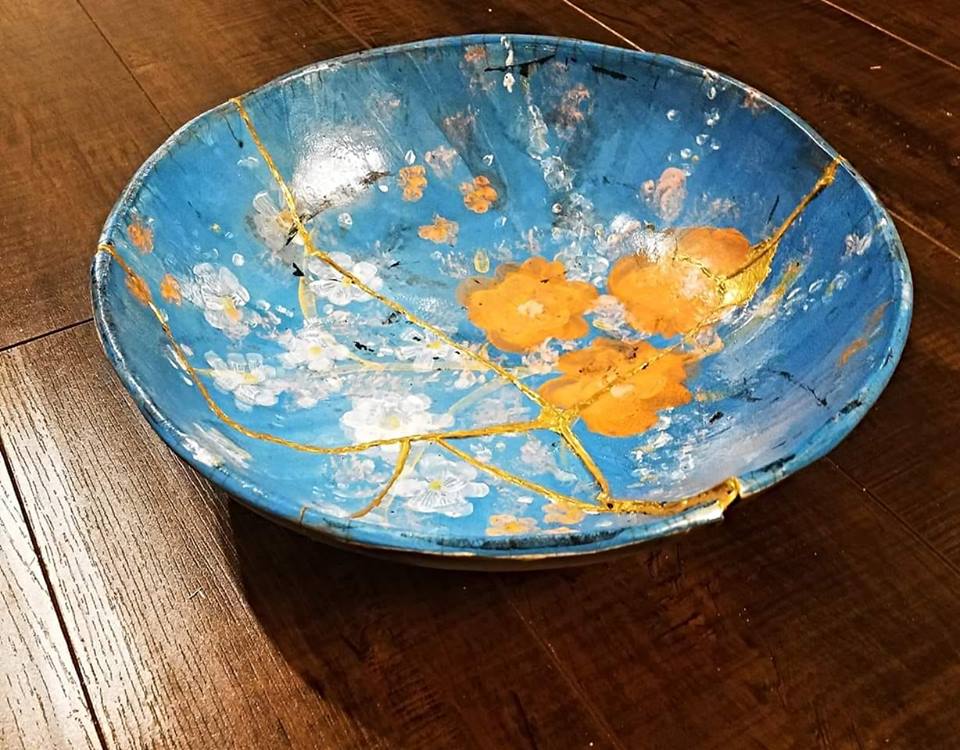
Photo by Ruthann Hurwitz, CC BY-SA 4.0, via Wikimedia Commons — Source

A Chinese celadon tea bowl called Bakohan (馬蝗絆, "locust-clasp bowl") is held today in the Tokyo National Museum as an Important Cultural Property, its crack still crossed by metal staples shaped like the legs of a locust — a repair the story credits with pointing toward kintsugi (金継ぎ, "golden joinery"), the technique of mending broken ceramics in lacquer and finishing the seam in gold, so the break becomes a permanent line running through the piece.
Gold is the last step, not the repair
The technique itself is patient work. A shattered bowl is first rejoined with an adhesive lacquer, often mugi urushi (麦漆, a paste of raw lacquer mixed with wheat flour), strong enough to hold ceramic fragments in place while remaining slightly flexible. Missing chips are built back up with further layers of lacquer combined with clay or fine powder, then shaped and sanded down to the level of the surrounding surface. Only at the end does gold appear: a fine finishing layer of lacquer is laid along every seam and, while it is still tacky, dusted with gold, silver, or occasionally platinum powder. The whole piece then cures for days in a humid cabinet, because urushi (漆, natural tree lacquer) hardens through moisture rather than through drying out. None of this is fast — a single bowl can take weeks from first crack to finished seam, and the gold dusting is the shortest part of it.
The mend is built to be noticed
What results announces itself as a repair. The gold line does not try to match the glaze around it — it sits on top of the break, tracing its exact path, so the fracture becomes the object's most visible feature.
A shogun's cracked bowl came home with a new name
The Bakohan bowl is where the best-known account of this way of mending is set. In the late fifteenth century, the story goes, the shogun Ashikaga Yoshimasa sent the bowl — then simply a favorite Chinese tea bowl, without its later name — back to China after it cracked, hoping for a replacement of equal quality. None could be found, and the bowl came back mended instead, its crack closed with the locust-shaped staples that gave it its name. Rather than being disappointed, Yoshimasa and the tea masters around him are said to have found the repair beautiful in its own right, and the bowl has been preserved ever since. Whether this particular bowl's staples were the direct spark for gold-lacquer repair, or whether kintsugi as a distinct technique developed somewhat later and separately, is not settled history: the surviving museum record confirms the bowl, the crack, and the staple repair, but the causal leap to kintsugi itself is a tradition passed down through the tea world rather than a documented fact. Told as legend, though, it captures something real — a culture that had already decided a visible mend could be worth more than an invisible one.
The crack becomes part of the object's record
Once a repair is visible, it stops being something to forget. The gold seam does not return the bowl to how it looked before it broke; it adds the break permanently to the bowl's surface, alongside the potter's original glaze and shape. Look at a kintsugi piece and you are looking at two moments in its life at once — the day it was made, and the day, sometimes centuries later, it survived being dropped, or shipped, or handed down through a family and cracked in the process. Each event the bowl has lived through becomes part of what the bowl now is.
Mending outranks replacing
Kintsugi did not appear in isolation. It sits inside a broader habit, especially strong in the world of the tea ceremony, of repairing rather than replacing valued objects, and of letting the repair itself carry aesthetic weight. Related techniques extended the same logic further. In yobitsugi (呼び継ぎ, "call-and-join" patching), a missing section of a broken bowl might be filled with a shard from an entirely different bowl — a different glaze, a different pattern — instead of a matching piece from the same vessel, joined in with lacquer and gold so that one object becomes visibly made from two. The mismatch is not softened; it is presented plainly, sometimes even set off deliberately against the original ware.
Underneath these techniques is a simple assumption: a broken object is still the object, and the correct response to breakage is to keep it in use, not to discard it for something unmarked. A bowl that has been mended and returned to the tea room has, by that fact, already proven itself worth the time the mending took.
Bonsai keeps its own scars in plain sight
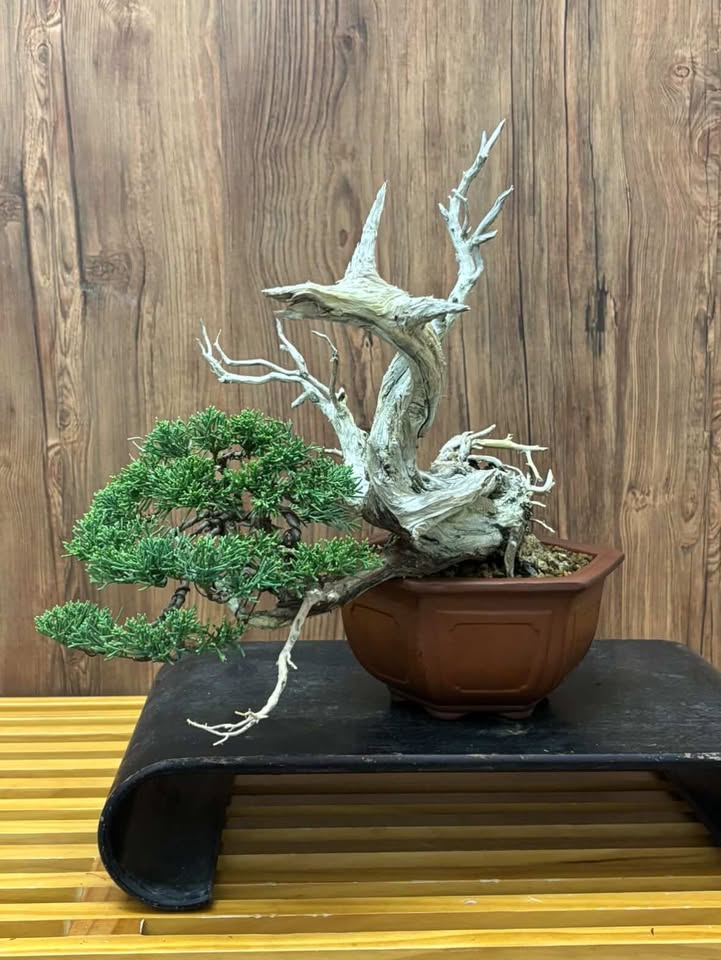
A shimpaku juniper bonsai. The white deadwood is shari; on this same tree, jin marks a bleached branch tip. Both are left exposed rather than removed. / Photo: Azukari
Bonsai has its own version of a break left in plain view. Jin (ジン/神, a branch stripped of bark and bleached to bare wood) and shari (シャリ/舎利, a comparable stretch of dead wood running along the trunk) both mark places where part of a tree has died — killed by wind, cold, or age. An artist chooses to shape and preserve that dead wood instead of cutting it away, working the surface until it whitens like bone. Set beside the living bark and green foliage of the rest of the tree, jin and shari turn a record of damage into one of the most closely observed features of the whole planting; growers speak of them as the tree's scenery, worth composing a view around.
The resemblance to kintsugi is not a shared technique. It is a shared refusal: a storm-killed branch, like a cracked bowl, is not treated as something to erase back to a clean, unmarked state. In a bonsai under long-term care, that same patience shows up season after season, in years of ordinary work that let a tree's whole history, breakage included, stay visible in its present form.
One question separates a hidden repair from a kept one
Carry one question out of this article and into the next old bowl or storm-marked tree you see: was the damage erased, or was it kept as part of the record? A repair that hides damage treats an object's history as something to correct back to a single, original state; a repair that runs a line of gold straight through the crack, or the shari left standing on a trunk instead of cut away, treats that same history as cumulative — each event adding to what the object now is, rather than being edited out of it. As we wrote in an earlier piece on wabi-sabi, this way of reading time on a surface runs through much of Japanese craft, not only kintsugi and not only bonsai. For more on how a tree's own marks of age and imperfection are read, see "The Beauty of Imperfection" and "How to Look at a Bonsai," which looks more closely at jin and shari themselves.
References
- Kintsugi — Wikipedia — overview of the technique (urushi lacquer, gold/silver/platinum powder, curing process), related methods including yobitsugi, and the Ashikaga Yoshimasa origin account.
- Tokyo National Museum — Bowl with a Foliate Rim, Named "Bakohan" — museum catalog record for the Southern Song celadon bowl, an Important Cultural Property.
- e-Museum (Japan) — Celadon porcelain bowl, named Bakohan — detailed provenance record: the bowl's history under Ashikaga Yoshimasa, its return from China mended with a locust-shaped metal clamp, and the tradition that the repair itself raised the bowl's regard.
- Victoria and Albert Museum — "Objects and opinion: sustainable histories" — museum discussion of kintsugi as a technique that "proudly displays damage as part of the object's history," with an example of an 18th-century Japanese Takatori bottle repaired in gold lacquer.
- KOGEI STANDARD — Crafts Glossary: Kintsugi — glossary entry from a Japanese crafts media resource defining kintsugi as "a technique for restoring broken or chipped vessels by gluing them together with lacquer and decorating the joints with gold or other materials."