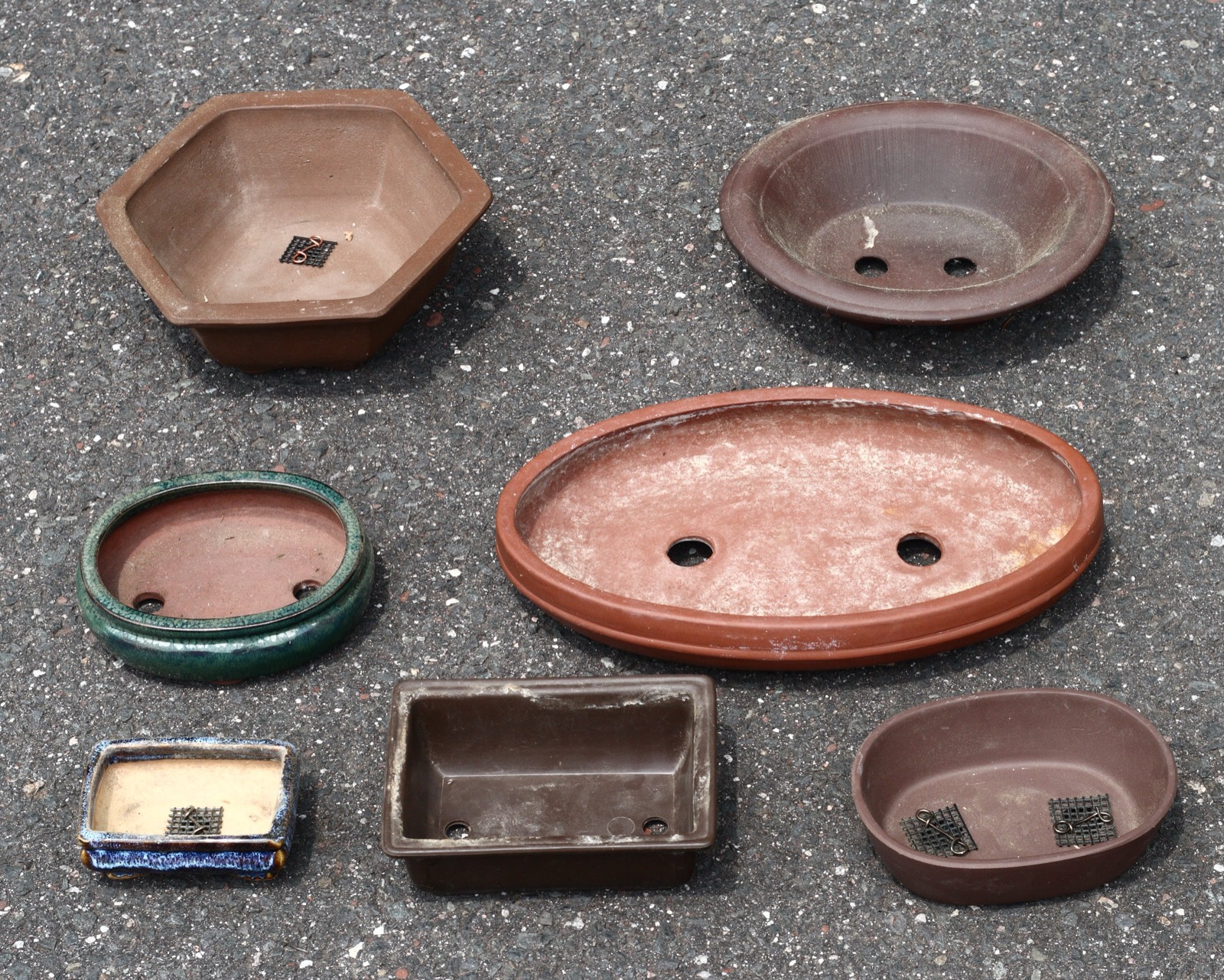
Bonsai pots vary widely in shape and finish — hexagonal, oval, round, and rectangular, some left unglazed and some glazed in blue or green. / Photo by Ragesoss, CC BY-SA 3.0, via Wikimedia Commons — Source

In Tokoname, a pottery town in Aichi Prefecture with close to a thousand years of ceramics behind it, the number of workshops still firing pots built specifically for bonsai has fallen from several dozen at their mid-twentieth-century peak to roughly a dozen today. The craft has shrunk. What a pot is asked to do for a tree has not.
A bonsai pot is not a container for soil. It is the stage an artist builds around a tree, and changing the stage can change how the tree itself is read.
Take a well-grown bonsai and move it from one pot into another — no branch cut, no leaf touched — and its whole presence can shift: heavier or lighter, older or younger, quieter or more severe. The word bonsai (盆栽) already carries this inside it: bon (盆, "tray" or "basin") joined to sai (栽, "planting"). A tree growing in open ground is not yet a bonsai in the full sense of the word. It becomes one only once it is set into a container chosen for it alone.
The pot is chosen after the tree, never before
A nursery pot exists to keep a plant alive. A bonsai pot exists to present one. Depth, width, glaze, and the thickness of the rim are chosen after the tree, in response to a specific trunk line and a specific season of foliage, rather than picked first and planted into. Japanese growers have a word for the harmony this aims at: hachi-utsuri (鉢映り, "how the pot reflects the tree"), the sense that pot and tree have become one composition rather than a plant merely sitting in a bowl. As a widely cited rule of thumb, a pot's length runs to roughly two-thirds of the tree's height, and its depth sits close to the thickness of the trunk just above the soil — a starting point stylists depart from as often as they follow it. It also gives you the nearest thing to a measuring stick available to an outsider: does the pot recede into the tree's own color and line, or is it still competing with them?
Shape, color, and texture are rules before they are taste
Growers reach for a loose set of shared conventions before taste ever enters the decision. A chokkan (直幹, "formal upright") trunk, rising straight and disciplined, usually sits in a plain rectangular or oval pot whose sharp lines do not compete with the trunk's own severity. A moyogi (模様木, "informal upright") trunk, with its gentler curves, tends to suit an oval or round pot instead, echoing the tree's own movement; a cascading trunk that falls below the rim generally needs a taller, deeper pot simply to keep the whole composition from reading as though it might tip over.
Color follows the tree's own palette. Pines and other conifers are traditionally set in unglazed pots — clay left in its fired earth tone, known generically as dei-mono (泥もの, "clay ware") — because a plain, recessive color sits behind dark bark and needles rather than competing with them. Deciduous, flowering, and fruiting trees are more often given glazed pots, iro-hachi (色鉢, "colored pots"), in white, blue, or green, chosen to carry the different faces the same tree shows across a year — new green in spring, color in autumn, bare branches by winter. Older, weathered trees are conventionally matched to quieter, more subdued glazes; younger stock can carry a brighter one. Texture is expected to follow the bark: deeply fissured, plated bark generally suits a coarser clay surface, while smooth young bark, on a maple or a beech, is more often set against an equally smooth pot. None of this is a fixed formula — exceptions are everywhere in practice — but it is the vocabulary a grower reaches for first, the way a chord progression precedes a melody.
Hachi-awase treats the pairing as its own skill, tested over seasons
The Japanese term for the whole exercise is hachi-awase (鉢合わせ, literally "matching the pot," the deliberate pairing of a specific pot to a specific tree). It is treated as its own skill in Japan, distinct from pruning or wiring, and rarely settled on a first attempt. Growers describe testing several pots against the same tree over more than one season — setting one, living with it, trying another — before a combination finally reads as good hachi-utsuri rather than a plant sitting in a bowl. Nor is the match permanent: as a young tree's trunk thickens and its surface roots spread, or as the tree moves from training toward a more finished presentation, the pot chosen for it years earlier can stop fitting, and it is matched again.
Two very different pot traditions supply the material for this judgment. Bonsai pottery is generally traced to Song-dynasty China, roughly the eleventh century, with the craft reaching Japan only much later; antique Chinese pots remain prized in Japanese collections today. Tokoname — the same town whose kiln count opened this piece, one of Japan's Six Ancient Kilns — had already made ceramics for close to a thousand years by the time it began producing pots made specifically for bonsai, a development generally placed in the middle of the Meiji era, a little over a century ago, on the strength of the bonsai boom then spreading out from Osaka. It remains Japan's best-known domestic source today, even at a fraction of its mid-century kiln count. Standing apart from Tokoname ware are kowatari (古渡り, "old crossing," antique Chinese pots imported from as early as the Song dynasty through the late Qing) — pieces prized in Japan's bonsai world as objects worth owning and admiring in their own right, and reserved by convention for a trunk with enough presence to stand beside one.
The pot can carry half of what a finished tree shows
Because bon already means "tray" inside the word bonsai, growers in Japan have long said, only half in jest, that the pot accounts for as much as half of what makes a finished composition work. A tree of real quality, set in a pot that fights its color or crowds its trunk, can look ordinary. The same tree, moved into a pot chosen with care, can look as though it had always belonged there — the container revealing what was already true about the tree rather than adding anything foreign to it. This is why hachi-awase is given the same seriousness as pruning or wiring, even though the pot itself is never touched with a tool once a tree sits in it: the judgment behind choosing it shapes how everyone who later looks at that tree will see it. We wrote elsewhere about the broader aesthetic this judgment belongs to.
A pot's fit is remade as the tree changes
A pot, once chosen, is rarely a tree's last pot. Repotting comes every few years regardless of the container, and a grower's read of a tree — its color, its taper, the mood it should carry into its next stretch of life — changes along with the tree itself. Choosing the pot is one more decision inside a much longer relationship between a tree and the people who keep it, made once and then periodically remade. It is also why the dozen kilns still working in Tokoname matter more than their shrunken number suggests: each pot they fire will likely outlast several of the trees it is first matched to, and be matched again after that.
Azukari sits inside that same ongoing relationship. An artist in Japan continues making judgment calls of exactly this size — this repotting, this pot, this season — long after a tree first finds an owner, and each one becomes part of the record that owner receives. A tree's pot, like the rest of its care, is never decided once and then left alone. For more on how a bonsai is set beside other objects once its pot is chosen, see "Bonsai and Suiseki" and "The Empty Tokonoma."
References
- Bonsai Empire — Choosing a Bonsai Pot for Your Tree — shape, depth, and color guidelines for matching a pot to a tree's style and species.
- Bonsai Empire — Tokoname Pots — on the decline of Tokoname's bonsai-pot kilns from several dozen to roughly a dozen active workshops today.
- Bonsai Empire — Bonsai Pottery (Origins) — origins of bonsai pottery in Song-dynasty China and its later spread to Japan.
- YUKIMONO — "The History of Tokoname Bonsai Pots" — Tokoname's roughly thousand-year pottery history and the emergence of bonsai-specific pots in the mid-Meiji era.
- The Japan Foundation, Wochi Kochi — "How the Combination of Tree and Vase Can Transform the Appearance of Bonsai" — on hachi-utsuri, antique Chinese kowatari pots, and the pot's role in a bonsai's composition.
- Hobby Times — Beginner's Guide to Matching Tree and Pot — definition of hachi-awase and shape guidelines by tree form (Japanese).