In 1485, builders at Ginkaku-ji in Kyoto finished a small study room called the Togu-do. Historians count it as the oldest surviving example of shoin-zukuri (書院造, a residential style organized around a built-in desk, staggered shelves, and a shallow display alcove), and that alcove — the tokonoma (床の間) — has kept the same rule for more than five hundred years: it holds exactly one object, chosen for one guest, for one season, set against a wall left bare on purpose.
A tokonoma is not a shelf for keeping things. It is a stage built to hold one object at a time, and the bare wall around that object is what lets it carry the weight of a household's welcome on a single day.
A tokonoma is a stage, not a storage nook
A visitor who has not seen one before tends to misread it: a raised floor set into the far wall of a formal room, a single hanging scroll above it, perhaps a branch of flowers in a low vase, and nothing else. It looks, at a glance, like a shelf someone forgot to fill. The form has a traceable history that explains why it is nearly empty on purpose. One account traces the tokonoma to the oshiita (押板, a board used in Zen temples to hold Buddhist altar objects — a candlestick, an incense burner, a vase — beneath a devotional scroll on the wall behind it). A second traces it to the room arrangements of shinden-zukuri (寝殿造, the open, pavilion-style residential architecture of the Heian aristocracy). Both threads converge in shoin-zukuri, which developed among the samurai class roughly across the Muromachi period, the fourteenth through sixteenth centuries. Inside a shoin-zukuri room, the alcove stopped holding devotional objects and became a fixed setting for art: the household's most valued scroll, shown to whichever guest currently sat facing it. By the Edo period the tokonoma had spread well beyond temples and samurai residences into any home built with a formal reception room in mind.
The alcove allows one object at a time
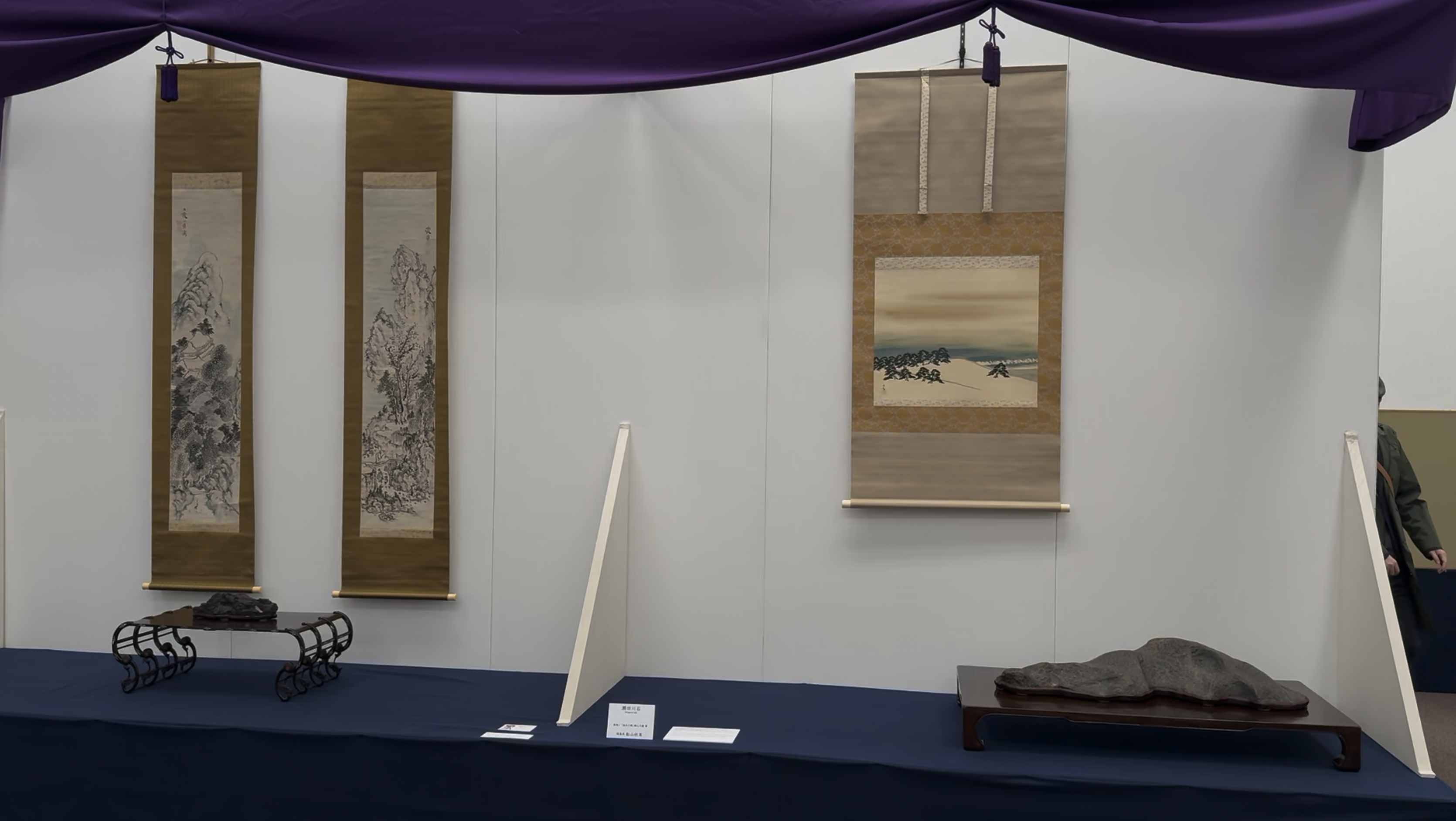
What makes a tokonoma worth studying is not its shape but its restraint. At any given moment it holds exactly one composition — most often a single kakejiku (掛け軸, a vertical hanging scroll of calligraphy or ink painting), sometimes paired with one ikebana flower arrangement, one stone, or one bonsai, but never two of these competing for attention at once. A second scroll is not hung beside the first for variety. A second vase is not added for balance. The rule is exactly this: one guest, one season, one object.
That single object also changes on a schedule a host controls directly. A scroll of plum blossoms suits early spring; a scroll of autumn grasses suits October. A scroll bearing an auspicious phrase suits a wedding visit; a quieter, more contemplative one suits a guest arriving in mourning. The arrangement is prepared before the guest arrives, and both host and guest read it the same way: as a private notice of what kind of occasion this is, and how the host regards the person now seated before it. A guest who steps into a tokonoma is reading something composed for that day only — not the day before it, not the day after.
Emptiness gives the object its authority
None of this would register if the object sat in a cluttered room. What lets one scroll carry that much meaning is the bare wall around it, the raised floor beneath it, and the recessed ceiling above — an architectural frame with the sole purpose of isolating one thing from everything else. Etiquette governs the space just as strictly. A guest does not step onto the alcove's raised floor except to change the display, and the most honored guest is traditionally seated with their back to the tokonoma, facing the room, so the composition stays visible to everyone else without turning attention into a spectacle around the guest's own body. Every object that might have stood in that space and does not is part of the arrangement too, chosen by being left out.
Bonsai earned a place in the alcove only recently
Bonsai's place in this tradition is a fairly recent and hard-won one. Historically the tokonoma was reserved chiefly for scrolls and ikebana — refined arts practiced indoors, considered suited to the alcove's dignity — while a tree grown outdoors in a garden was, for a long stretch of that history, not judged proper material for a space this formal. Only once the practice of bonsai had matured into its own refined discipline, worthy in the eyes of collectors and hosts of the same attention as a fine scroll, did it earn a place inside. Today a well-formed tree, alone or paired with a suiseki (水石, a viewing stone appreciated for a landscape suggested in its natural form) and a scroll, is a recognized and honored form of tokonoma display — what Japan calls toko-kazari (床飾り, formal alcove display), or seki-kazari in a bonsai exhibition setting. The discipline devoted to this art of display is the subject of What Is Keido, and the stones themselves of Bonsai and Suiseki.
Once admitted, a bonsai gets no exception from the alcove's other rule: it appears alone, for that day's guest and that day's season, and is taken away again once its moment has passed. No living bonsai could tolerate indoor display for more than a few days without suffering for the lack of light and air, so it is brought in for an occasion and returned to its bench outdoors afterward — exactly as a scroll is unrolled for a visit and rolled away once the guest has gone.
The pairing matters more than the object
The habit worth taking from a tokonoma, if you ever stand in front of one, is not admiring the emptiness for its own sake — that reading stops at decor. Look instead for what the single object is paired against: the calendar, in a scroll chosen for the season; the guest, in a scroll chosen for their visit and no one else's; the exhibition's theme, in a bonsai set beside one stone and nothing more. The object alone tells you what a host owns. The pairing tells you what a host was thinking about you, or about the day, when they chose it. That is the question a toko-kazari is built to answer, and it is the one most visitors never think to ask.
A tree's finest hour in the tokonoma is not spent occupying the room. It is spent, briefly, at the center of one.
References
- Tokonoma — Wikipedia — overview of the alcove's two competing origin theories (oshiita in Zen temples; shinden-zukuri room arrangement), its display conventions for scrolls, flowers, and bonsai, and the etiquette governing the space.
- Shoin-zukuri — Wikipedia — the development of the shoin-zukuri residential style from the Muromachi period, its core features (tokonoma, staggered shelves, built-in desk), and the Togu-do at Ginkaku-ji, dated to 1485, as its oldest surviving example.
- Shoin-zukuri — Encyclopaedia Britannica — a concise architectural history of the shoin style and its association with Zen Buddhism and the tea ceremony.
- MATCHA — "Tokonoma, An Essential Element Of Japanese Architecture" — on the tokonoma's origins among the samurai class and its character as a display space without practical utility.