One December, reading a book by the bonsai master Kunio Kobayashi, I came across a word I had never seen written down before: keido (景道, "the way of display") — a discipline built around arranging a tree, a stone, and the space between them as a single scene. I called the garden the next day: Shunkaen BONSAI Museum, in Edogawa on the eastern edge of Tokyo, where more than a thousand trees stand inside one set of walls. I have studied there since just after New Year last year. The first thing keido asked me to notice was not a tree. It was the plain, untouched stone that, in the best displays, sits beside one.
This is not filler. It is suiseki (水石, "viewing stones"), a Japanese viewing tradition practiced for centuries under imperial patronage and refined alongside the tea ceremony and Noh theater. Suiseki means finding a mountain, a waterfall, or a distant island already present in an untouched stone, then setting it on a carved wooden base or in a shallow tray of sand to be admired. Unlike bonsai, nothing is shaped or grown; the entire practice rests on how you read a form the stone already has.
Understanding how a stone like this is read changes how you look at a bonsai too — the two have been trained to be seen together for centuries.
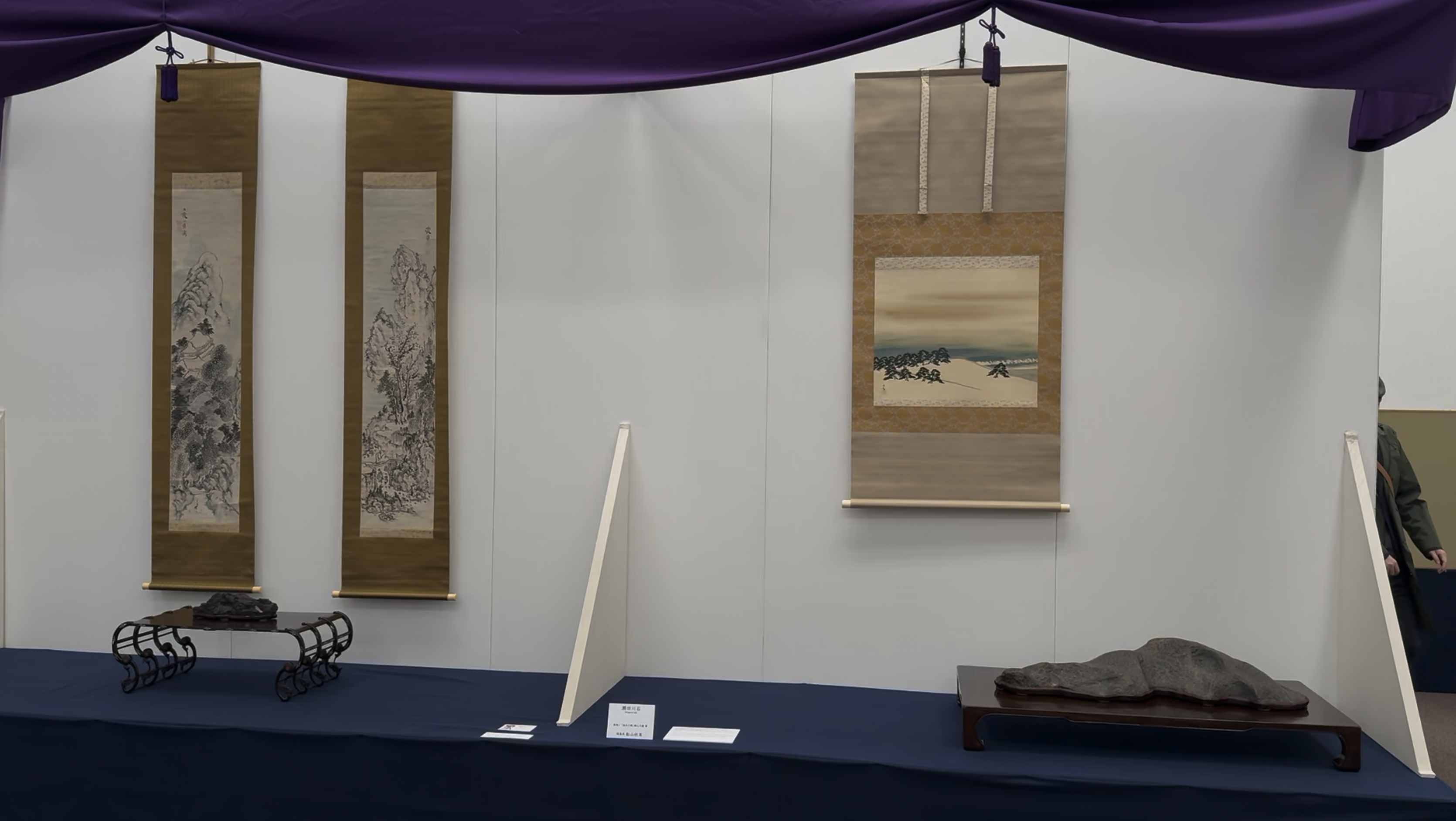
A suiseki exhibition. Stones set on wooden stands are displayed alongside hanging scrolls.
A Chinese taste for stone became a Japanese way of seeing
The name suiseki is thought to be a shortened form of sansui-keiseki (山水景石, "landscape view stone"). A second account holds that water splashed on a stone in a tray deepens its color and sharpens its expression, lending the practice its name. (Source: Nippon Suiseki Association, "What is Suiseki")
The practice traces back to China, where appreciating a stone for its own form is thought to have begun. It reached Japan during the Muromachi period, in the Nanboku-cho era of the fourteenth century, and changed shape once it took root there: Zen Buddhism, the tea ceremony, and the aristocratic taste of the Higashiyama culture all left their mark, and a Japanese preference for dark, subdued stones displayed singly grew apart from the Chinese taste for more colorful stones shown in groups. (Source: Nippon Suiseki Association, "What is Suiseki") The exact route and timing remain debated, so this should be read as the general shape of the history rather than a fixed date.
A related pastime called bonseki (盆石, arranging stones on a tray to form a scene) is considered suiseki's direct ancestor. By the Edo period, the practice had spread beyond the samurai and court classes into everyday life, and appreciating a stone for its own sake had become part of ordinary culture. (Source: Sui Sui Suiseki, "History and Origin of Suiseki")
The stone never changes; what you read into it does
The heart of suiseki is a practice called mitate (見立て, "seeing one thing as another"). Look at the plain outline of a stone and you find a mountain ridge in it. Trace a white vein running across a stone and you read it as a waterfall in motion. This act of reading is the whole of suiseki's appreciation.
Certain shapes have settled into recognized categories over time. A toyama-ishi (遠山石, "distant-mountain stone") suggests a line of mountains receding into the distance, and is considered suiseki's most basic form. A taki-ishi, or waterfall stone, carries a white vein crossing it that reads immediately as falling water. Stones are also grouped by shapes such as shima-gata-ishi, gently rolling island forms; dan-seki, stones with stepped, terrace-like layers; and doha, stones suggesting a rolling hill or plateau. (Source: Sui Sui Suiseki, "Classification of Suiseki")
The stone itself never changes through any of this. The same stone can look like a mountain to one viewer and a waterfall to another. What shifts is the eye that looks at it.
If bonsai is the art of painting a landscape inside a pot, suiseki is the art of finding a landscape already waiting inside a stone. One shapes something to create a scene; the other reads a scene without touching anything at all. The novelist Yasunari Kawabata, in his Nobel lecture "Japan, the Beautiful, and Myself," described this same compression at work in the Japanese garden: "Compressed to the ultimate, the Japanese garden becomes the bonsai dwarf garden, or the bonseki, its dry version." (Source: Nippon Suiseki Association, "What is Suiseki") (For more, see "Bonsai is not a small tree".)
A living tree needs an unmoving companion to show its age
Bonsai and suiseki have long been displayed as a pair. In a tokonoma alcove, a bonsai, a hanging scroll, and a suiseki are arranged together to express the mood of a season in a single space — a practice called seki-kazari (席飾り, a tokonoma arrangement combining tree, scroll, and stone). Sometimes a suiseki sits alone on a shelf; more often, in the basic tokonoma arrangement, a bonsai and a suiseki flank a hanging scroll hung at the center. (Source: Bonsai Navi, "Displaying Bonsai Beautifully: Seki-kazari and Suiseki")
A bonsai is alive. It buds, grows, gets pruned, and changes its shape with the seasons — a living thing that moves through time. A suiseki changes nothing. It carries centuries, sometimes far longer, of geological time into the present exactly as it was: an unmoving presence.
Set side by side, the two draw out something in each other that neither shows alone. A bonsai on its own shows only the turning of the seasons. Next to a suiseki, that seasonal change becomes visible as a single moment inside a far longer span of time.
The stone tells you whether it belongs to water or to land
There are two common ways to display a suiseki. One sets the stone on a daiza (台座, a carved wooden base) fitted to its exact contours, lending it a formal presence suited to a tokonoma alcove. The other sets it in a suiban (水盤, a shallow tray of sand), smoothing the sand to suggest open water or level ground around the stone.
The choice is not simply aesthetic. A stone suggesting a distant island or a wave-worn shore is conventionally read as belonging to water and set in a suiban; a stone with a standing, upright form suits the daiza better, so as to avoid the "floating" effect the sand would otherwise suggest around it. (Source: Nippon Suiseki Association, "Display")
That is the one question worth carrying out of a display like this: does the stone belong to water, or does it stand? Almost every decision about how it is shown — the base it sits on, the angle it is turned to, even where it sits in a room — follows from that single answer. Turn the same stone slightly and the mountain in it can look rugged or gentle; learning that rhythm is where the enjoyment of suiseki begins.
What keido asks of the eye, a bonsai eventually asks too
Suiseki adds nothing. The stone itself never changes; what is asked of you is what you find in it. Growing that eye for seeing-as carries directly into how you look at a bonsai, which also asks you to read the landscape an artist built into the flow of a trunk, the spread of roots, and the harmony between tree and pot. (See "How to Look at a Bonsai".)
Keido, the practice that first put a name to that plain stone for me, treats bonsai and suiseki as two halves of one discipline: one built by hand, one read as found. For more on keido as a whole, see "What Is Keido? The Aesthetics of Bonsai and Suiseki" — that article traces keido across the whole practice; this one goes deeper into suiseki on its own terms.
A stone does not grow, and a tree does not hold still — but keido asks you to read them as one, and it is a large part of why I built Azukari around keeping a tree inside that unbroken practice, in Japan, rather than lifting it out of it.