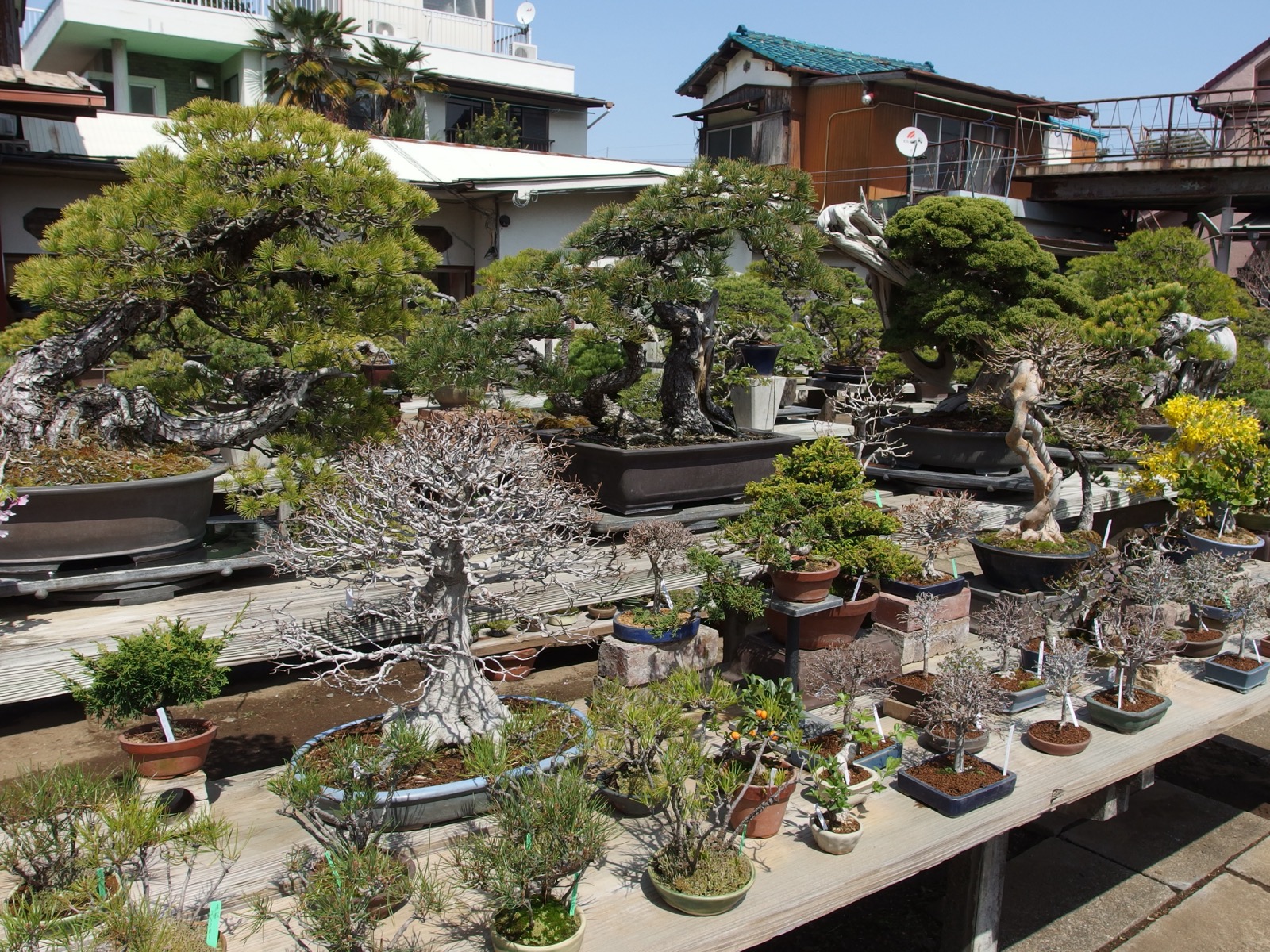
Old pines and fresh stock share the same nursery bench at Omiya Bonsai Village — decades apart in training, waiting on the same thing. Photo by Guilhem Vellut, CC BY 2.0, via Wikimedia Commons — Source
.jpg)
In 2025, Omiya Bonsai Village (大宮盆栽村), the cluster of nurseries north of Tokyo that has trained more of Japan's bonsai profession than any other single place, closed out its first hundred years. A hundred years is long enough to try more than one answer to the question of how a craft like this keeps going, and Omiya's own history already holds two of them, decades apart — one now familiar, one nearly forgotten.
Bonsai's next hundred years will not be decided by how many trees Japan manages to keep, but by how many people, inside Japan and far outside it, still have a reason to keep a pair of hands trained to shape one.
A market that closed at home, and one that opened decades ago
The shrinking of the first is well documented. As we've written elsewhere, Omiya held around thirty bonsai gardens in 1930 and has six today, and the reasons are almost all domestic: fewer houses built with a tokonoma (床の間, "an alcove for displaying art") to hold a full-sized tree, owners aging without an heir, land and inheritance costs that make a small family nursery hard to pass on whole. None of it required anyone in Japan to love bonsai less. It required fewer of them to have anywhere to put one.
The growth abroad reads like recent news, but it is not new to Omiya's own history. Government trade figures put Japan's bonsai exports at roughly ¥493 million in 2021, climbing to about ¥917 million by 2023 before easing to ¥906 million in 2024, with China, Italy, and the Netherlands the largest destinations by value. But long before that trade data existed, a bonsai master working out of Omiya had already staked a career on the same wager. Saburo Kato, the third-generation proprietor of the village's Mansei-en garden, spent the late 1970s and the 1980s building what became the World Bonsai Friendship Federation, founded in 1989 on a principle he called "World Peace Through Bonsai" — the conviction that a discipline built on patience and attention could carry friendship across borders as readily as across generations. The first World Bonsai Convention, held that same year in Omiya, the village where Kato had spent his career, drew roughly 1,200 visitors from 32 countries. Bonsai's turn toward the world did not begin with a quarantine rule easing in the 2020s. It began on a nursery bench in Omiya, nearly forty years earlier, with one grower deciding the craft's future customers did not all have to live in Japan.
A technique that already travels, even when the tree cannot
None of that outward-looking history solves the harder half of the problem: a craft is not only its technique, but a reason, close enough to actually reach the people practicing it, for someone to want what the technique produces. We've written before about how that reason has thinned at home even as the skill itself remains teachable. What is easy to miss is that the skill has already been crossing borders for decades — carried by people, rather than by trees.
Valentin Brose, a bonsai artist from Germany, spent three years apprenticing under master Kunio Kobayashi at Shunkaen Bonsai Museum in Tokyo, part of a European following for bonsai that, according to a Japanese government account of his training, traces back to the 1970s and '80s — the same years Kato was laying the groundwork for the WBFF. Brose now teaches workshops across Europe and leads tours of European enthusiasts through Japan's gardens. A tree that stays rooted in Japan and an apprentice who leaves it, trained, are answers to the same problem arrived at from opposite directions: one keeps the material in the only soil it fully belongs to; the other lets the knowledge travel to wherever the interest already is.
What has to survive together, not separately
Set the two halves side by side and a structure starts to appear. The tree does best staying exactly where its climate, soil, and daily care already are — a fact we've examined elsewhere in terms of what it actually costs, in quarantine years and paperwork, to move a living bonsai across a border at all. The technique travels reasonably well, carried by apprentices like Brose or by the artists who train under Japanese masters and then teach abroad. What has never had a reliable way to travel is the third piece: a paying reason, reaching from wherever the interest now lives, for a nursery in Japan to keep a tree in training and an apprentice on its bench.
That third piece decides whether the other two survive to matter in a hundred years. Rooted trees and teachable technique are each necessary and neither is sufficient alone. Without someone willing to sustain the relationship between them, a nursery with capable hands and healthy trees still closes — the way roughly two dozen of Omiya's own gardens already have.
What Azukari is built to hold together
Azukari is one attempt at that third piece. A tree stays in Japan, in an artist's ongoing care; an owner elsewhere joins that relationship not by moving the tree but by keeping a record of it, season after season — the same kind of record that has long been how a shokunin (職人, "a craftsperson defined by trained hands rather than by title") and an owner have shared responsibility for a tree neither of them expects to see finished. It does not, by itself, reopen a closed nursery or shorten an apprenticeship. What it can do is give a nursery in Japan one more reason, next spring, to take on someone willing to spend years learning a technique that, on its own, has never been the part in short supply.
A bonsai's second century, like its first, will be counted out in seasons no single report can compress into a headline. What can be said now, before any of it plays out, is what has always been true of a tree kept in a pot: it will still need water tomorrow, pruning the year after, and someone, somewhere, willing to be the one who provides it.
For more on the two sides of this problem, see "The Succession Problem" and "The Last Generation of Japanese Masterpiece Bonsai."
References
- Omiya Bonsai Art Museum — "About the Omiya Bonsai Village" — official figures on the village holding around 30 gardens in 1930 versus six today.
- Omiya Bonsai Village — "History" — the village's 1925 founding after the 1923 earthquake, and Saburo Kato's role as Mansei-en's third-generation proprietor and an organizer of the first World Bonsai Convention.
- World Bonsai Friendship Federation — "History of WBFF" — the WBFF's 1989 founding by Saburo Kato and others, its "World Peace Through Bonsai" principle, and the first World Bonsai Convention's roughly 1,200 attendees from 32 countries.
- JapanGov / Tomodachi — "Enchanted by the Bonsai Universe" — on Valentin Brose's apprenticeship under Kunio Kobayashi at Shunkaen Bonsai Museum and Europe's bonsai following dating to the 1970s–80s.
- JETRO — Export Item Report: Flowers (Ornamental Trees, Bonsai) (輸出品目別レポート「花き(植木・盆栽)」, updated August 2025) — bonsai export values by year and destination country.