Not every question about bonsai is a question about the tree. Some are about the people who spend a working life shaping one, and a plainer question sits underneath the culture and the craft: can doing this work actually support a life? Omiya Bonsai Village (大宮盆栽村), on the edge of Saitama, is as good a place as any to look for an answer, because it has been answering that question — not always well — for exactly a hundred years.
Bonsai has survived centuries of Japanese history, but a craft only survives as long as the people practicing it can earn a living from it, and for much of the last hundred years, that has not been something bonsai could take for granted.
A village that went from thirty-five gardens to six
Omiya Bonsai Village carries "bonsai" in its own address today. It began in April 1925, when Toshitaro Shimizu, part of a group of Tokyo bonsai growers whose businesses had been damaged in the Great Kanto Earthquake of 1923, became the area's first resident. Others followed from the same disaster-hit neighborhoods of Tokyo, drawn by good soil, clean groundwater, and open land close to Hikawa Shrine and Omiya Park. By 1928, roughly twenty residents had formed a cooperative and agreed on a short list of rules for anyone who wanted to live there: keep at least ten bonsai on the property, leave the gate open to visitors, build no second story, and enclose the garden with a hedge rather than a wall.
At its prewar peak, the village held 35 nurseries. Today, according to a 2024 report from the Saitama Resona Industrial and Economic Research Foundation, it holds six. The report traces the decline to several forces working together: a shrinking bonsai trade generally, changing lifestyles, aging nursery owners, a lack of successors, and, in recent decades, the rising cost of land and inheritance tax on property that has often stayed in one family for generations. None of those forces required anyone to love bonsai less. The six remaining gardens still draw visitors from around the world. What has proven far harder to sustain is the business underneath the affection — a small nursery, usually run by one household, earning enough across enough years to be handed to the next generation.
When the business crowds out the craft
The same report points to a quieter problem, visible even in the nurseries still open. To stay afloat, many now spend more of their working hours buying trees that are already partly shaped and reselling them, rather than doing the slower work of raising and training a tree from raw material, because there is no longer time in the day for both. That shift keeps the doors open, but it is not quite the same trade the village was built around. A shokunin (職人, "a craftsperson defined by trained hands rather than by title") earns a living by doing the work itself, not by moving stock faster than the nursery down the road. When the economics of a business start to reward the second over the first, the underlying skill has less room to be exercised — and less reason for anyone to spend years learning it.
Saitama City's response has been to start where the skill still lives: with younger growers themselves. Since late 2022, the city has run a study group for younger bonsai artisans — some hoping to open a nursery of their own, some set to inherit an existing one, others aiming to work from raw stock as tree-shapers in their own right. Their stated goal, in their own words as recorded by the Institute, is plain: they don't want to see a nursery close and its trees scattered, and they don't want Omiya Bonsai Village to disappear. What they are short of is not motivation. It is a version of the trade that pays enough, reliably enough, for someone to choose it over an ordinary job.
What a wider market is starting to change
One part of that picture has shifted over the past few years: demand from outside Japan. According to a JETRO report on flower and tree exports updated in August 2025, Japan's bonsai exports grew from roughly ¥493 million in 2021 to roughly ¥917 million in 2023, before easing slightly to about ¥906 million in 2024. China was the single largest destination in 2023, at roughly ¥203 million, more than double the year before; Italy followed at roughly ¥189 million, and the Netherlands at roughly ¥184 million, up 68.5%. Kuromatsu (黒松, "Japanese black pine") has historically made up close to 40% of that trade by both volume and value, and Saitama and Kagawa prefectures together have supplied more than 90% of it, according to the most detailed government species breakdown available, a 2015 survey. A regulatory change helped open one large market: the European Union lifted its ban on black pine imports in 2020, imposed over concerns about a pest that can kill the species, and after two years of monitored cultivation, full exports to the EU began in 2023.
That growth only helps a nursery in Saitama if it actually reaches the nursery in Saitama — and if the buyer at the other end understands roughly what they are looking at. JETRO's own market reporting notes a French trend toward so-called "indoor bonsai": inexpensive imports from China or Indonesia that casual buyers treat as houseplants, alongside a smaller circle of collectors who hold that a real bonsai has to be Japanese-grown. Both groups are, technically, bonsai buyers. Only the second is participating in the same trade that keeps a Japanese nursery's lights on. Explaining that difference clearly — what separates years of a shokunin's attention from an anonymous pot of greenery — is not decoration added on top of the craft. It is close to the whole of what determines whether demand abroad ever reaches the people actually growing the trees.
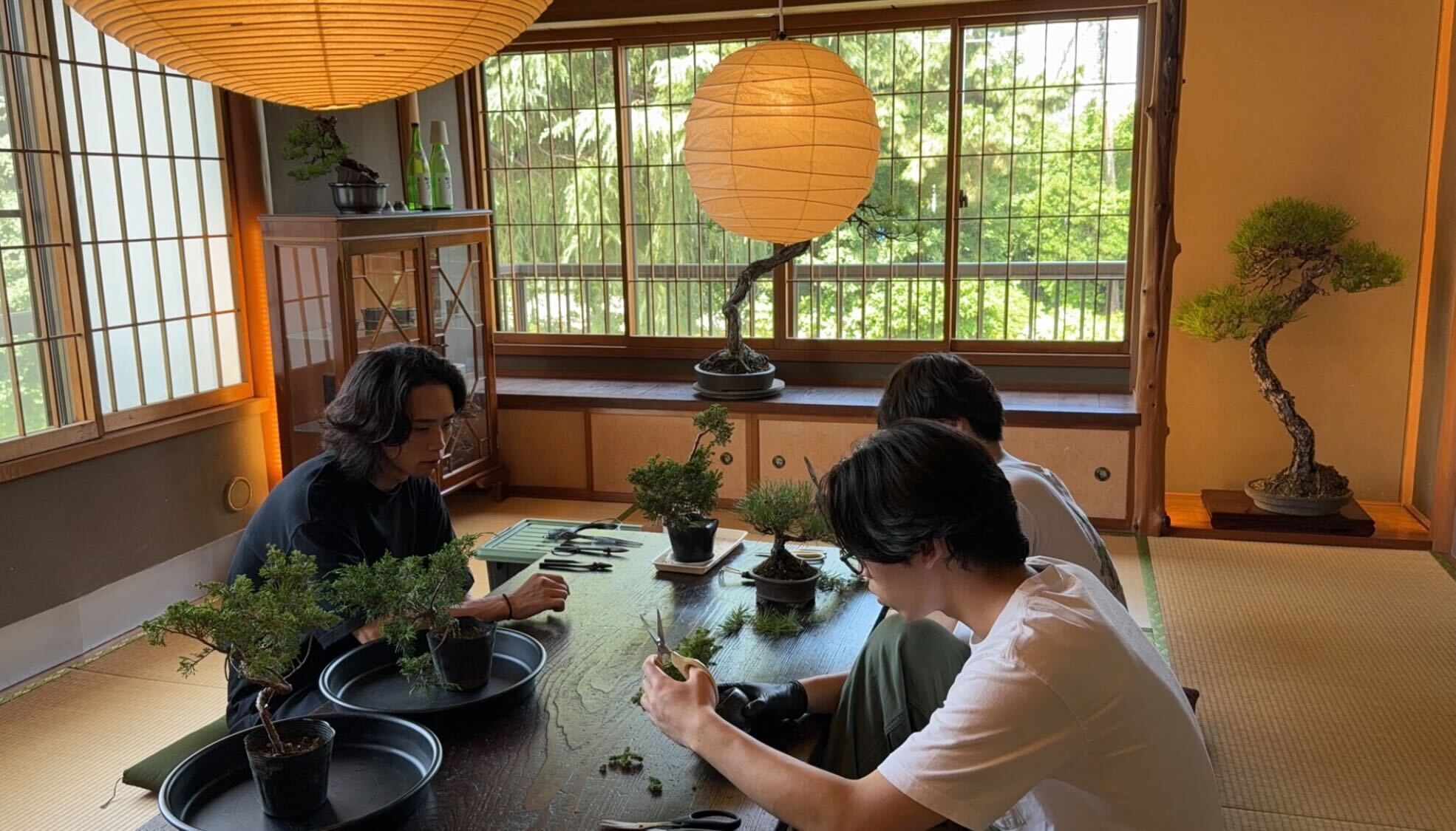
Passing a craft to the next generation means passing down technique and a living, together.
Building something to carry it
None of this gets solved by a single campaign, and Saitama City has not pretended otherwise. To mark the village's hundredth anniversary in 2025, the city ran a public fundraising drive from May to July 2024 with a ¥10 million goal, aimed at two modest, specific things: young bonsai artisans doing outreach to explain Omiya's history to a wider public, and a program gifting a miniature bonsai to every child born in the city, so the next generation grows up with one in the house before anyone has to explain what it is.
Azukari was built around the same basic problem, at a different scale. A tree stays in Japan under an artist's continuing care; someone elsewhere joins that care through a seasonal record, rather than by asking the tree to travel or the artist to stop shaping it. That structure does not, by itself, reopen twenty-nine closed nurseries or rebuild an apprenticeship system. What it can do is connect people who have come to recognize what a Japanese-grown, artist-tended tree actually represents with the ongoing, unglamorous cost of keeping the people who make one in business. A craft this old was never going to be carried forward by admiration alone. It needs enough of a living left in it for someone to still be doing the work in another hundred years.
For more, see "Shokunin," on the philosophy behind this kind of hands-first craftsmanship, "Shinise: A Nation of Old Companies," on how Japan's oldest businesses have managed to keep going, and "The Succession Problem," on who is left to carry a trade like this forward.
References
- JETRO — Export Item Report: Flowers (Ornamental Trees, Bonsai) (輸出品目別レポート「花き(植木・盆栽)」, updated August 2025) — bonsai and ornamental tree export values by year and destination, species breakdown, EU regulatory history.
- Omiya Bonsai — History — the village's founding in 1925, its origins after the 1923 earthquake, and its founding residency rules.
- Saitama Resona Industrial and Economic Research Foundation — "Omiya Bonsai: Toward the Next 100 Years" (埼玉りそな経済情報, December 2024) — the decline from 35 nurseries to 6, its causes, and the young artisans' study group.
- City of Saitama — Omiya Bonsai Village crowdfunding announcement (2024年4月25日発表) — the 2024 campaign's goal and its intended use.