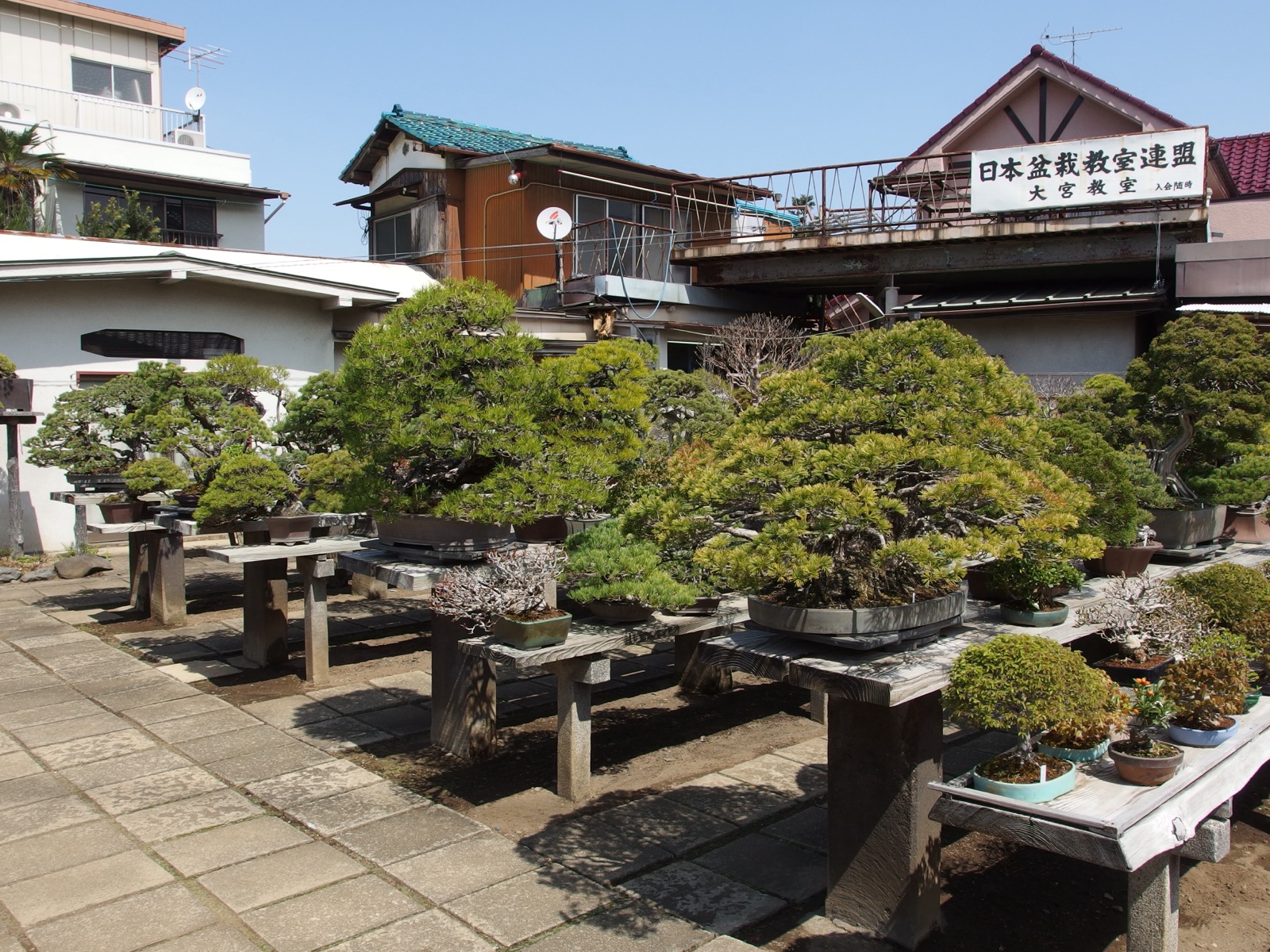
A nursery bench in Omiya Bonsai Village, one of the villages that has trained bonsai artisans since 1925. Photo by Guilhem Vellut, CC BY 2.0, via Wikimedia Commons — Source
.jpg)
Ask anyone close to Japanese bonsai what worries them most about its future, and one word tends to surface: koukeisha (後継者, "a successor"). Who will take over. It is usually discussed as though bonsai faces this question alone — the last, fragile branch of a disappearing art. It does not face it alone. The same shape of decline runs through most of Japan's traditional industries, and in bonsai's case, the harder half of the problem is not a shortage of hands willing to learn — it is a shortage of demand for what those hands would make.
A decline bonsai shares with other crafts
Japan's Law for the Protection of Cultural Properties recognizes ningen kokuho (人間国宝, "living national treasures") — at present only 116 people nationwide, spanning noh theater, the tea ceremony, lacquerware, and other disciplines the government has judged worth actively transmitting to the next generation. Even at that protected level, a widening gap between aging masters and too few successors has become a recognized national concern.
The pattern repeats in less protected corners of the same economy. In Kanazawa, a handful of families still beat gold into leaf thin enough to gild a shrine or a bowl of food, a process that takes a year of soaking and months of hammering to prepare the paper alone. One workshop owner there recently put the arithmetic plainly: in his youth the city held more than 300 gold-leaf craftsmen; today fewer than 20 remain. His own son will take over the family shop — "so in our case, we had a successor," he said. "Many other artisans' families in Kanazawa were not so lucky."
Bonsai's own version of this is written into the geography of Omiya Bonsai Village, north of Tokyo. The village was founded in 1925 by a group of bonsai gardeners who relocated after the 1923 Great Kanto Earthquake, drawn by clean water and open land. At its height in 1930, around thirty gardens made up the community. Today, by the Omiya Bonsai Art Museum's own account, six remain. Different craft, same curve.
Technique survives; demand is what thins
What makes bonsai's case worth separating from a simple story of "dying skills" is that the technique itself is, for now, still transmissible. A serious student can still find a nursery willing to take them on, still learn a kata (型, "a fixed form") the old way — by years of daily proximity to a master, watching before doing, rather than from a manual. Apprenticeship in bonsai has not run out of teachers who can teach it. What has thinned is the demand waiting at the other end of that training.
A house built with a tokonoma (床の間, "an alcove for displaying art") gave a full-sized bonsai somewhere to live and be seen. As apartment living has replaced that kind of house across Japan, both the space and the occasion for a large, formally displayed tree have narrowed, and smaller bonsai — often under 20 centimeters — have taken their place in the culture, according to industry figures interviewed by The Japan Times. The Kanazawa gold-leaf shop shows the same mechanism from a different craft: a workshop with an heir can still shrink, because temples and altars that once needed reams of gold leaf are fewer than they were a generation ago.
This is the distinction worth holding onto. A craft is not only its technique. It is technique plus a reason, at the far end, for someone to want what the technique produces. Bonsai can keep training capable hands and still arrive at a future with too few places left, inside Japan alone, for those hands to work.
Opening to the world
The clearest counterweight to a shrinking domestic reason is a growing one abroad. The Japan Bonsai Growers Cooperative — a body with a 95-year history that, by its own account, produces nearly all of the world's bonsai masterpieces — has been working with Japan's agriculture ministry and with individual foreign governments to ease the plant-quarantine conditions that currently limit how many trees can leave the country, treating the United States, where interest is reportedly highest, as its first priority. Yasuyuki Suzuki, a director at the cooperative, pointed to a broader curiosity behind that interest in remarks to The Japan Times: Western enthusiasm for concepts like Zen and wabi-sabi (侘び寂び, "beauty in imperfection and transience") — he cited Steve Jobs as one example — has, in his view, fed a wider appetite abroad for bonsai as a form of "living art."
This opening should not be mistaken for an easy one. A living tree crossing a border is not a shipment of paper or lacquerware; it carries soil, pests, and disease risk with it, and each destination country sets its own quarantine terms, changing only slowly through the kind of negotiation now underway. Sending more trees abroad, even where demand exists, remains bounded by biology as much as by policy.
There is a second way to open, though, that does not depend on the tree itself crossing anything. If the tree can stay in Japan — in the soil, climate, and daily care it already knows — while the relationship of ownership reaches outward instead, the same growing curiosity abroad can support a Japanese nursery without waiting years for quarantine terms to change.
What this changes, and what it does not
This is closer to what Azukari does than to what a standard export does. An owner abroad enters a relationship with an artisan in Japan; the tree does not travel; the record of its care crosses the distance instead, season by season. It is one structural answer to the demand side of the succession problem — a reason, reaching from further away than before, for a nursery to keep a tree, and to keep training the next set of hands to care for it.
It does not, on its own, solve the other half. Technique still passes the way it always has in Japan — one master, one student, years of watching before doing, a tree that will very likely outlive both of them. Azukari cannot shorten that. What it can do is make it more likely that a nursery still has a reason, next spring, to take on someone willing to learn it.
For more on how this looks from the artisan's side, see "The Last Generation of Japanese Masterpiece Bonsai" and our own account of looking for a second partner artist.
References
- The Japan Times — "Japan's cultural heritage and its aging guardians" — on the 116 living national treasures and the widening gap between aging masters and successors across Japan's protected traditional arts.
- The Japan Times / Japan Flowers and Plants Export Association — "Japanese horticulture demand blooms in overseas markets" — on the Japan Bonsai Growers Cooperative's export and quarantine-easing efforts, changing domestic display habits, and overseas interest in bonsai.
- NPR — "Japan's traditional crafts are struggling to survive the country's population decline" — on the decline of Kanazawa's gold-leaf craft and the succession pressure facing small traditional businesses nationwide.
- Omiya Bonsai Art Museum — "About the Omiya Bonsai Village" — official history of the village's 1925 founding, its peak of around thirty gardens in 1930, and the six that remain today.