
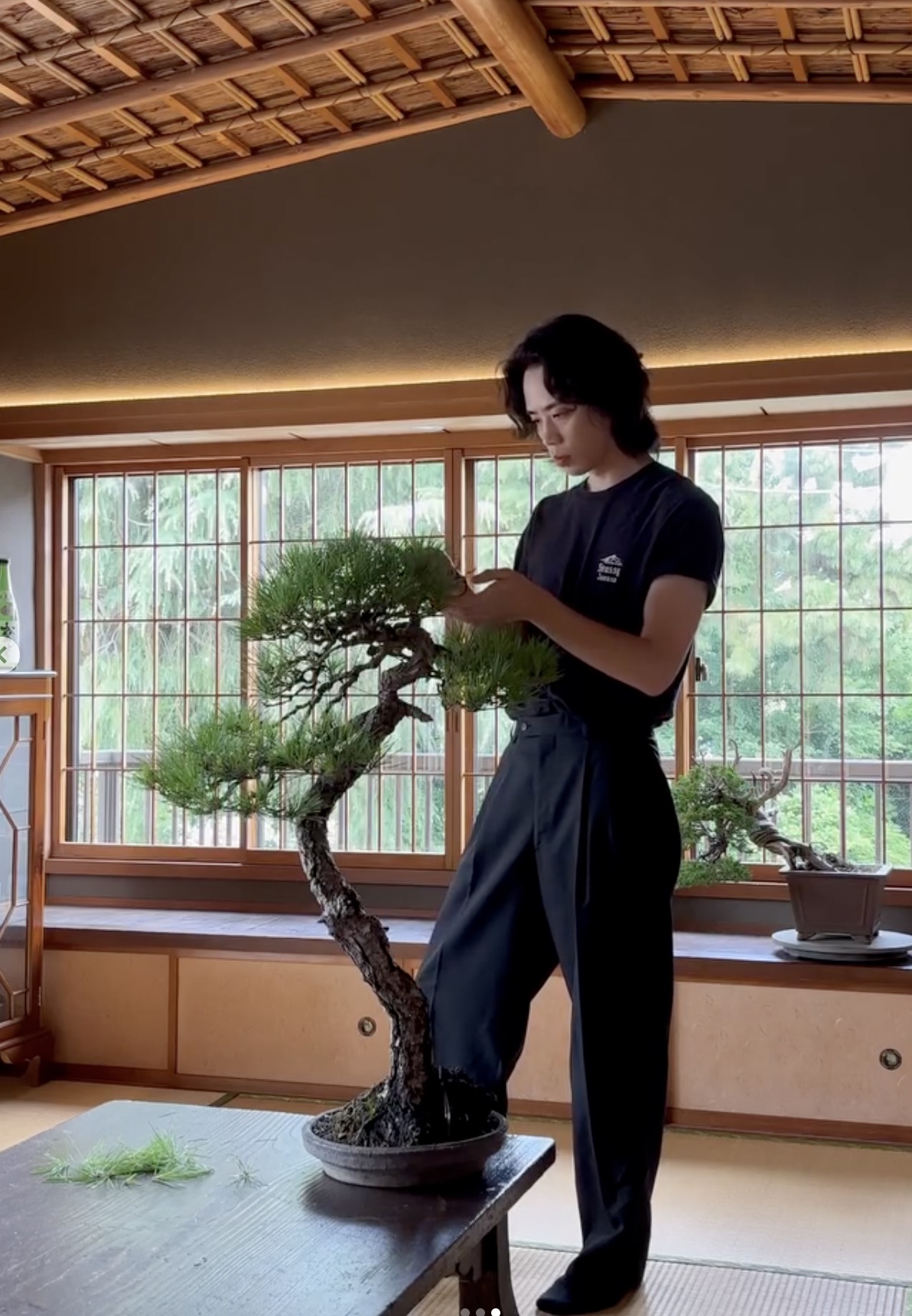
Keiichi Fujikawa spent five years apprenticed to Saburo Kato at Mansei-en, a nursery in the Omiya Bonsai Village north of Tokyo, before founding his own school, the Fujikawa International School of Bonsai, in Osaka. Five years, in a bonsai garden, means the work every apprenticeship there begins with: sweeping the yard, carrying pots, watering rows of trees that are not yet yours to touch with a blade. Ask a Japanese bonsai nursery why it takes that long to train an artist, and no one hands you a syllabus. They give you a number of years — five, most often, sometimes far more.
A bonsai apprenticeship is measured in years, not lessons, because the judgment it produces cannot be handed over in any smaller unit.
That is not a nursery being evasive. It reflects an old conviction, still active across Japan's craft traditions, that certain kinds of judgment cannot be compressed by better teaching. They can only be absorbed, slowly, by a body that has been present long enough to notice.
Watching Replaces Teaching for the First Years
In many Japanese craft lineages, a beginner is called a minarai (見習い, literally "watching to learn" — an apprentice or trainee). The word describes the method as much as the rank. A new arrival at a bonsai nursery does not begin at the workbench. He sweeps the yard, carries pots, waters rows of trees not yet his to touch, and watches the senior hands work. This structure has a formal name across Japanese arts: uchi-deshi (内弟子, "an apprentice who lives with the teacher"), a live-in arrangement found in kabuki, rakugo, the martial arts, and craft workshops alike, in which a student moves into a master's household or its immediate orbit and serves alongside daily practice. Bonsai nurseries still run on close variations of this pattern. The apprentice is not kept apart from the real work to protect him from it. He is kept beside it, on the understanding that watching, sustained for long enough, is itself a form of instruction.
Silence Is the Method, Not a Gap in the Teaching
A second, related habit runs through the same tradition: masters in these workshops often withhold the step-by-step verbal explanation a newcomer might expect. Japanese has a phrase for the obligation this places on the student — gijutsu wo nusumu (技術を盗む, "to steal the skill") — describing an apprentice's task of working out a technique through observation and repeated failure rather than through a supervisor's spoken instructions. The belief behind the phrase is specific: a skill a student had to extract for themselves is retained more securely than one simply handed over. In a bonsai nursery, this shows up in exactly the judgments that resist being put into words in the first place — how much resistance a wire should meet before it is wound too tight, how a root ball's weight in the hand signals it needs water before any visible sign does. A teacher can describe these things only approximately. A body that has repeated the motion for years knows them directly — the same idea explored in an earlier piece on the shokunin (職人, "artisan"), whose knowledge lives in the hands before it lives in words.
A Fixed Form Still Takes Years to Reach Without Being Told
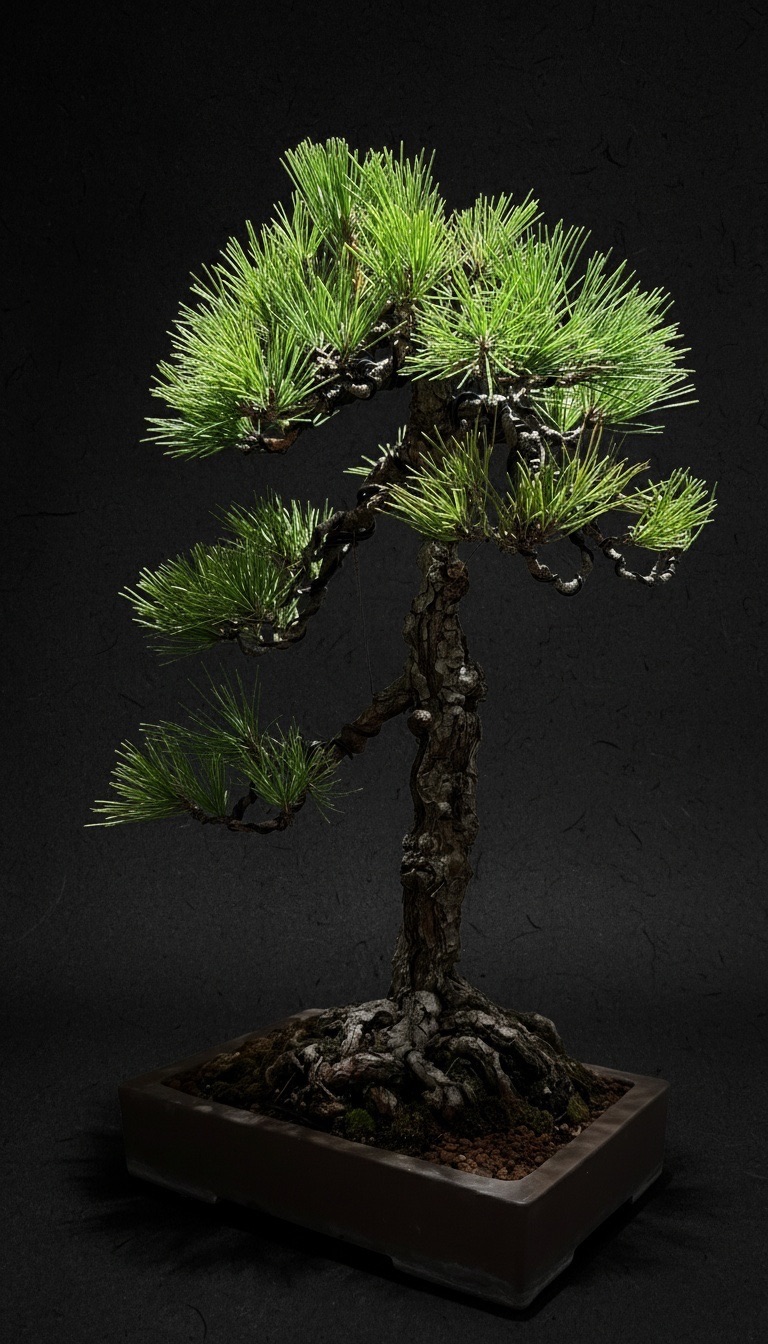
A black pine trained into a formal, upright shape. The trunk answers to a fixed kata — and, in its own way, so does the training of the hands that shaped it.
This is also why the years are hard to shorten. A trunk line follows a kata (型, "a fixed, inherited form"), the subject of an earlier piece on what a kata is and on shu-ha-ri (守破離, "obey, break, leave"), the three-stage discipline explored in a companion piece that governs how a student comes to hold one. Obeying a form on command, for a single lesson, is possible almost immediately. Obeying it without being told — reaching for the right cut before the mind has finished deciding — takes years of the same motion repeated on real material, under a teacher watching closely enough to correct it. Fujikawa's five years at Mansei-en, before he returned to run his own family's nursery, is one documented case; elsewhere in Japan's craft world, apprenticeships of a decade or longer are not unusual, and at least one master craftsman has described the bond they form as reaching past technique into something closer to a shared philosophy of the work.
The Same Clock Runs in Every Serious Craft
The same shape recurs well beyond bonsai. A sushi kitchen, a lacquerware workshop, a family-run inn — each tends to organize its own training along the same lines, years given before a student is trusted with the part of the work that matters most. It is one of the steadier structures in Japanese working life: standing in a craft is conferred not by age or by a diploma, but by the number of years a person has spent inside it, watched over by someone who has already spent theirs. That is the axis worth carrying into any claim of mastery, bonsai or otherwise: not what someone says they can do, but how many years they were made to wait before anyone let them try.
A Nursery Trains Apprentices Only as Long as the Work Keeps Coming
None of this is unique to bonsai, but bonsai depends on it more than most crafts do, because the material being trained on is also, itself, a living record of years. A tree entrusted to a nursery for long-term cultivation gives that nursery a reason to keep working, season after season, on something that will still need shaping a decade from now. That same continuity is what allows a nursery to keep a young apprentice fed, housed, and instructed through the years the craft actually requires — a place at the workbench only stays filled for as long as there is enough ongoing work to justify it.
That is the part of the apprenticeship that a buyer, sitting outside Japan, still has a hand in. Azukari keeps a tree under long-term custody with a working artist rather than selling it once and moving on, which means the same decade of paid, ongoing work that keeps a master occupied is also what keeps a place open for the person sweeping his yard. An apprenticeship survives on exactly that kind of unglamorous continuity — work that keeps arriving whether or not anyone outside the nursery ever hears about it.
For more on how a craftsman's years are shaped, see our pieces on shu-ha-ri, on what a kata is, and on the life of a bonsai artist.
References
- Wikipedia — Uchi-deshi — overview of the live-in apprentice system found across Japanese kabuki, rakugo, martial arts, and craft traditions.
- Japan Intercultural Consulting — "Gijutsu wo Nusumu: Japanese Workers 'Stealing Knowledge' to Get Ahead" — on the traditional practice of withholding explicit verbal instruction so that apprentices "steal" a technique through observation.
- Fujikawa International School of Bonsai — School — biography of Keiichi Fujikawa's five-year apprenticeship under bonsai master Saburo Kato at Mansei-en nursery in Omiya.
- JAPAN HOUSE Los Angeles — "Deshi and the Art of Apprenticeship" — on the traditional deshi apprenticeship system in Japanese crafts, discussed with bamboo artist Tanabe Chikuunsai IV.