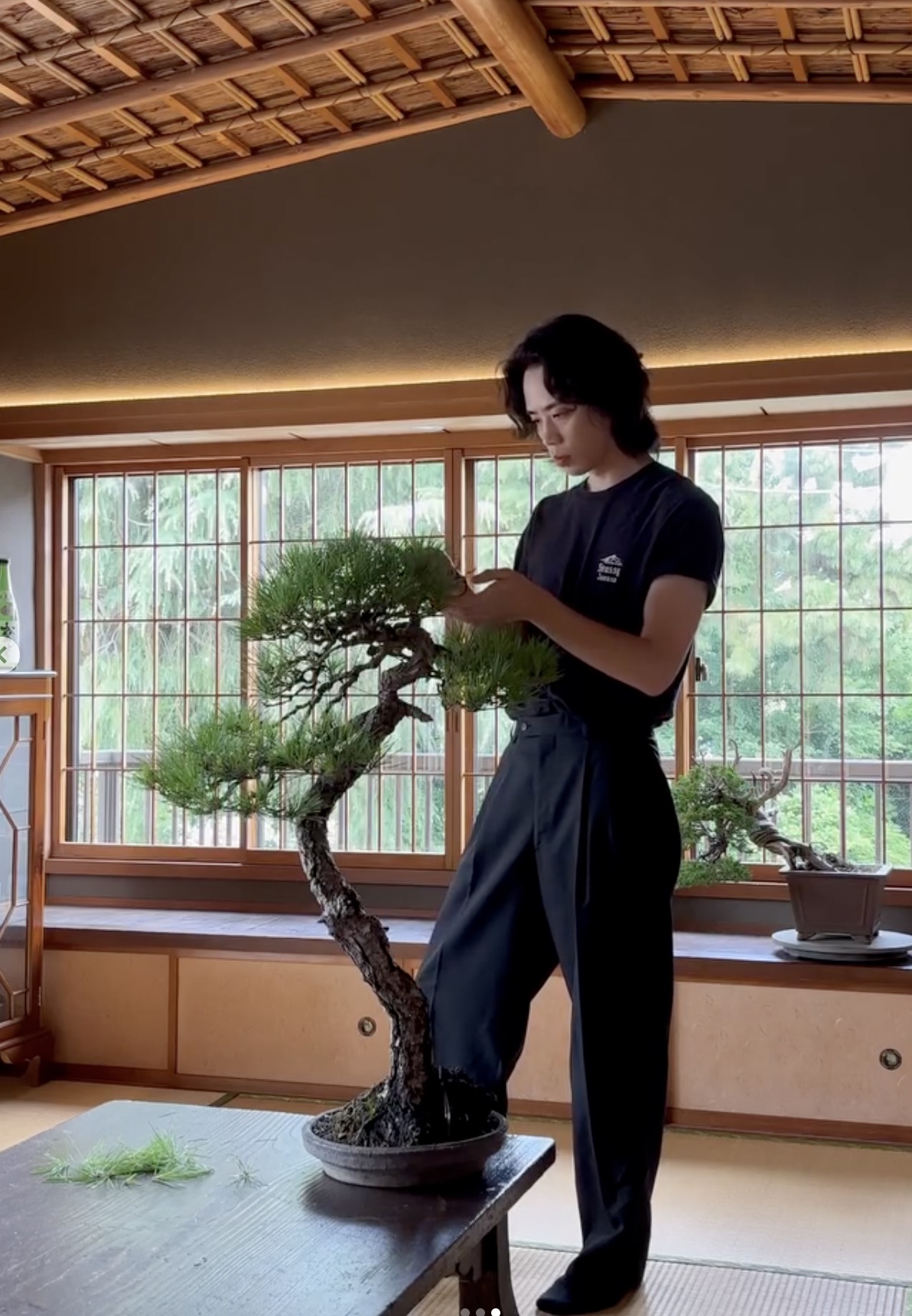
Bonsai artist Kazuki Saeki tending a black pine bonsai. In Japan, this kind of daily attention has long been treated as a job separate from ownership — one a tree's owner does not have to perform themselves.
Of all the trees this blog has written about, exactly one article shows photographs of the actual plants rather than a stock image: two princess persimmons, rouyagaki (老爺柿), photographed in a grower's field in Kiryu, Gunma, one of them still wearing a name tag that reads Urashima Taro. We brought both out of that field. Neither will be shaped by the person who eventually owns it — an artist will change the pots, set the branches, and carry them toward their autumn fruit. That division of labour is not an arrangement we designed. Japan had built it into a word centuries before anyone thought to name a company after it.
A bonsai's owner and the person who waters it, wires it, and repots it every few years have never had to be the same person. Japan built this separation into a word — azukari (預かり, "to receive and hold something in trust") — long before anyone thought to build a company around it.
No one grows a hundred-year-old bonsai alone, from a single balcony, in a single lifetime. What makes owning one possible at all is that old habit: splitting a tree's care into two jobs, and letting two different people hold them.
Two Jobs, Not One
In everyday Japanese, azukaru (預かる) means something more specific than simply "to hold." Dictionaries define it as accepting a request to take custody of a person or an object and then managing its safekeeping and care on the requester's behalf — the coat check, the safety-deposit box, the neighbor asked to water your garden while you travel, all fall under the same verb. What the word assumes, every time it is used, is that the person doing the holding is not the same person who has final say over the thing being held.
Japan's museums run a formal version of the same split. When a temple, a shrine, or a private collector wants a work of cultural property kept and displayed by a museum without giving it up, the arrangement used is kitaku (寄託, "deposit"), which the Kyushu National Museum defines plainly: ownership of the cultural property stays with its holder, while the museum handles its storage and display. It is set apart from kizo (寄贈, "donation"), which transfers ownership outright. The Nara National Museum has held such deposits since the early twentieth century: a wave of temple deposits followed a 1903 exhibition of Nara's National Treasures, and among the works placed in the museum's keeping over the years that followed were Kofuku-ji temple's own Hachibushu (八部衆, "a set of eight guardian-deity statues," among them the temple's celebrated Ashura), deposited while ownership stayed with the temple. After the Second World War, as temples across the region built their own fireproof treasure halls, many of these works were returned to their original homes: proof that kitaku was never a transfer of ownership, only ever an arrangement over who does the keeping.
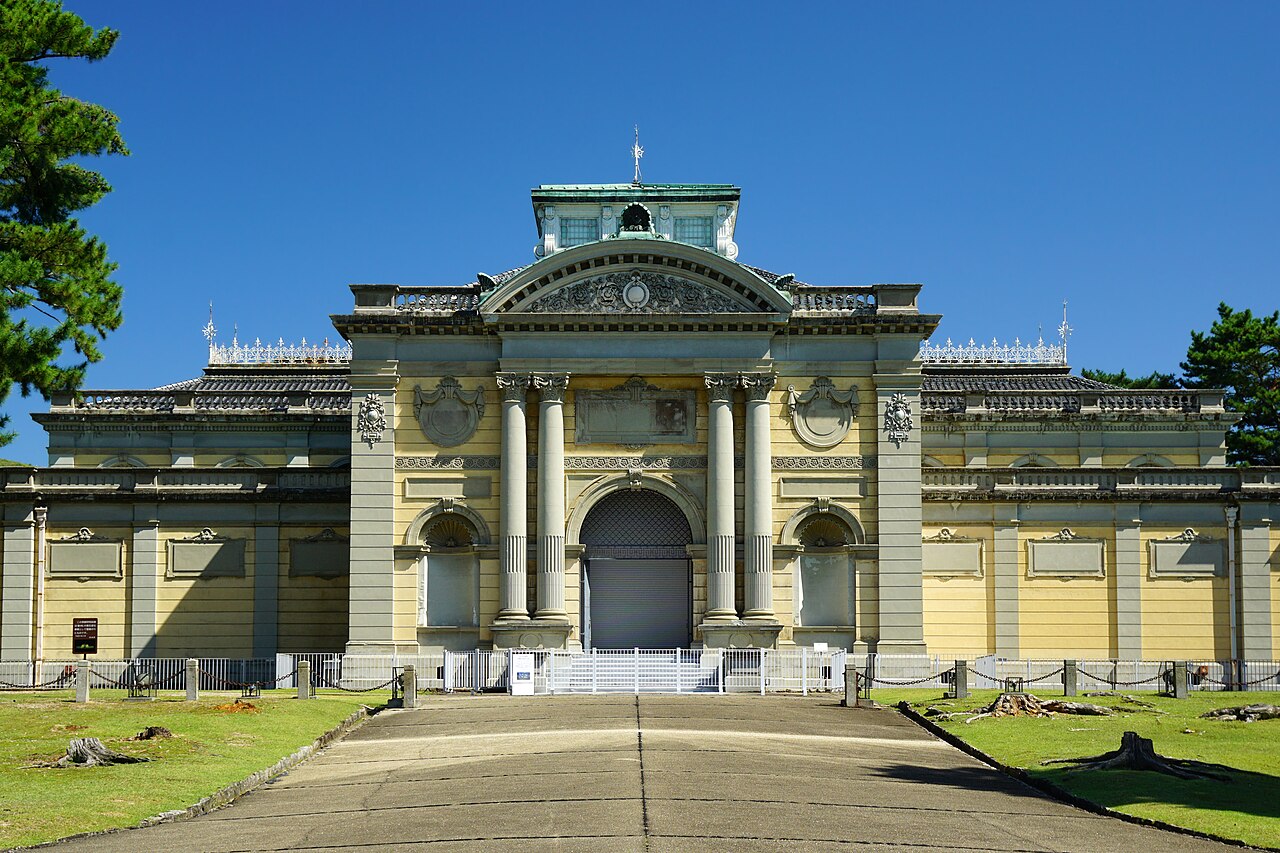
The Nara National Museum, Nara. Works deposited here by temples and shrines are kept and displayed by the museum while ownership stays where it was. / Photo by 663highland, CC BY 2.5, via Wikimedia Commons — Source

Bonsai runs the same logic at a far more ordinary scale, and it runs constantly, because a tree cannot simply sit in storage the way a statue can. At Daijuen, a bonsai nursery in Okazaki, Aichi Prefecture, which bills itself as ninety years in business, the nursery describes its custodial service plainly: an owner's black pine is entrusted to the nursery, and its bonsai professionals take responsibility for the tree's care for as long as it remains in their keeping — bud-pinching, pruning, fertilizing, pest watch, and the rest of a full year's calendar of work, carried out by people trained to do it, on a tree that still belongs to someone else. The Japan National Tourism Organization has documented the same pattern from the owner's side, quoting Yoichi Nakanishi, a fifth-generation grower in Kinashi, Shikoku: bonsai are "hard to keep alive," they have to be watered two to three times a day in summer, and they have to be replanted every four or five years so the roots do not stay cramped. Retired people do best with them, he says, because they have more time. Some of his customers bring a tree in only while they are away on vacation; others buy one and keep it at his nursery all the time.
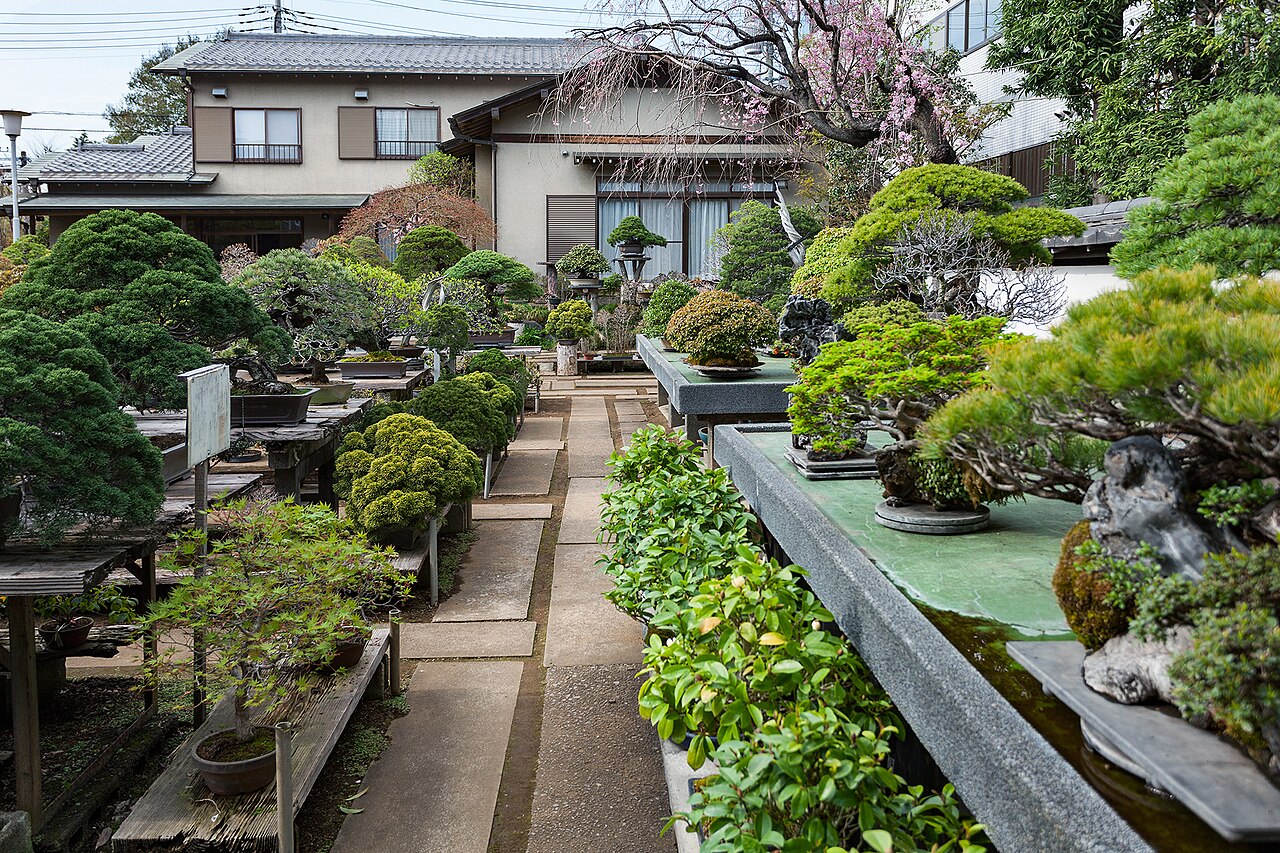
Fuyo-en, a bonsai nursery in the Omiya Bonsai Village, Saitama. Trees kept on benches like these live on a professional's calendar — watering, pinching, pruning, season after season. / Photo by TypeZero, CC BY-SA 4.0, via Wikimedia Commons — Source

What Changes Hands Is Time, Not an Object
None of this would matter much if a bonsai, once entrusted, could simply be left alone. It cannot. This is where azukari differs from a coat check, or even a museum's kitaku storeroom, where an object mostly waits, unchanged, until it is retrieved. A tree left unattended does not wait. It grows the wrong way, dries out, or dies.
What is actually placed in someone else's hands, then, is a stretch of ongoing time that has to keep moving forward, one watering and one pruning cut at a time, or the thing being held will not survive to be returned. We have written elsewhere about mochikomi (持ち込み, "the count of years a tree has spent actively worked in a pot rather than merely alive"), and mochikomi only accumulates because someone, continuously, keeps doing the work that makes it accumulate. An owner entrusting a tree takes on something more demanding than storing an heirloom in a drawer: a daily obligation to keep a particular, ongoing process from stopping.
The Tree Does Not Notice a Change of Hands
Because the labor and the title were separated from the start, one of them can change without disturbing the other. A tree's owner can change — through sale, gift, or inheritance — without the tree itself losing a single day of care, so long as whoever holds the daily work simply keeps doing it. This is close to the opposite of how it worked at the Nara National Museum, where a change in custody — a temple reclaiming its Hachibushu figures once it had its own storehouse — was the notable event. In bonsai, a change of owner is meant to be the uneventful part; the continuity of care is the whole point.
Japan has even built a record-keeping system meant to outlast any single relationship of this kind. Since 1980, the Nippon Bonsai Association has run a formal registration for what it calls kicho bonsai (貴重盆栽, "a bonsai registered for its documented value") — more than 1,200 trees reviewed and accepted for their form, history, or rarity, each recorded with photographs taken at the moment of registration. A tree's entry in that registry outlasts any particular owner. It is a fixed point the tree can be checked against, whoever happens to be holding it, this year or fifty years from now.
The Structure Azukari Borrows Its Name From
This is the pattern the company Azukari takes its name from, applied as a working arrangement rather than a figure of speech: a tree stays in Japan, in the same soil, under an artist who does the daily watering, wiring, and repotting that a tree this demanding actually needs, whether or not its owner happens to be in the country. The owner holds the tree's title and joins its record for one stretch of an ongoing story, the same way a museum's kitaku depositor or a Daijuen client does — present in the arrangement without having to be present at the pot every morning. What passes to the owner is a place inside a process already running before they arrived, built to keep running after they are gone.
The two persimmons described at the start — the pair from the grower's field in Kiryu — are what this arrangement looks like on two particular trees: decades of a grower's time already in them, an artist's hands next, and a camera pointed at the real thing instead of a stand-in.
Closing
Splitting ownership from daily care is not a workaround Japan invented for people who travel too much to water their own trees, though it does solve that problem too. It is closer to an old, practical honesty about what a living tree actually needs: not one person holding it entirely alone, but two roles — one that decides, one that tends — that different people can hold at once, for as long as the tree keeps growing. We look more closely at what it feels like to be on the deciding side of that arrangement here.
References
- Kyushu National Museum — Request for Deposits and Donations — official definition distinguishing kitaku (deposit, ownership retained) from kizo (donation, ownership transferred).
- Wikipedia (Japanese) — Nara National Museum — on temple deposits gaining pace after a 1903 exhibition of Nara's National Treasures, Kofuku-ji's Hachibushu statues among the works deposited, and the post-WWII return of many deposited works to their home temples.
- Daijuen — "A 90-Year Professional Explains the Care and Custody of Premium Black Pine Bonsai" — on the nursery's custodial (azukari) cultivation service for black pine bonsai.
- Japan Travel (JNTO) — Bonsai Is Big in Japan — on the daily watering and repotting demands of bonsai, and owners who leave trees with a grower permanently.
- Nippon Bonsai Association — About the Association — on the kicho bonsai registration system, running since 1980 with more than 1,200 trees registered.