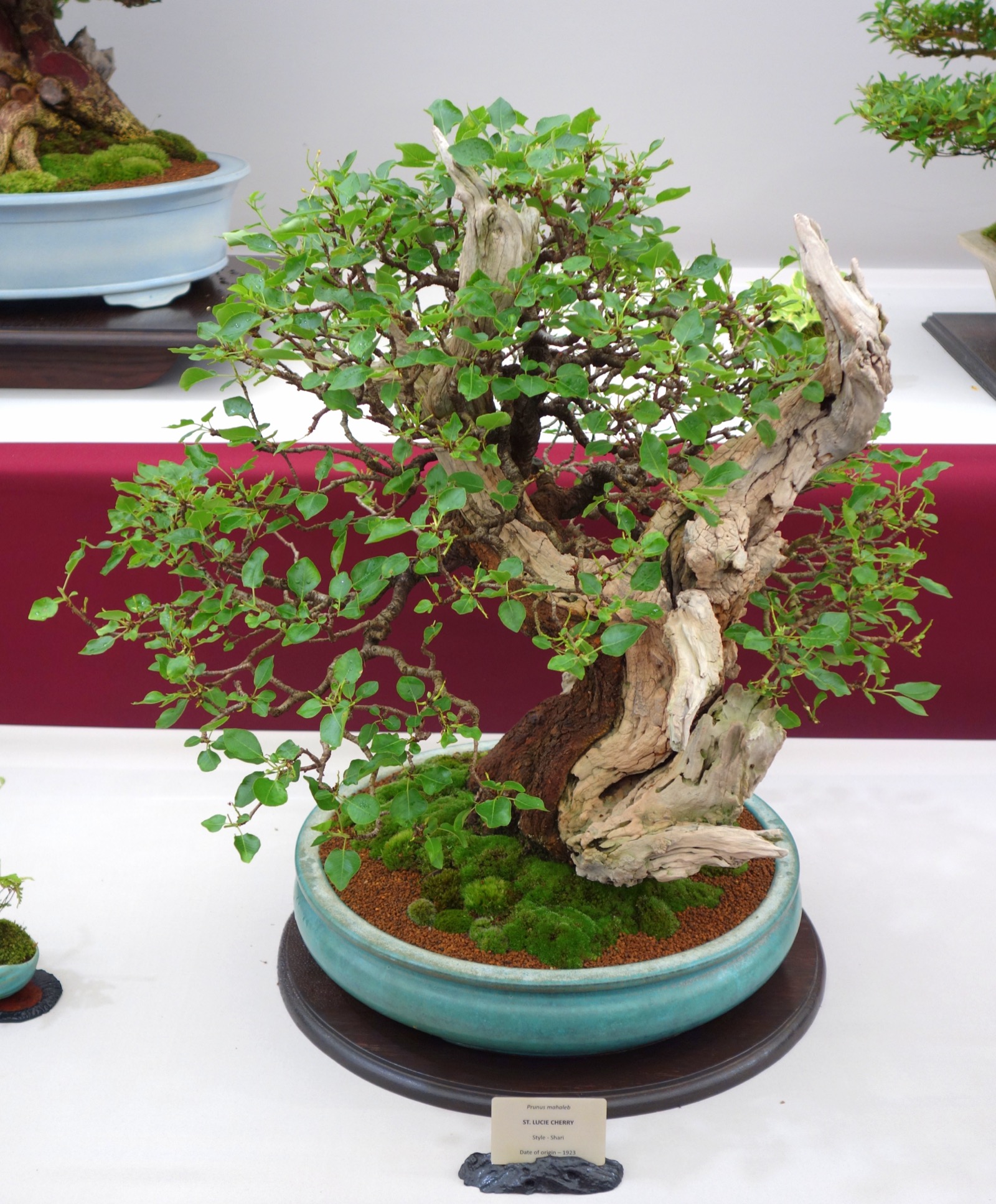
Photo by Daderot, CC0 1.0, via Wikimedia Commons — Source

A hundred-year-old St. Lucie cherry (Prunus mahaleb), a European relative of Japan's ornamental sakura, trained in bonsai form and shown at the Chelsea Flower Show, London. Photographed in early summer, fully in leaf — a reminder that flowers occupy only a small fraction of a cherry bonsai's year.
A sakura (桜, "Japanese flowering cherry") bonsai spends perhaps two weeks a year in the state everyone wants to see it in, and the other fifty in the state that makes those two weeks possible.
Wilson Called Fuji Cherry the Only Japanese Cherry Small Enough for a Pot
We've written elsewhere about flowering bonsai as a category, and cherry sits at its most demanding edge. Most bonsai species are chosen and trained for bark, branch structure, or the shape of an aging trunk — qualities that hold steady across the year. A flowering cherry is judged, at least once a year, on something far more specific: how completely its small frame fills with blossom.
Not every cherry does this well in a pot. Growers most often reach for Prunus incisa (Fuji cherry), cultivars of Prunus serrulata, or related dwarf and weeping forms bred for compact growth and free flowering rather than for fruit or height. Fuji cherry has a particular claim to this history: Ernest Wilson, the plant collector whose early-twentieth-century notes are preserved in Bean's Trees and Shrubs Hardy in the British Isles, described it as the only Japanese cherry that could be trained into a dwarf tree able to live and flower freely in a small pot. Among its garden cultivars, one called Kojo-no-mai (湖上の舞, "a dance upon the lake") — recorded as having been found in the wild on the flanks of Mount Fuji by Shizuo Akaike, some time before 1985, and carrying the thin, zig-zagging, contorted branches prized in miniature cherries — remains one of the forms most associated with cherry bonsai in Japan today. A young, well-budded specimen can carry flowers along nearly every centimeter of exposed branch — a density of bloom no full-sized tree, viewed from below at a park, offers the eye at anything like that same close range.
This Spring's Flowers Were Decided the Summer Before
None of that density happens by accident, and almost none of the work behind it happens while the tree is in flower. A cherry's flower buds form the summer before, on wood the tree grew that same year — meaning the blossoms a grower sees each spring were effectively decided eight or nine months earlier. Push growth too hard, too late in summer, and there is little left over to form buds with. Hold the tree back too far and the same problem shows up from the opposite direction.
The trickiest stretch comes right after the petals fall, and it is the point on which the care guides part company. Some advise pruning hard as soon as the flowers have gone, the way a maple or a quince tolerates without complaint; others warn that new shoots trimmed too early frequently die back rather than branching the way a grower intends. The more cautious approach is to let new growth run largely unchecked for some weeks after flowering, feeding the tree so it can rebuild what the bloom just spent, and only then, once the wood has hardened toward autumn, shorten that season's long shoots back to a handful of nodes each — setting the framework for the following spring. Repotting guidance varies in the same way: commonly once every two or three years in earliest spring before flowering, though some growers repot annually in late winter as soon as the flowers finish. Watering has to stay generous and steady through the growing season — a cherry is reported to be unusually thirsty in spring, and a rootball left to dry out is a known way to lose leaves, and with them the buds being set for the following spring. Wiring is usually easiest on a leafless tree, though young twigs stay pliable enough to shape during the growing season; left another year or two, the same wood turns stiff and brittle. Aphids, caterpillars, and birds after the flower buds add a layer of daily watching that most conifer bonsai never require.
Add it up and the arithmetic of a cherry bonsai runs opposite to how the tree is usually pictured. The flowering week is the payoff of a year spent almost entirely on wood, root, and timing — care aimed at a display that, mistimed even once, simply will not happen that spring.
The Beauty Was Never Only About the Bloom
We've written at length elsewhere about why Japan's affection for cherry blossoms rests as much on the petals falling as on the flowers at their peak. A cherry bonsai does not step outside that logic by being small. If anything, keeping the tree within arm's reach sharpens it: a grower who has spent eleven months preparing a branch for ten days of flower watches those same ten days end at unusually close range, petals settling onto moss instead of pavement.
Keeping a Cherry Bonsai Means Keeping Nearly a Full Year for Ten Days of Bloom
What a sakura bonsai finally offers is a compressed, tended version of the whole cycle behind the bloom — the bud set in summer, the flower in spring, the scattering that follows, and the quiet season of leaf and root work that makes the next bloom possible. We've written elsewhere about the particular luxury of arranging one's year around a season rather than rushing past it; a cherry bonsai asks a grower to build nearly an entire calendar around a display measured in days. Few habits in Japanese horticulture demand that kind of patience quite so literally.
This is also the arithmetic Azukari's owners actually see, spread across three photographs a year rather than one: the buds forming in summer, the flowers opening in spring, the petals scattering days later onto moss instead of pavement. Ume opens the season before the leaves return; the cherry that follows it carries the same discipline forward, concentrated into a smaller frame and a shorter week. The measure of a well-kept cherry bonsai was never the ten days of flower — it was the fifty weeks nobody photographs.
References
- Bonsai Empire — Cherry Bonsai (Prunus) care guide — species used for cherry bonsai, watering, feeding, repotting every two to three years in early spring, the die-back risk from trimming new shoots too early, shortening autumn shoots to a few nodes, wiring on leafless branches, and pest and disease notes.
- Bonsai4Me — Prunus / Cherry Bonsai species guide — the contrasting regime: hard pruning as soon as the flowers have fallen, annual repotting in late winter, wiring in spring and summer, and weekly summer feeding for flower bud production.
- RHS — Prunus incisa 'Kojo-no-mai' — flower size and timing, mature size, and growing habit of the Fuji cherry cultivar.
- Trees and Shrubs Online — Prunus incisa — the article from Bean's Trees and Shrubs Hardy in the British Isles, including Ernest Wilson's account of the species as "the only Japanese cherry that can be fashioned into dwarf trees which will live and flower freely in small pots".
- Van den Berk Nurseries — Prunus incisa 'Kojou-no-mai' — the cultivar's discovery in the wild on the flanks of Mount Fuji by Shizuo Akaike before 1985, its zig-zagging twigs, and its flowering period.