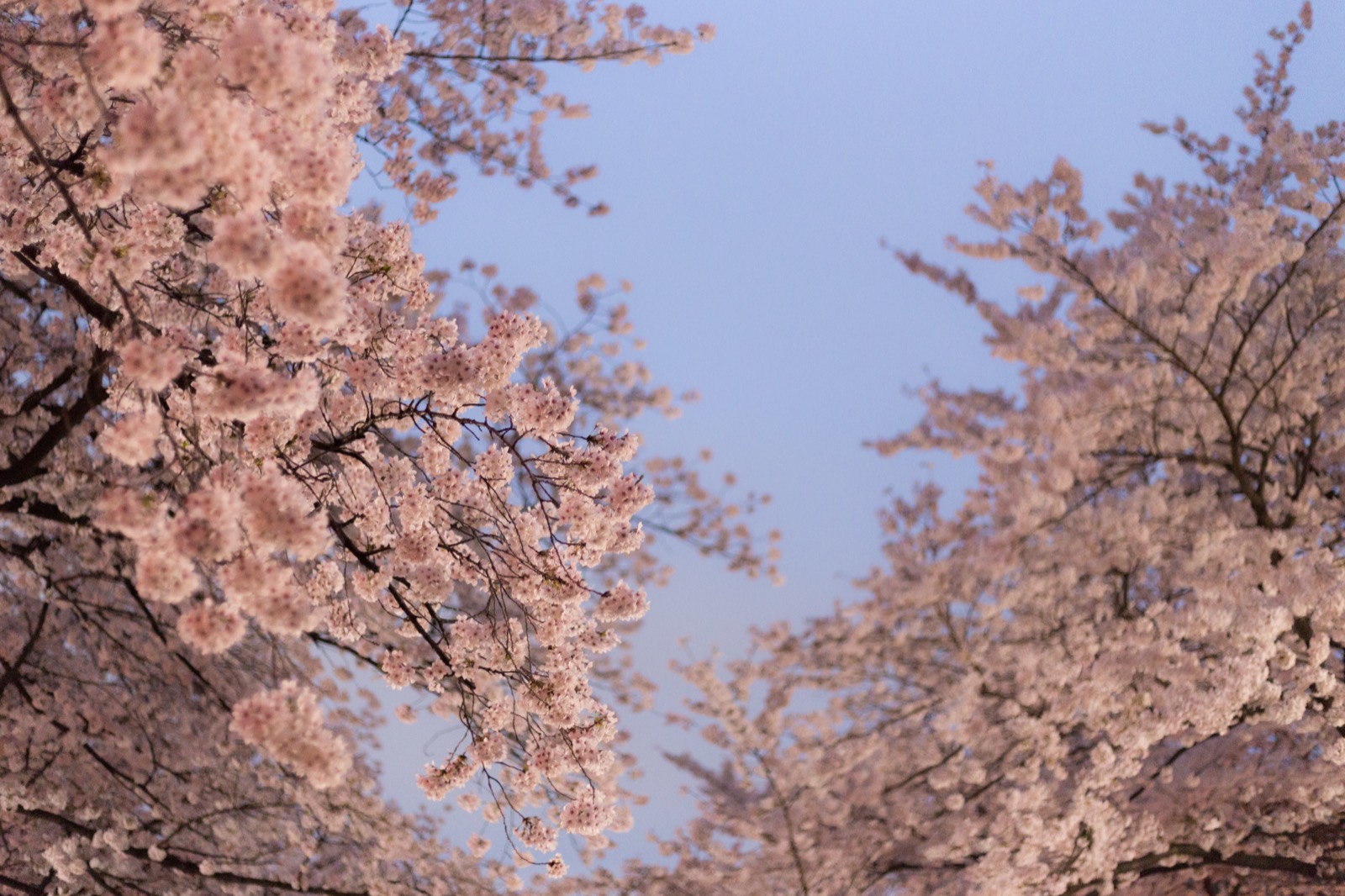
A gust moves through a stand of cherry trees in the last days of their bloom, and for a few seconds the sky fills with drifting petals before a pale layer settles over the ground like snow out of season. Japan has kept a separate word for this exact moment since long before anyone wrote it down: hanafubuki (花吹雪, literally "a blizzard of flowers"), narrowed to sakurafubuki (桜吹雪) when the flower in question is cherry. English has no equivalent term for the fall alone, kept apart from the bloom. Japan needed one.
In Japan, the day the cherry blossoms scatter is treasured as deeply as the day they reach full bloom — by many accounts, more deeply.
A sakura (桜, "Japanese flowering cherry") tree draws its largest crowds when every branch is dense with pink and white. But ask someone who has watched cherry blossoms for decades, and many will describe that scattering gust, the hanafubuki, before they describe the bloom itself. Japan's affection for cherry blossoms has never rested on the flower at its peak alone. It rests just as much, if not more, on the flower letting go of the branch.
Full bloom is announced; the fall is what gets praised
Every spring, forecasters track the cherry blossom front as it moves north across Japan, and the news treats mankai (満開, "full bloom") as an event worth announcing. Crowds gather under the branches for hanami (花見, "flower viewing"), spreading blue tarps in parks for a picnic under the canopy.
The phrase most often used to praise a good cherry blossom season, though, is "a good scattering" — praise for how the petals fell, as much as for how the flowers looked while they lasted. A tree that blooms in a single dense, even burst and then releases its petals all at once, in a short, clean fall, is considered to have given a particularly fine season. The bloom functions as an overture; by long convention, the scattering functions as the close, and it is judged with equal care.
Naming the ending mattered as much as naming the flower
That hanafubuki carries its own name, separate from the word for the blossom itself, says something on its own. Japanese culture named the ending, gave it dedicated vocabulary, and turned it into something to watch for on purpose — a short-lived weather event made of flowers instead of snow, worth standing under.
A flower that bloomed for months would lose the charge a sakura carries
The clearest account of this sensibility comes from the eighteenth-century scholar Motoori Norinaga, who placed a concept at the center of his reading of classical Japanese literature: mono no aware (もののあはれ), often rendered as "the pathos of things," a sensitivity to the quiet feeling stirred by the passing of things. In Norinaga's account, being moved by the beauty of cherry blossoms — and moved further by their falling — was itself a form of knowledge, a way of understanding the world clearly.
A flower that bloomed for months would be pleasant, but it would not carry the particular charge a sakura carries. The tension between the blossom's brief week or two of bloom and the long bare months of the tree's ordinary life is what gives hanami its intensity. Knowing that a flower is already, from the moment it opens, moving toward its fall sharpens the pleasure taken in the bloom. In Norinaga's reading, that impermanence is the very source of the beauty.
The flower's ending came first, the samurai reading came later
A well-known saying places the cherry blossom beside a very different subject: "hana wa sakuragi, hito wa bushi" (花は桜木、人は武士, "among flowers, the cherry; among people, the warrior"). Recorded in a 1630s miscellany as verse attributed by tradition, though not with full certainty, to the Zen monk Ikkyu, the full form continues by naming the finest example in several other categories: the finest pillar is cypress, the finest fish is sea bream, the finest garment is autumn-colored silk. The comparison that has endured is the first one — flower and warrior, praised on the same grounds.
The grounds were manner of ending. A cherry blossom does not wilt slowly on the branch, fading in color over weeks; whole petals let go together and fall while still vividly colored. That clean, undiminished departure became a metaphor for how a samurai was expected to meet death, without clinging past the moment when clinging no longer suited it. Precision matters here: scholars trace the saying's familiar modern wording to eighteenth-century theater, popularized well after the era it is often linked to. It functions as literary metaphor, later folded into the idealized code of bushido (武士道, "the way of the warrior") — a code twentieth-century critics such as Nitobe Inazo were already questioning by the time it had hardened into legend. Separately, and on firmer ground: Edo-period samurai are well documented holding elaborate cherry-blossom-viewing gatherings, writing poetry that compared their own lives to blossoms letting go of the branch once their moment had passed.
A flowering bonsai builds a whole year around a few days of bloom
This same instinct shapes a much smaller, quieter tradition: the flowering bonsai kept and shown for a bloom that may last only a matter of days each year. A grower spends the other fifty weeks tending a tree — pruning, wiring, watching light and water — for a window of flowering measured in days, sometimes less. A flowering bonsai's blossom lasts only days at most, and what matters to the person who keeps it is something closer to hanami itself: presence, deliberately arranged, for a beauty that will not repeat itself twice in quite the same way, and a year built around the chance to see it. In a Japanese spring, that same attention extends outward from the garden to the whole season — a culture organizing itself, for a few weeks each year, around a flower it already knows is falling.
The measure worth carrying past the cherry tree: judge a season, a display, or a piece of work not only by how full it gets at its best moment, but by how well it lets go once that moment has passed.
The sensibility behind this — finding more to look at in what is incomplete or already passing — is explored further in The Beauty of Imperfection.
References
- Mono no aware — Wikipedia — overview of the concept, its formulation by Motoori Norinaga, and its use of cherry blossoms as a central example.
- 花は桜木人は武士 — Wikipedia (Japanese) — history of the saying, its earliest 1630s textual record, its association with Ikkyu, and its later popularization through Edo-period theater.
- Inside the Japanese Tradition of Cherry Blossom Viewing — HISTORY — history of hanami and its long association with the fleeting nature of life.
- Samurai — The Metropolitan Museum of Art, Heilbrunn Timeline of Art History — on samurai cherry-blossom-viewing gatherings and poetry comparing a warrior's life to a falling blossom.