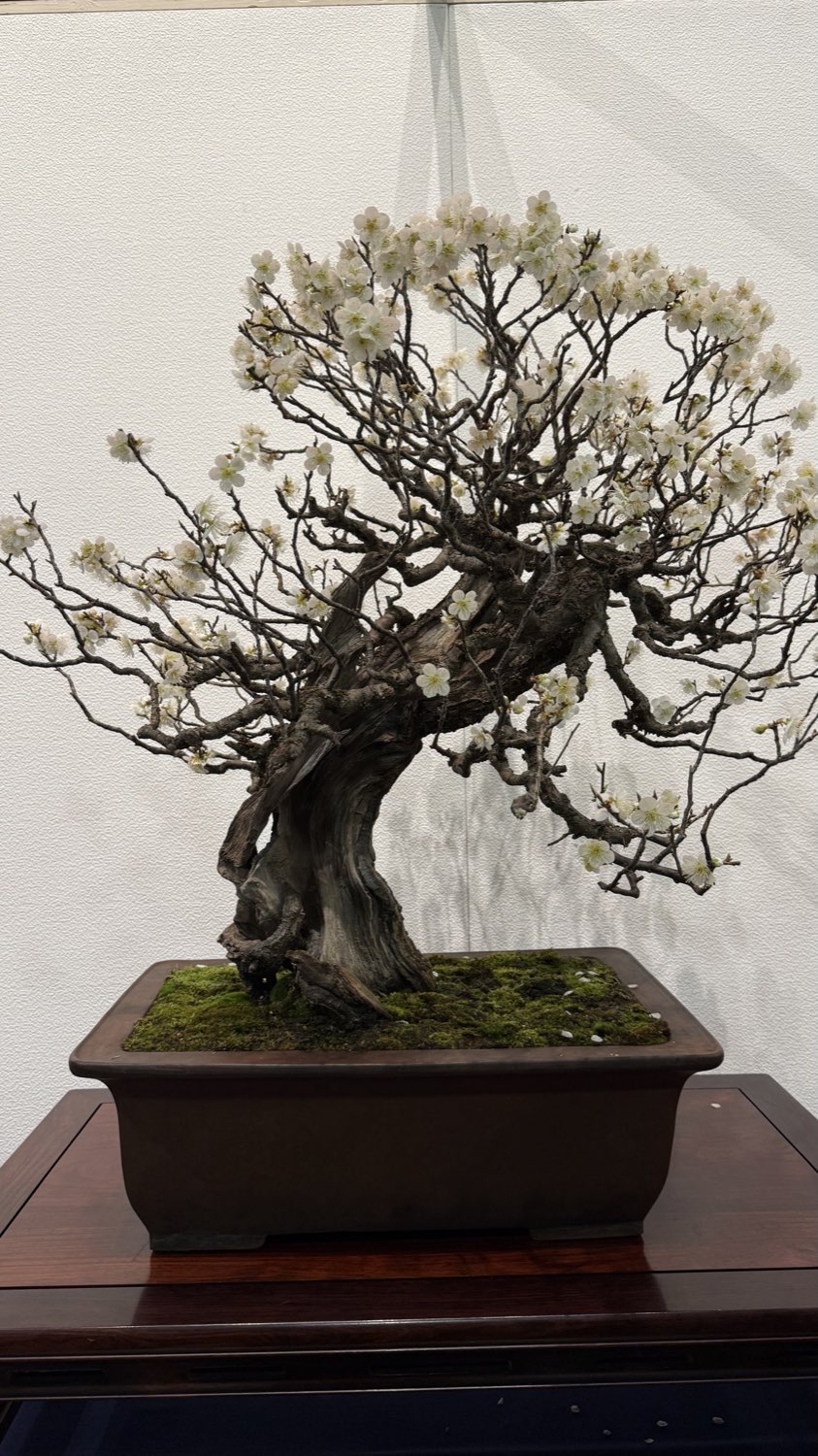
A plum bonsai in bloom. White flowers open on branches still bare of leaf, the trunk's bark thickened and cracked by decades of age.
In the mildest parts of Japan, ume opens as early as January: small white or pink flowers push out of wood that will not carry a leaf for weeks, while every other tree on the bench is still asleep. It is ume (梅, known in English as "plum blossom," though many horticultural sources classify the tree as a Japanese apricot rather than a true plum) — the first bonsai a nursery watches for each year, and not, as it happens, the one visitors ask about most.
No other bonsai in a Japanese collection opens this early or this bare. Ume flowers on wood that carries no leaf yet, releases a fragrance few flowering bonsai attempt, thickens into bark that only grows rougher with age, and for well over a thousand years — long before cherry blossom took the title — has been the flower that told Japan winter was over.
The flower arrives before the leaf does
Most bonsai keep to a simple order: leaf first, flower tucked in sometime after, alongside the season's general greening. Ume reverses it. Its flower buds form on that year's new growth during the summer before, then hold through the cold months on wood that carries nothing else, opening earliest in the mildest parts of the country and stretching into February and March further north. The leaves wait longer still; by most botanical accounts, they do not appear until the petals have already begun to fall, rather than before. For a few weeks each year, the tree is reduced to branch and flower and nothing else. No green comes between the eye and the blossom.
That bare-branch immediacy is not incidental to why growers value the tree; it is close to the whole of it. Elsewhere we've written about the wider range of flower bonsai, many of which open their blossoms alongside or after their leaves. Ume stands apart by removing that competition entirely, for exactly as long as the flower lasts.
Fragrance carries what the small flower doesn't
A single ume blossom, looked at closely, is a modest thing — five petals, roughly two to two and a half centimeters across, ranging from white through pink to a deep red depending on the cultivar. What the eye alone would call unassuming, the nose does not. Ume carries a sweet, faintly spiced scent that horticultural writers describe as distinctive even among its own relatives, strong enough to reach across a garden. It is one of the few bonsai where growers name fragrance, not form, as the first trait worth mentioning.
Rough bark and a delicate flower share one trunk
Look past the flowers and the trunk tells a different story. A mature ume develops thick, dark bark that cracks and fissures with age, and older specimens commonly carry deadwood or a partially hollowed trunk — the kind of ruin usually associated with conifers many times its age. Growers describe the resulting effect as conflict and harmony at once: a rough, half-dead-looking trunk producing flowers as delicate as anything in the flowering catalogue.
There is a small technical fact behind that contrast worth knowing. Ume rarely backbuds on old wood, and its flower buds form only on that year's new shoots — so the blossoms on even a genuinely ancient trunk are, without exception, new growth. Every bloom a nursery records is proof the tree pushed fresh growth again this year, from wood it has carried, in some cases, for far longer than anyone currently tending it.
Ume was Japan's flower before sakura
Long before cherry blossom became shorthand for a Japanese spring, ume held that place. In the Man'yoshu (万葉集, Japan's oldest surviving poetry anthology, compiled through the 8th century), the plum tree appears in roughly 118 of its poems — second only to bush clover among all plants named in the collection. The tree is believed to have reached Japan from China around the Nara period, prized first as a medicinal import, and it was during that same Nara period that court poets favored ume as the flower most worth putting into verse. Only in the Heian period that followed did cherry blossom overtake it as the flower Japan reached for first.
Ume's standing in that older poetry has outlasted the shift. In 2019, the Japanese government drew the name of the current era, Reiwa (令和), directly from a Man'yoshu preface describing a plum-blossom viewing party held in the year 730 — "the plum blossoms open like powder before a mirror," reads the passage the name was taken from, describing flowers opening into a gentle spring air after the hardship of winter. More than 1,300 years after those blossoms were first written down, the tree that opened them is still the one a nursery watches for first each January.
A trunk's age and a flower's age are never the same
What ume asks of a grower is small: steady water, an undisturbed rest for the flower buds, and a hand that prunes after the bloom rather than before it. What it gives back, every year, is the earliest sign that the dormant season has ended, before anything else on the bench has stirred.
Azukari keeps that same record for an ume under an artist's care in Japan — the swelling of a bud before the cold has fully broken, the first flower opening on wood that has already carried a great many winters before this one. The season that follows belongs to cherry blossom, a story of its own; ume only insists on going first, proof each year that waiting on a season can be its own kind of luxury. Read the trunk and the flower as two separate ages: the bark may be a century old, but the bloom on it never is.
References
- Wikipedia — Prunus mume — flowering before leaf emergence, bloom timing from mid-winter into early spring, and the documented shift in Japanese preference from plum blossom to cherry blossom between the Nara and Heian periods.
- Bonsai Empire — Japanese Apricot (Prunus mume) Care Guide — flower size and fragrance, and the tree's scent described as distinctive even among apricots.
- Peter Tea Bonsai — "Japanese Flowering Plum Basics" — mature bark and deadwood characteristics of old ume trunks, the description of old bark against delicate flowers as "conflict and harmony," and flower buds forming only on the current year's new growth.
- Meguri Japan — "A Fondness for Flowers, Part 1: Ume, the Japanese Plum" — the plum blossom's count of roughly 118 poems in the Man'yoshu, second only to bush clover among plants named in the anthology.
- Prime Minister's Office of Japan — statement on the origin of the era name "Reiwa" — the Man'yoshu preface to the 730 plum-blossom viewing party from which the era name was drawn, including the quoted passage on the blossoms opening into spring.