
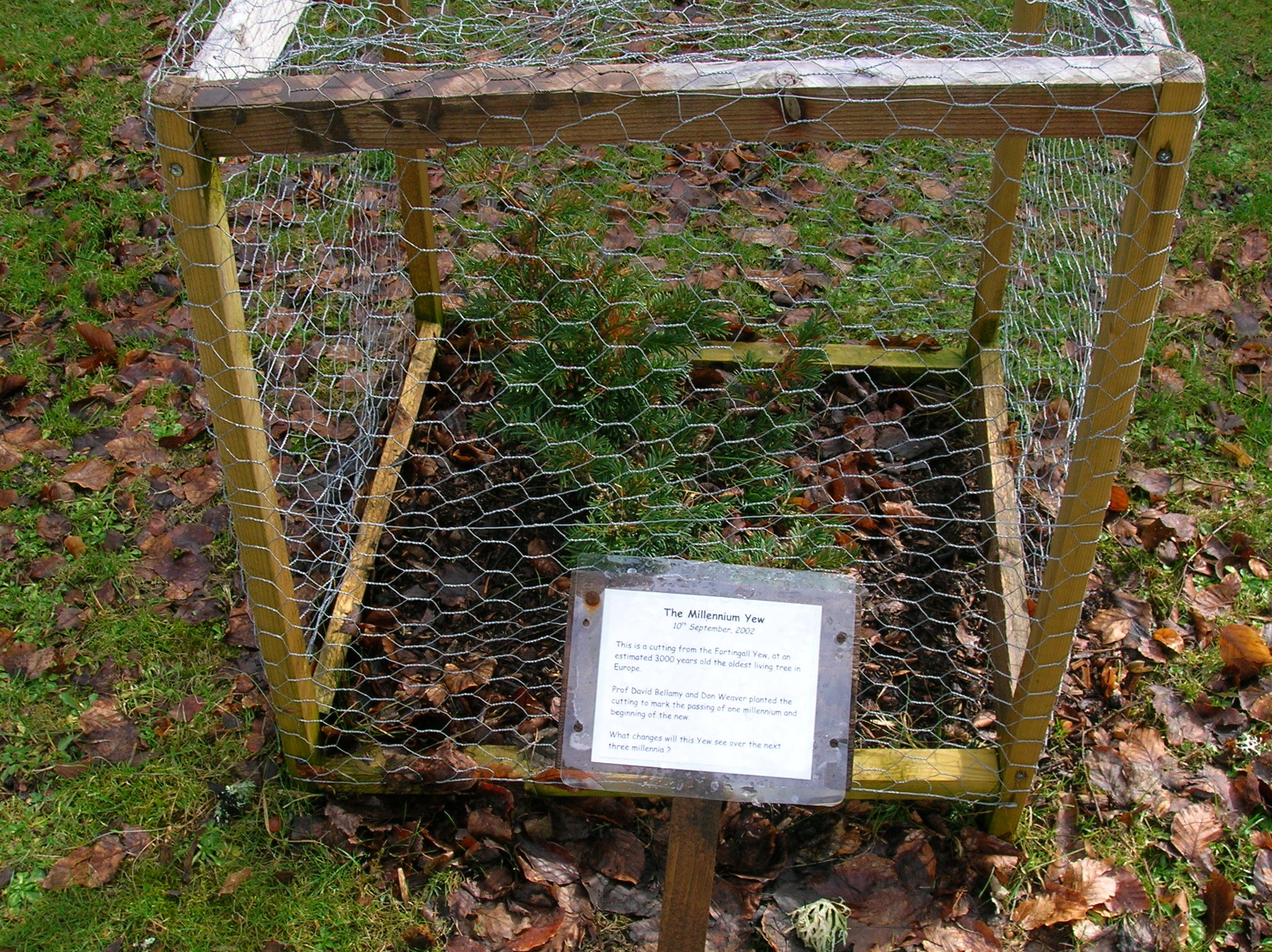
A yew grown from a cutting taken from the Fortingall Yew, an ancient tree in Perthshire, Scotland, photographed at the Kindrogan Field Studies Centre. Photo by Roger Griffith, public domain, via Wikimedia Commons — Source

The Fortingall Yew has stood in a Perthshire churchyard long enough that no one agrees on its age — estimates run to several thousand years, among the oldest living things in Britain. The tree itself has never been dug up and moved. What has left that churchyard instead are cuttings: sections of its wood, rooted elsewhere into trees of their own, some now growing in a conservation hedge at the Royal Botanic Garden Edinburgh, one of them pictured above. Every young tree in that hedge carries the Fortingall Yew's exact genetic code and none of its thousands of years. Bonsai growers have a name for this kind of multiplication: sashiki (挿し木, "a stuck-in branch," the standard term for propagation by cutting). The stem removed for the purpose is a sashiho (挿し穂, "the cutting itself").
A cutting is exactly its parent at the genetic level — same bark, same growth habit, same foliage — and it carries forward none of the years that parent spent being trained.
The right week matters more than a green thumb
The method is simple to describe and easy to get wrong at the wrong moment. A grower selects a shoot from the current or previous year's growth — soft enough to bend, firm enough to hold its shape — trims it just below a leaf node, strips the lower foliage, and sets the cut end into a free-draining mix, commonly sand or perlite blended with potting compost. The Royal Horticultural Society recommends this kind of "semi-ripe" cutting for evergreen shrubs and conifers taken from summer into mid-autumn, when a stem is firm at the base but still soft at the tip — miss that window and the same technique, on the same tree, fails far more often. Growers often dip the cut end in rooting hormone to improve the odds, then leave warmth, steady humidity, and time to do the rest. For a juniper cutting, that wait can run anywhere from a few weeks to the better part of a year before enough root has formed to pot it on its own.
A hundred cuttings share one genetic identity
Grow a hundred trees from the seed of one parent and each inherits a fresh, unpredictable mix of traits — some coarse, some fine, no two quite alike. Take a hundred cuttings from a single branch and, barring a stray mutation, every one carries the parent's exact genetic makeup. A seedling is a new combination of traits; a cutting is the same individual, continued on a new set of roots.
One fortunate tree's leaf character becomes many trees' leaf character
This is precisely why sashiki matters to a bonsai nursery beyond simple convenience. We wrote elsewhere about hasho (葉性, "leaf character") — the size, density, and color of a tree's foliage, a trait largely fixed at germination and resistant to correction through training alone. A cultivar prized for unusually fine, dense needles cannot be bred back into an ordinary tree through careful pruning; every specimen of that cultivar traces back, by cutting or graft, to the one individual in which the trait first appeared. Sashiki is how a nursery turns one fortunate tree with outstanding hasho into many — not by improving ordinary stock, but by copying the one tree that already had what growers were looking for.
Pines refuse what junipers accept
Not every species agrees to root from a cutting with equal willingness. Junipers are among the most cooperative — shimpaku in particular is one of the bonsai world's most commonly cutting-grown subjects — and many flowering and fruiting species used in bonsai, quince and cotoneaster among them, root readily too. Pines are the exception growers plan around. Two-flush pines such as kuromatsu (黒松, Japanese black pine) are usually grown from seed instead, a method called misho (実生, "growing from seed"), or propagated from a specific individual by grafting a scion onto seedling rootstock; cuttings are seldom used for pines because they root poorly, though air-layering succeeds with some. Where neither seed nor a clean graft will serve — a fine low branch on an otherwise unreachable old tree, say — a grower may instead root a branch while it is still attached to the parent, a related but distinct technique called toriki (取り木, air-layering). The choice between these methods is rarely about which is easiest. It is about what the grower is trying to preserve: an individual tree's exact genetic identity, or the fresh variation that only seed provides.
A cutting's inheritance stops at its genes
The yew pictured above already makes the point once: genetically, it is the Fortingall Yew. In every other sense, it started from nothing. A meiboku (銘木, "a celebrated bonsai with a documented history") can be propagated the same way — a cutting taken to carry a valued individual's exact genetic character into a new tree — but what it cannot carry forward is that parent's keireki (経歴, "its recorded history of care and custody"). No seasons of training behind it, no artist's hands recorded, no years yet spent in a pot. A cutting inherits a tree's character. It still has to earn its own history from the day it roots.
What a cutting still has to earn
That distinction — what a tree is born with, and what it accumulates afterward — sits close to how bonsai is actually grown, and, at Azukari, how it is actually kept. Azukari does not deal in cuttings itself; the trees an owner is entrusted with already carry years, sometimes generations, of keireki behind them. But the logic underneath is the same one that shaped the yew above. A nursery that takes a cutting from its finest juniper is not manufacturing a shortcut, and it is not manufacturing a copy. It is starting a new tree, with good genetic material and an empty record, exactly where every tree, however it began, once had to start.
References
- Wikipedia — "Cutting (plant)" — on cuttings as a form of vegetative propagation producing offspring genetically identical to the parent plant.
- Royal Horticultural Society — "Cuttings: semi-ripe" — technique and timing (summer to mid-autumn) for semi-ripe cuttings of evergreen shrubs and conifers.
- Bonsai Empire — "Juniper Bonsai Tree" — on propagating juniper bonsai from seed or cuttings.
- Bonsai Empire — "Japanese Black Pine Bonsai Tree" — on propagating two-flush pines from seed or by grafting, with air-layering possible for some.
- Wikipedia — "Fortingall Yew" — on the tree's disputed but ancient estimated age and its cuttings' use in the Yew Conservation Hedge Project at the Royal Botanic Garden Edinburgh.
- Wikimedia Commons — File: Fortingall Yew cutting, Kindrogan.JPG — source and public-domain license (photo by Roger Griffith) for the header image.