
Photo by Mihailo Grbic, CC BY-SA 3.0, via Wikimedia Commons — Source

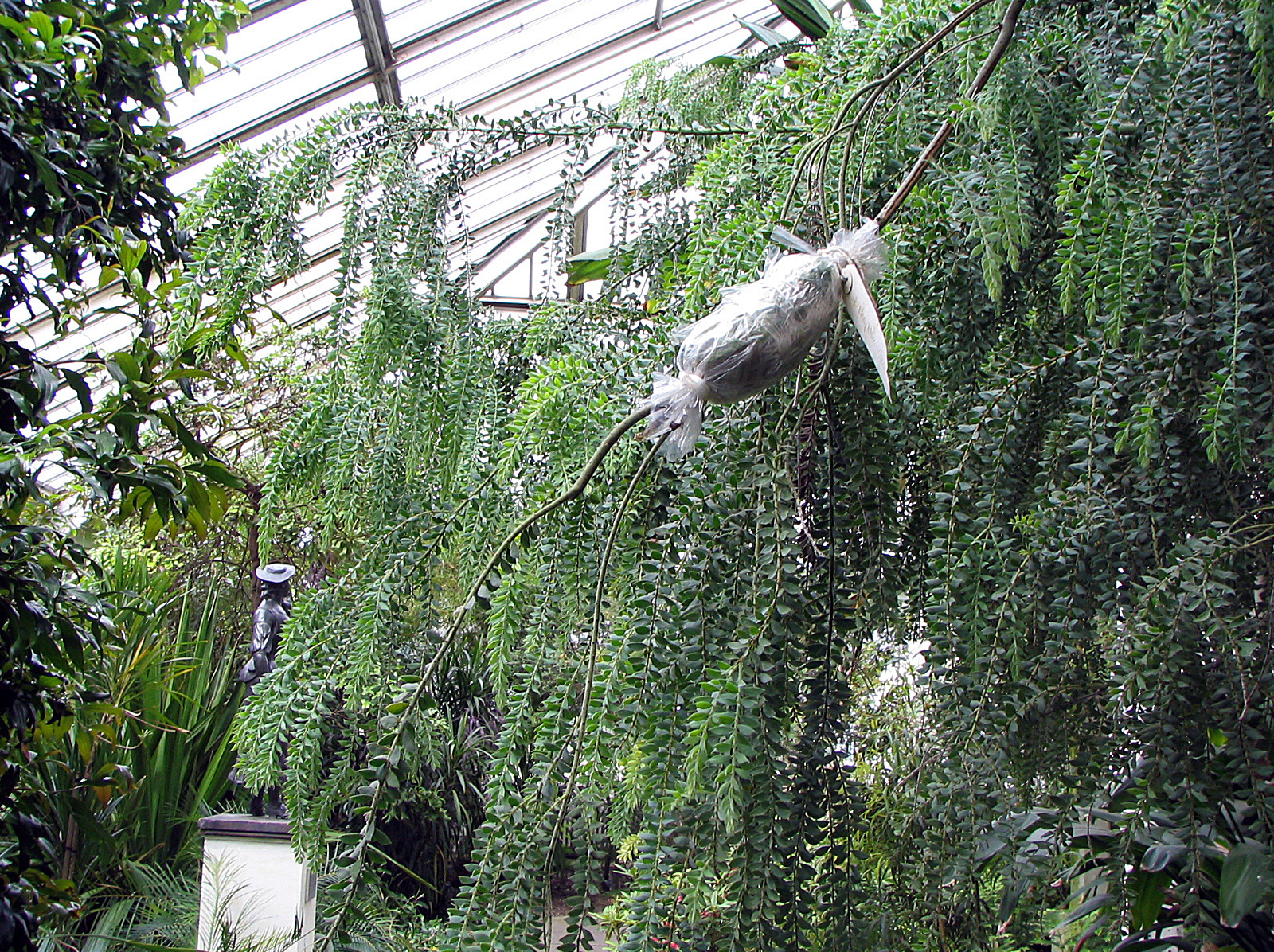
The branch in this photograph is still attached to its parent plant, still carrying its own leaves and drawing its own water, while a fist of damp moss wrapped in clear plastic sits partway along its length, holding a wound open until roots appear inside it. This is toriki (取り木, literally "taking a tree"), the Japanese name for what English-language horticulture calls air-layering: a way of making a new, independently rooted tree out of a piece of an existing one, without a cutting, without a seed, and without ever fully separating the branch from its parent until the new roots are already doing the work.
Toriki lets a grower cut a mature section of trunk or branch free from its parent only after that section has grown its own roots, so the resulting tree starts its independent life already carrying years of trunk girth, taper, and branching that no seedling could produce in the same span of time.
Forcing roots to grow mid-trunk
Ordinarily a tree's roots sit at its base, and everything above them depends on that single connection to the soil. Toriki interrupts that arrangement on purpose, at a point chosen partway up the trunk or along a branch. A grower either strips a narrow ring of bark down to the pale wood beneath — cutting off the downward flow of sugars made in the leaves above — or winds a length of copper wire tightly enough around the same spot to choke that flow gradually as the wood thickens against it. Either way, sugars and growth hormones that would normally travel down to the roots instead build up just above the wound. Within weeks a callus forms there, and new roots begin to emerge directly from it. The wound is packed with damp sphagnum moss and sealed in plastic to keep it moist and dark while this happens, and depending on the species and the season, new roots are usually visible inside the moss anywhere from a few weeks to several months later. Only then is the branch finally cut free below the new root mass and potted as its own tree. The two methods suit different trees: conifers such as kuromatsu (黒松, "Japanese black pine") and goyomatsu (五葉松, "Japanese white pine") generally tolerate the gentler wire method better than the loss of a complete ring of bark, while vigorous deciduous species such as maple root readily even after the more aggressive ring cut.
A trunk borrowed from an older tree
What makes toriki distinctive among propagation methods is what the new tree inherits. Growing a bonsai from seed, misho (実生, "growing from seed"), starts a trunk at zero thickness and lets decades of growth build it up one ring at a time. Toriki instead takes a section of trunk that a much larger, already mature tree spent years or decades thickening, tapering, and branching in the ordinary course of its growth, and simply gives that section its own roots. A field-grown branch left to develop for several seasons before being layered off arrives at its first bonsai pot already carrying the girth and movement a seedling would need a generation to reach on its own. The new tree is, in a real sense, built from wood the parent tree had already finished growing.
Turning a flaw into two trees
Not every tree is equally good along its whole length. A trunk might carry an old scar, a section of thin or lopsided nebari (根張り, "surface roots"), disease, or a bend a grower simply does not want, low down near the soil, while the upper trunk and branches, further from the problem, are healthy and well shaped. Rather than discard material like this, a grower can layer above the flaw, isolating everything worth keeping into a new tree with a clean start, while the compromised lower section is set aside or left to keep growing on its own. The same logic applies to correcting a poor root system: a new set of roots grown by air-layering tends to spread out fairly evenly around the wound, often producing a more even nebari than the tree had to begin with. Toriki, in this sense, is as much a tool for rescuing flawed material as it is a way of multiplying good material.
Age that arrives in a single growing season
Because the trunk, taper, and branch structure already existed before the roots did, a tree made by toriki can look decades old the same year it is finally severed and potted on its own, even though, counted strictly by its own root system, it is brand new. This is the part of the technique that most unsettles a simple idea of a tree's age: the wood is old, the roots are young, and the tree as a whole is neither. A bonsai's years under cultivation are usually counted by a separate measure from this kind of question, but toriki is a reminder that a tree's visible maturity and the literal age of any one part of it were never quite the same measurement to begin with.
Where this idea leads
Alongside propagation from cuttings, sashiki (挿し木, "cuttings"), toriki is one of the ordinary ways Japanese nurseries multiply good material without waiting a lifetime for each new tree to grow from nothing. But it also carries a small idea that shows up elsewhere in how bonsai are thought about: a tree's story does not have to be counted from a single starting line. A trunk taken by air-layering carries forward years another part of the same tree already lived through. Azukari is built on a related premise, though at the level of ownership rather than propagation — a tree an owner is entrusted with in Japan has usually already spent years, sometimes generations, under an artist's care before that owner's own record with it begins. In both cases, joining a tree's story partway through is not a lesser way of beginning it.
References
- Bonsai Empire — Air layering as a Bonsai cultivation technique — the tourniquet and ring methods, the physiological process behind rooting, and typical timelines.
- Bonsai4Me — Layering techniques for Bonsai — species suitability for each method, seasonal timing, and the use of air-layering to isolate well-tapered growth from mature parent trees.
- Wikipedia — Layering (horticulture) — the general definition of air-layering (marcotting), the girdling process, and how it differs from propagation by cuttings.
- Texas A&M AgriLife Extension (Aggie Horticulture) — Air Layering for Difficult-to-Root Plants — step-by-step process and background on air-layering as a long-practiced method for difficult-to-root woody plants.